


2018 School Spending Survey Report
World Book Night and Social Media Strategies for School Librarians
Both school and public libraries in Virginia's Loudoun County turned to social media to jointly promote World Book Night on April 23, and Loudoun County middle school librarian Lauren McBride reports on how school librarians can use similar social media strategies for their own marketing and relationship-building.
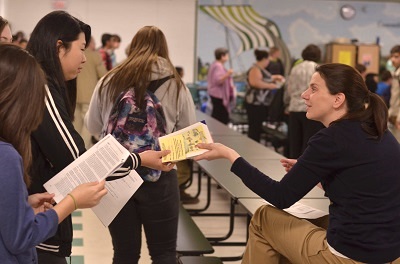
A teacher gives a free book to a student at Loudoun Valley High School in Loudoun County, Virginia on World Book Night. Photo courtesy of Loudoun Valley High School.
In Virginia’s Loudoun County Public Schools, where I work as a school librarian at Seneca Ridge Middle School, both school and public librarians have turned to social media to jointly promote events using their following on social media, which was key in the success of our community’s World Book Night on April 23. World Book Night (hashtag #WBN2014) is a celebration in which more than 25,000 volunteers across the United States hand out over 500,000 free books to people in their community who do not regularly read. The pick up locations for the books are public libraries and book stores, and one third of these books are distributed to students in secondary schools. According to Carl Lennertz, the executive director of World Book Night in the United States, the marketing of World Book Night relies heavily on social media websites. This year the event generated an estimated 200 million impressions—in online advertising speak, "impression" is the number of times an ad is seen, whether opened or not—from traditional media and blogs, as well as over 230,000 page views on its Facebook page during the week of World Book Night alone.
This year's World Book Night logo. Image courtesy of World Book Night resource site (www.worldbooknight.org).
The success of World Book Night’s social media strategy made me start to think about how we, as school librarians, can use social media to promote our events, work, and programming—as well as how to partner with other organizations, like public libraries, to cross-promote toward mutually beneficial ends. For example, this year for World Book Night, I worked closely with Loudoun County Public Library (LCPL) and Enchanted (Harcourt, 2012) author Alethea Kontis to launch this year’s event with a series of events at LCPL and Seneca Ridge Middle School. Getting the word out about World Book Night was a pooled effort in social media critical mass, and I used Twitter to publicize Kontis’s upcoming visits. In turn, Kontis posted about the upcoming #WBN events on her Facebook account. Meanwhile, LCPL retweeted my tweets and shared Kontis’ Facebook posts. Working together and promoting each other’s posts and tweets, we were able to increase the audience for World Book Night for greater turnout. According to Lennertz, there are two questions to ask when using social media marketing: First, what is the goal or purpose of your message? And second, what audience are you trying to reach? World Book Night’s goals using social media are not that different than those of many school librarians trying to promote events, programming, and information, such as: sharing information, cheerleading (sharing stories and pictures of events and activities that take place in communities nationwide), and providing service.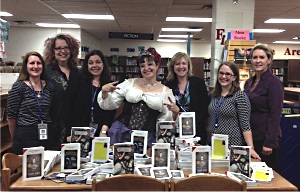
Author Alethea Kontis (center) with Seneca Ridge Middle School librarian Lauren McBride (immediate left of Kontis) and teachers on World Book Night. Photo courtesy of Lauren McBride and Jennifer Henry.
As an author and public figure, Kontis shared her experience with social media and how she has used it to reach target audiences. Her younger reader audience—eight to twelve year-olds—tend to follow her on Instagram and Youtube, where she has used her theatrical background to create a Youtube show called “Princess Alethea’s Fairy Tale Rants." (Her short videos have generated hundreds of hits.) According to Kontis, her early teen audience tends to follow her on her "Princess Althea" Tumblr blog, where they can scroll through pictures and GIFs with fewer words, or follow relevant blogs, if they prefer. Facebook tends to appeal to her fans that want to have more interaction through a conversation—usually the "older crowd." According to Kontis, it is far easier to follow a conversation on her Facebook page than, for example, on Twitter, which is good for brief 140-character interaction and allows you to connect with more people using hashtags.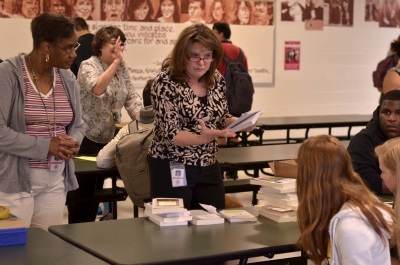
Teachers at Loudoun Valley High School booktalk to students during World Book Night. Photo courtesy of Loudoun Valley High School.
Personally, I find Twitter an effective means of reaching out to both the teenage and adult demographic, as well a support for my own professional development. To train school librarians on how to use Twitter, The Virginia Association of School Librarians organizes a weekly Twitter chat using the hashtag #vaslchat for sharing best practices. Also, the Live Binders website provides "An Educators Guide to Twitter." Social media is a rich field in which to expand your librarianship and forge a network of relationships. Some public libraries will have a social media policy in place, such as the South Carolina State Library, and others will offer resources for best social media practices, including METRO LibGuides (a service by the Metropolitan New York Library Council) that posted a list of do's and don't's for librarians called "Social Media Best Practices for Libraries." The bottom line is to develop your social media education—and start somewhere. Whether you are already a seasoned social media user or if you have never used a Twitter account, you can find a way to further your professional development using social media. Organizations like World Book Night—and authors such as Kontis—offer the blueprints and proof of success for how to use social media to stir up interest in reading. We librarians, can build interest in reading, programs, and events in our communities—one school or local library at a time.Lauren McBride is a school librarian at Seneca Ridge Middle School in Sterling, Virginia of the Loudoun County Public School District. Follow her on Twitter @bravelibrarian.

Added To Cart
RELATED


RECOMMENDED
CAREERS
The job outlook in 2030: Librarians will be in demand
CAREERS
The job outlook in 2030: Librarians will be in demand
ALREADY A SUBSCRIBER? LOG IN
We are currently offering this content for free. Sign up now to activate your personal profile, where you can save articles for future viewing
ALREADY A SUBSCRIBER? LOG IN
Thank you for visiting.
We’ve noticed you are using a private browser. To continue, please log in or create an account.
Add Comment :-
Be the first reader to comment.
Comment Policy:
Comment should not be empty !!!