



2018 School Spending Survey Report
Why This Book? The Conundrum of Virality and A Fine Dessert
Friends, Romans, Countrymen. Lend me your ears. I come to discuss A Fine Dessert, not to praise it or denigrate it. Not to really talk much about the book itself at all except as a recent phenomenon. A phenomenon unique to our particular day and age and that remains relatively mysterious, despite (or perhaps because […]
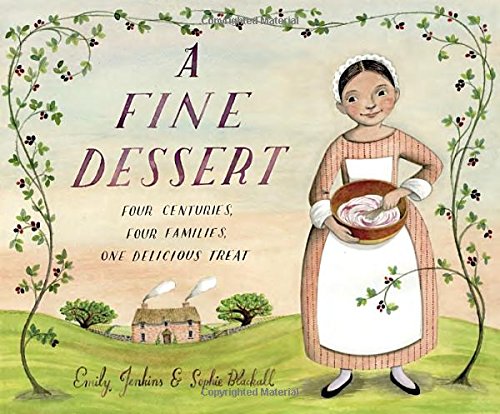 Friends, Romans, Countrymen. Lend me your ears. I come to discuss A Fine Dessert, not to praise it or denigrate it. Not to really talk much about the book itself at all except as a recent phenomenon. A phenomenon unique to our particular day and age and that remains relatively mysterious, despite (or perhaps because of) the thousands of people who have found themselves wrapped up in the discussions that surround it. Discussions that, insofar as I can tell, show no signs of coming to a halt.
Now if there’s anything that bugs me online it’s when blogs, Twitter accounts, and Facebook feeds talk about an issue without bringing up to speed those folks who have remained ignorant of the discussion from the start. So in the event that you get ALL your children’s book news through my particular blog (an act that I do not recommend as my weekly reporting skills are spotty at best), a quick summary that I will call “The Tale of A Fine Dessert”.
Actually, I’m not entirely certain where the A Fine Dessert controversy first began. Maybe it was on August 4th when a blog called Trybrary wrote a piece that brought up Illinois librarian Elisa’s concerns with how the book chose to depict the slaves in the story. This, in turn, was mentioned by Calling Caldecott and subsequent Twitter discussions seem to be dated to late October at this point. What sets the discussion apart from many others about issues in children’s books is that it didn’t stay relegated to the world of librarians, children’s book bloggers, teachers, and author/illustrators. My first clue that the talks had gone viral occurred when NPR’s Codeswitch picked up on the story on October 30th. The New York Times followed suit soon thereafter on November 6th, but if you think the discussion would stop there how wrong you are. Daniel José Older uploaded a video of himself on a panel criticizing the book in early November. Since then it’s pretty much continued to be mentioned online, the most recent discussion happening when Sam Juliano wrote about it on his site Wonders in the Dark (185 comments and rising as of this post). And I think it is safe to say that Sam’s will not be the last place the book is discussed this year or next.
So here is my question to you today: Of all the books that are considered controversial or debatable in terms of content and quality, why has the A Fine Dessert debate exploded while others have stayed relatively under the radar? Lest you harbor the notion that the book is extraordinary in its content, some of the issues surrounding the book were contained in other 2015 picture books depicting slavery and will continue to exist in 2016. In 2015 alone I’ve heard people debating problematic elements (specifically involving race) in books like Sometimes I Feel Like a Fox, An Invisible Thread, Home, and Over the Hills and Far Away, just to name a small sampling. Yet nothing has touched a nerve like A Fine Dessert. Why?
If social scientists could figure out what makes a topic viral online we’d all be living in a very different world. As it is, this could just be the case of the book coming out at precisely the moment when discussions about slavery have actually been on our newscasts at night. Recall that it was as recent as late June / early July of this year that debates raged over whether or not the Confederate flag would be removed from the South Carolina House. But even that doesn’t explain the book discussions’ continual presence online.
Perhaps the perpetual interest isn’t just due to our increased awareness of depictions of all races, genders, religions, and sexuality in our books for youth. A Fine Dessert is a picture book and traditionally picture books are debated for not just their writing but their images as well. People who challenge books have known this for years. You can object to content for some books (like And Tango Makes Three, The Lorax, Where the Wild Things Are, etc.), and to the images in others (The Rabbits’ Wedding, Sylvester and the Magic Pebble, In the Night Kitchen, etc.). If both words and pictures are deemed offensive in some way then the book has more of a chance of offending a wider swath of people. This is why the Frequently Challenged Books list of ALA always has plenty of slots filled with graphic novels. Images carry a different power than words.
In the end, the answer may be a simple one. Perhaps A Fine Dessert is so heavily debated because unlike some of the other 2015 books I’ve mentioned, it has supporters that are as outspoken as its critics. Sometimes when people discuss a book there will be a sense that one side or another has “won” the debate regarding the quality of the title. What’s remarkable about this book is that the debate does not feel one-sided. And just as one side quiets down, the other side speaks right up again.
To be continued? I think that goes without saying.

Added To Cart
RELATED


RECOMMENDED
CAREERS
The job outlook in 2030: Librarians will be in demand
CAREERS
The job outlook in 2030: Librarians will be in demand
ALREADY A SUBSCRIBER? LOG IN
We are currently offering this content for free. Sign up now to activate your personal profile, where you can save articles for future viewing
ALREADY A SUBSCRIBER? LOG IN
Thank you for visiting.
We’ve noticed you are using a private browser. To continue, please log in or create an account.
Add Comment :-
Be the first reader to comment.
Comment Policy:
Comment should not be empty !!!