


2018 School Spending Survey Report
When Clothing Approximates Sexism (and other woes)
A friend of mine who is not particularly into the children’s literary world, except that she has small children and reads to them, forwarded on to me this recent article in Vox. It sports the clickbait title I never noticed how racist so many children’s books are until I started reading to my kids. It’s […]
A friend of mine who is not particularly into the children’s literary world, except that she has small children and reads to them, forwarded on to me this recent article in Vox. It sports the clickbait title I never noticed how racist so many children’s books are until I started reading to my kids. It’s one of those pieces that sort of write themselves. Periodically we’ll see articles come out from new parents, shocked and horrified by some aspect of children’s literature. Whether its disdaining Maisy or taking issue with Knuffle Bunny, this comes up all the time. They’re sort of the easiest pieces an author can write. You’re already reading to your kids. Why not write something about the experience? I should note that even as I say this, I’ve spent a good portion of my career as a blogger doing EXACTLY THIS. So who am I to pooh-pooh other authors for doing the same? Besides, sometimes they make very interesting associations.
In this particular case I read the piece and found it was this curious amalgamation of good points (why yes, Little Black Sambo IS offensive!) and downright weirdness. First off, the author mentions books like The Cricket in Times Square, which is one of my favorite SURPRISE, IT’S RACIST! books out there. Folks tend to forget about it. The author of this piece, Ms. Leigh Anderson, also makes an effort to tie this into the We Need Diverse Books campaign, which is a nice idea. Essentially, the article is a call for reaching out and reading newer children’s books that have an eye towards both literary quality and diversity rather than just relying on the books you were read as a kid. I’m all for that.
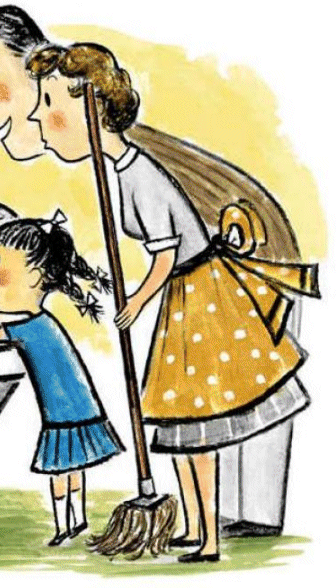
Horrors!
Unfortunately the author of the piece effectively shoots herself in the foot when she begins to equate the existence of mothers wearing aprons in books with sexism. Several times throughout the piece she mentions a book (like Bread and Jam for Frances or Harry the Dirty Dog) and says that because the mother is wearing an apron and cooking for the other family members, the book is automatically sexist. Years ago when I worked in the Jefferson Market branch of NYPL I would get in a continual stream of grad students looking for “sexist children’s books” because they were writing various papers and needed examples. Never equating an article of clothing with sexism (my friend Erin points out that Ms. Anderson, “seems to be calling anything that isn’t feminist, sexist, which is ridiculous”) I really had to hunt and peck for these students to find anything that (A) might apply and (B) was still circulating (hat tip to Lois Lenski for helping me out on that one). Ms. Anderson, in contrast, is far too happy to throw all her childhood favorites under the bus. She writes:
“Here’s what happens when you try to recreate your 1979 childhood library: You buy Bread and Jam for Frances, Frog and Toad, Blueberries for Sal, One Morning in Maine, Heidi, The Cricket in Times Square, Lyle Lyle Crocodile, Stuart Little, Babar, Sylvester and the Magic Pebble, The Secret Garden, The Little Princess, and the whole Ramona Quimby series. All were treasured books of my childhood, read and reread to me, and then read again as soon as I could read to myself.”
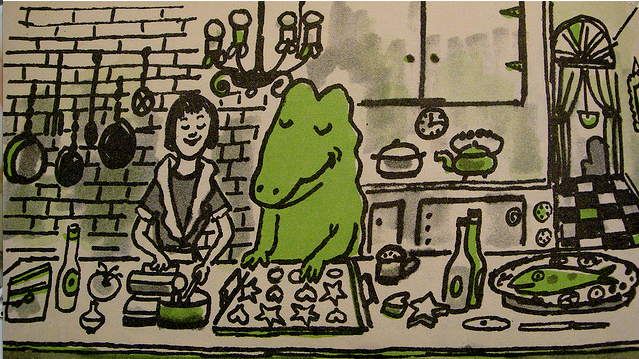
Sacre bleu!
She then explains the problems with some of these books but not others. Ramona’s crime, as it happens, is that “Ramona Quimby’s mother begins the series as a housewife in 1955; in the mid-’70s she goes back to work; by the mid-’80s she’s pregnant again and quits.” Because, after all, that has never happened before. The crimes of some of the other books are left for us to infer. I assume the apron problem, such as it is, applies to Blueberries for Sal (never mind that Sal is a wonderfully androgynous character that both boys and girls relate to), Lyle Lyle Crocodile (where Lyle, who is male, cooks and ice skates with the missus), and Sylvester and the Magic Pebble (anyone else remember how subversive making the cop a pig was?).
Eventually the piece becomes more about We Need Diverse Books and quotes some recent pieces about Shannon Hale’s experiences with boys and her books and the work of independent booksellers. All of which is worthy and good (though she does fail to spellcheck Whistle for Willie). As such, it’s a pity that she had to paint this piece with such a broad brush. Outright sexism did indeed exist in children’s literature in the past, but just because a book is reflecting the times in which it was written, that does not automatically make it unworthy reading.

Added To Cart
RELATED


RECOMMENDED
CAREERS
The job outlook in 2030: Librarians will be in demand
CAREERS
The job outlook in 2030: Librarians will be in demand
ALREADY A SUBSCRIBER? LOG IN
We are currently offering this content for free. Sign up now to activate your personal profile, where you can save articles for future viewing
ALREADY A SUBSCRIBER? LOG IN
Thank you for visiting.
We’ve noticed you are using a private browser. To continue, please log in or create an account.
Add Comment :-
Be the first reader to comment.
Comment Policy:
Comment should not be empty !!!