


2018 School Spending Survey Report
West of the Moon and The Night Gardener
I’m trying to re-read A SNICKER OF MAGIC again to participate in that discussion, which has gotten very interesting. Meanwhile, Julie Corsaro mentioned in that comment thread a couple of spring titles I’m more interested in talking about. Recalling Vicky Smith’s guest post this time last year, Reader Know Thyself, I had to recognize that [...]
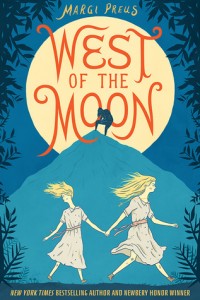 I’m trying to re-read A SNICKER OF MAGIC again to participate in that discussion, which has gotten very interesting. Meanwhile, Julie Corsaro mentioned in that comment thread a couple of spring titles I’m more interested in talking about.
Recalling Vicky Smith’s guest post this time last year, Reader Know Thyself, I had to recognize that I wasn’t a raging fan of either Deborah Wiles’ or Margi Preus’ previous works, before I approached REVOLUTION or WEST OF THE MOON with as open a mind as possible. In both cases, my appreciation for these writers has now grown significantly. But whereas I’m still not totally sold on REVOLUTION, I’m admittedly over the moon with WEST OF THE MOON. I went from “hmm, this is different,” … to “wow, this is interesting” … to “erg, I’m really liking this” … to “Yeah!”
On my second read, I was immediately struck by how much longer I’d felt the story was than it actually is, word for word. There is a dense richness in the use of prose for scene setting and storytelling that gives the reader so much, page for page, and keeps the story at just under 200 pages (we’ll compare this, later, to EGG & SPOON, which is similar in tone but goes on forever. A lovely forever…) The pacing feels just right, as we are led along by a master storyteller as if in a folktale whose ending would seem predetermined…this feeling pulling perfectly against the sense of real risk and edginess that is Astri and Greta’s life and race for survival.
I’m particularly engaged by the moral questioning in this story. It seems to take place secondarily to the action, but is really at the center of the character arc. Astri steals, lies, maims (perhaps murders?) in order to save herself and her sister, and she never takes any of these actions without questioning them, but is always able to find a way forward (not always comfortably) by situating herself within the morality of a story. The fact that a storytelling haze/tone settles beautifully over the whole story, even when the story itself is not beautiful, tells us that Astri’s survivalist storyteller instincts work, whatever the cost. Is this a folktale? Is it a tale of Astri deluding herself? Are we supposed to think this is a real story, or a sneakily satisfying one replete with possible magic and impossible coincidences? Preus asks us to accept both, and I do. This is a story that I think will feel radically different from one reader to the next, and I can imagine some intense 4th grade classroom arguments over exactly what we are supposed to think of Astri’s decisions. It’s a story that invites the reader to bring themselves to it, and, like Astri, take what they need.
 THE NIGHT GARDENER is another title worthy of discussion, which many of you have mentioned and is also a popular favorite on Goodreads. Using the “niche” discussion from the SNICKER post… here’s a title that takes the spooky-magic-with-orphans genre and gives it meat. The setting, tone, and style are almost the major players here, and I think is what readers of this kind of story want most. The plot doesn’t suffer either, though in the end I felt the denouemont was a little thin (actually is reminding me of David Mithchell’s THE BONE CLOCKS, but that’s a different discussion), and for the well-done thrill of the ride, I didn’t leave the book feel feeling as surprised by or convinced of the reality of the characters and world, as I did with WEST OF THE MOON. Yet, when I compare this, for instance, to last year’s honor-winning THE DOLL BONES, I have to think that THE NIGHT GARDENER has teeth…and they are sharp, my dear.


Added To Cart
RELATED


RECOMMENDED
CAREERS
The job outlook in 2030: Librarians will be in demand
CAREERS
The job outlook in 2030: Librarians will be in demand
ALREADY A SUBSCRIBER? LOG IN
We are currently offering this content for free. Sign up now to activate your personal profile, where you can save articles for future viewing
ALREADY A SUBSCRIBER? LOG IN
Thank you for visiting.
We’ve noticed you are using a private browser. To continue, please log in or create an account.

Add Comment :-
Be the first reader to comment.
Comment Policy:
Comment should not be empty !!!