


2018 School Spending Survey Report
#WeNeedDiverseBooks: Not a Trend, But Here to Stay | BEA 2014
Over 300 people attended the #WeNeedDiverseBooks panel on May 31 held at New York City’s Jacob Javits Center as part of BookExpo America’s consumer-focused BookCon event; the session was added late to the program after the grassroot campaign’s hashtag went viral following its launch, eliciting more than 162 million tweets since May 1.
 Over 300 people attended the #WeNeedDiverseBooks (WNDB) panel on May 31 held at New York City’s Jacob Javits Center as part of BookExpo America’s (BEA) consumer-focused BookCon event; the session was added late to the program after the grassroot campaign’s hashtag went viral after being launched in late April, eliciting more than 162 million tweets since May 1. According to #WeNeedDiverseBooks team member Tracy Lopez, over the course of eight days (April 28 - May 5), the hashtag campaign has made 156,000,624 impressions from 84,952 posts with 22,492 users, reaching a total of 43,705,463 individuals. The WNDB panel occurred simultaneously as another late BookCon add-on panel “Where Are the People of Color in Children's Books?" that took place at the Uptown Stage. With the room at capacity, a group of about 50 hopefuls stood outside the room waiting, and were later allowed in after some protest. WNDB campaign organizers (who are authors as well) Ellen Oh, Marieke Nijkamp, Aisha Saeed, and I.W. Gregorio shared with attendees an overview of how the initiative came to be—in response to BEA’s announcement of an all-white, practically all-male lineup—and the wave of support that has grown since its inception. Author panelists included YA authors Lamar Giles, Mike Jung, Matt de la Peña, Grace Lin, and Jacqueline Woodson.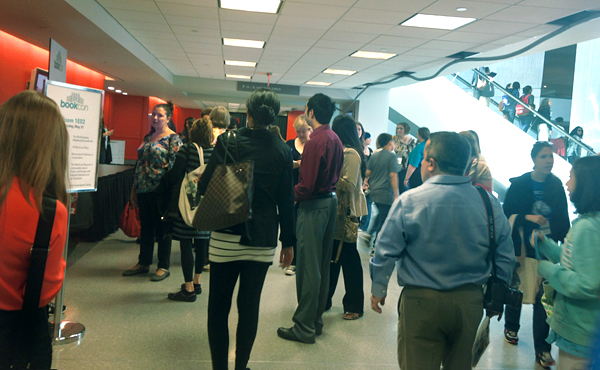
Even before 10 a.m., the room for the #WeNeedDiverseBooks panel was at-capacity.
Additional room was made for these initially shut-out attendees.
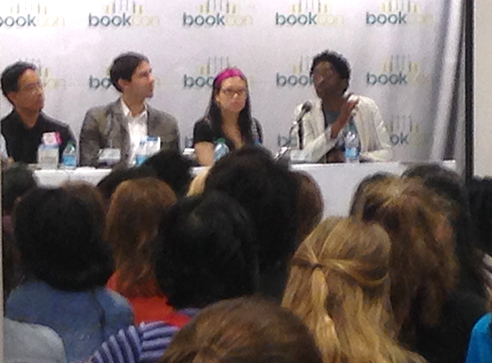
Some of the members of the #WeNeedDiverseBooks author panel. (l. to r.) Mike Jung, Matt de la Pena, Grace Lin, and Jacqueline Woodson. The screen on the left displayed photos that were part of the grassroots social media effort.
Speaking about what inspired them to join the campaign, the panelists discussed the diverse books that they first encountered and what their vision is for the future of the campaign. Giles was first inspired by Walter Dean Myers’s Fallen Angels (Scholastic, 1988), finally a book not about slavery or the civil rights movement. “It was a good jolt, because he was an African American man making it in the publishing world.” Jung sets his middle grade novels in a world filled with characters from all types of backgrounds because “it’s a multifaceted contemporary world that reflects the daily reality my kids live in.” Margaret Edwards Award-winner Woodson paused to reflect that the panels’ diverse audience was an “author’s dream.” She went on to say that her biggest vision is “to not having to need panels like this one.” The authors also emphasized that books about diverse topics shouldn’t be relegated to the multicultural shelf in bookstores, but should be embraced for their specific genre. Lin, a children's author who is a former-bookseller, has created a tip sheet for those wanting to promote these titles, without emphasizing their “otherness” and that will nudge potential readers to get past preconceived labels. de la Peña, who credits educators and librarians for the success of his writing career, spoke about a powerful experience he had when a white, suburban teen emailed him to say, “Yo, my life is just like Sticky’s,” the half-Mexican American protagonist of his Ball Don’t Lie (Delacorte, 2005). Writing diverse books isn’t “either or. It’s also,” de la Peña said. When asked about whether the adage “diverse books don’t sell” is true, Giles answered, “If that reality actually exists, then it’s a reality that was created. There are people in this room that have the power to change it.” See also:BookCon-troversy: Uproar Over Lack of Diversity at BEA’s Consumer Day
First Book Pledges to Buy Diverse Books in Response to #WeNeedDiverseBooks | BEA 2014

Added To Cart
RELATED


RECOMMENDED
CAREERS
The job outlook in 2030: Librarians will be in demand
CAREERS
The job outlook in 2030: Librarians will be in demand
ALREADY A SUBSCRIBER? LOG IN
We are currently offering this content for free. Sign up now to activate your personal profile, where you can save articles for future viewing
ALREADY A SUBSCRIBER? LOG IN
Thank you for visiting.
We’ve noticed you are using a private browser. To continue, please log in or create an account.
Add Comment :-
Be the first reader to comment.
Comment Policy:
Comment should not be empty !!!