


2018 School Spending Survey Report
The Unlikable Female Character: Thoughts on Middle Grade Literature
While making the rounds through the old internets I came across a recent New Statesman piece entitled Why I want more unlikeable female characters. The premise pretty much boils down to a desire to see “women who are every type of humanity – assholes and all” in our literature and popular culture. And while the [...]
While making the rounds through the old internets I came across a recent New Statesman piece entitled Why I want more unlikeable female characters. The premise pretty much boils down to a desire to see “women who are every type of humanity – assholes and all” in our literature and popular culture. And while the piece was not specifically about children’s literature (though Katniss was referenced on the YA side of things) it got me to thinking about what our expectations are when we read children’s books.
First off, let’s back up a bit and think about whether or not children’s books (and we’ll include everything from picture books on up to middle grade novels) are even allowed to have unlikeable protagonists. For the most part, likeability is pretty much in the eye of the beholder. I might cringe at the exploits of Eloise or get all frowny when I look at David’s antics, but for every adult that fails to approve, there are a millions kids crowing and capering along with their antiheroes. A little older and there are unlikeable characters out there, but they’re usually not allowed to stay unlikeable. Some are explicitly evil, like Artemis Fowl, while others are merely annoying/racist like Gilly Hopkins. Very very few are permanently unsympathetic. If they are, it is interpreted as a kind of failure on the part of the author.
Indeed, when discussing books with my fellow NYPL children’s librarians last year, I was struck time and again by the sentence, “I just didn’t like the main character.” Normally this would be enough to condemn the book right there and then, but that was before I noticed that from time to time, and it IS rare, we aren’t really supposed to like the main characters in our books all the time.
Which brings us to the unsympathetic female character. Two books were published in America in 2014 with such a creation gracing the pages. And in both cases I found myself having a devil of a time convincing my fellow librarians that while normally not liking the main character was a mark against a title, in these books it was the novel’s very strength.
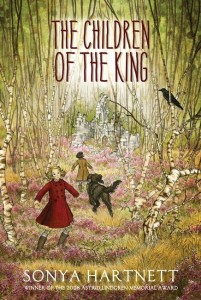 The first book is an Aussie import that flew almost entirely under the radar: Children of the King by Sonya Hartnett. A divisive book, to say the least, I enjoyed it but was cowed early on by people I knew who complained about its unsympathetic heroine. Cecily , the girl in question, is a spoiled, rather dim little upper class twit that, upon finding herself in the country during WWII, proceeds to steal the book’s spotlight from the far more interesting, if introspective, character of May. “Annoying” is how people describe Cecily and they’re not wrong. It is, however, rather the point of the book. Cecily’s attitude and her thick headedness both make her a good foil for the action taking place around her. In this book Hartnett takes an incredible risk. May, a refugee Cecily’s family takes in, would have been the obvious choice of heroine in most novels. By instead focusing on Cecily the reader is forced to see the world through the eyes of someone shockingly ignorant. Since I read the book I’ve met person after person who has commented on how much they really loved and appreciated this title. I now regret that I didn’t fight for it more last year.
 The other singularly unlikeable heroine that comes to mind is one I did fight for. Gerta from West of the Moon by Margi Preus is an original. Here we have a character that is sympathetic and yet not someone you particularly love. This was a distinct choice on the part of the author and not some kind of misplaced flaw in the writing. Preus made the conscious choice to have Gerta do things that would twist and upset our sympathies for her. She cheats the good and kind, just to rescue herself and her sister. She lies outright and gains passage to America through questionable means. Do the ends justify these means? One of the things that I liked so much about the book was how it dared to ask this very question. Yet like the Hartnett title, the objection lobbed most consistently in the book’s direction was Gerta’s unsympathetic demeanor.
Is this a quality condemned more consistently in books starring girls vs. books starring boys? Actually, I don’t think so. To my mind, any children’s book that stars a kid who isn’t harboring a secret heart of gold beneath a crusty exterior, just more crust, falls under intense scrutiny. We demand role models for our child readers. Moral complexity upsets that expectation. So as 2015 proceeds apace I’ll be keeping watch for characters that deliberately eschew our hearts. Sometimes, there’s more to them than meets the eye.

Added To Cart
RELATED


RECOMMENDED
CAREERS
The job outlook in 2030: Librarians will be in demand
CAREERS
The job outlook in 2030: Librarians will be in demand
ALREADY A SUBSCRIBER? LOG IN
We are currently offering this content for free. Sign up now to activate your personal profile, where you can save articles for future viewing
ALREADY A SUBSCRIBER? LOG IN
Thank you for visiting.
We’ve noticed you are using a private browser. To continue, please log in or create an account.

Add Comment :-
Be the first reader to comment.
Comment Policy:
Comment should not be empty !!!