


2018 School Spending Survey Report
The King and I
The Coretta Scott King Award has touched kids’ lives in surprising ways
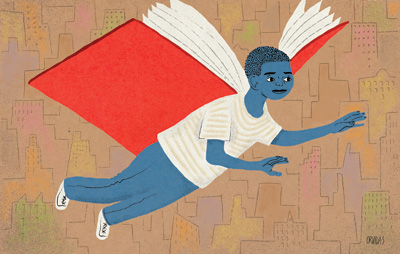
Illustration by Ken Orvidas
Author Sharon Flake had signed dozens of books, T-shirts, posters, and even arms during a weeklong workshop at West Jefferson High School in New Orleans, when a star-struck 15-year-old approached her to ask how old she was—and if she was married. Taken aback, Flake answered no, she was single. “That’s when he proposed to me, right there in front of hundreds of his peers,” recalls Flake, 52, whose books have received a John Steptoe Award for new African-American talent and several Coretta Scott King Honor citations. The impromptu proposal (which the author politely declined) dramatically illustrates that when books like Flake’s find the right audience, they stir readers to surprising reactions. That’s exactly what the Coretta Scott King Award’s originators, school librarians Mabel McKissick and Glyndon Greer, had in mind when they attended the American Library Association’s (ALA) annual conference in New Jersey back in 1969 and wondered why there wasn’t a distinguished award for African-American authors. This year marks the 40th anniversary of the first Coretta Scott King Book Award, which encourages “the artistic expression of the black experience via literature and the graphic arts.” The award, which began honoring illustrators in 1974, added the Steptoe Award in 1995. No doubt, past King award winners like Flake, Jerry Pinkney, Kadir Nelson, and Sharon Draper have all benefited from the honor, but more important, books stamped with the Coretta Scott King seals—bronze and black for winners and pewter and black for honor books—have often had a lasting impact on children’s lives. Draper’s Forged by Fire (S & S, 1997) is a perfect example. English teacher Heather Brown had no idea what effect the novel would have on her daughter Taaja Draughn when she asked her to take a look at it. Yet by the time the 11-year-old was done, it had changed her life. The story, about a boy named Gerald who ultimately forgives a menacing stepfather amid the turmoil of inner-city crime and drug abuse, altered the way Draughn, now an adult, looks at the world. “I’m an emotional person, and I cried when I read it,” Draughn recalls. But as the book “settled in,” she says she began to see where she, too, needed to forgive her own father, who had been in prison most of her life. “I didn’t consider forgiveness much until then,” she says. “It was in my mind and in my heart, but I just didn’t have the strength in my heart. Until I read about Gerald, I just couldn’t move on. It’s made a big difference.” Likewise, veteran author Walter Dean Myers sees Coretta Scott King Award–winning books as “a wonderful resource to young readers and those who teach them.” In fact, he often sees parents turn to a list of these titles to help their children discover new viewpoints. During the first Gulf War, in 1991, for instance, a woman approached Myers at an ALA conference in Chicago and asked if he was the author of Fallen Angels (Scholastic, 1988). Her teenage son, she explained with tears in her eyes, was convinced that he needed to quit school and join the army—that is, until he read the novel, set in the Vietnam War’s trenches. “It completely changed his mind about what war was all about,” the boy’s mother told Myers, thanking him for stopping her son from enlisting. Stories like these are often heard by those familiar with Coretta Scott King Award–winning books, which also have a way of moving people beyond stereotypes, says Scholastic editor and author Andrea Davis Pinkney. “I’m telling the story as an African-American author,” says Pinkney, whose Let It Shine: Stories of Black Women Freedom Fighters (Harcourt, 2000) received a Coretta Scott King Honor in 2001. “I do feel responsible for presenting African Americans in the best possible way and illuminating things that people may not know. But I am also trying to write in a way that is most universal.” Pinkney was struck by that universality last May when she watched a group of students from a predominantly white elementary school in Syracuse, NY, debut a film they created in which each student acted out the role of a historical figure—from Rosa Parks to Duke Ellington—from her many books. After class, a blond, blue-eyed fourth grader approached Pinkney to shake her hand and introduce herself as Harriet Tubman. That incident reinforced Pinkney’s belief that the impact of the Coretta Scott King Award is both broad and deep. “I think that medal means something powerful to people,” says Pinkney, the daughter-in-law of author-illustrator Jerry Pinkney, explaining that perhaps that teacher would not have otherwise picked up her book. “That award helped get my books into the classroom as curriculum and gave the students an incentive to make a movie, a great movie that showed that everybody can feel the accomplishment of Rosa Parks or Harriet Tubman.” Chrystal Carr Jeter, a youth services manager at the Cleveland Public Library, says when she started working as a librarian in Alaska 35 years ago, there were only a handful of books available by African-American writers and illustrators. So promoting Coretta Scott King winners has become her “passion.” Jeter tries to expose young visitors to her urban library’s extensive Coretta Scott King collection, creating attractive displays of the award-winning titles, drawing readers to her interactive online Coretta Scott King Award book club, and sponsoring visits by strong award contenders like Sister Souljah. Jeter’s efforts have paid off. “You see kids come in with their copies of books with rattered and tattered pages from this list [of award-winning books] that they have just loved to pieces,” she says. “These books have a way of moving people.” Shadra Strickland’s work inspired one youngster to send a note about her recent John Steptoe Award–winning picture book, Bird (Lee & Low, 2008), which tells the story of a young boy who learns that his ability to draw can elevate him above the sadness and pain of his day-to-day life. “Keep up drawing all good books for children because your books [are] an inspiration to us all and can teach us a lesson… Bird taught a lesson,” the student wrote. Strickland says the student’s letter “reminds me how important stories are, how they keep us all connected, and how they act as guiding lights throughout our lives.” Jerry Pinkney was reminded of the power of books when he recently met a woman at a conference who was so eager to have an old copy of The Talking Eggs (Dial, 1989) autographed that she rushed home to search through her daughter’s childhood room to find it. “She rifled through the girl’s things, moving past books, toys, and other precious items from the girl’s childhood. The Talking Eggs was nowhere to be found,” recalls Pinkney, who has won five Coretta Scott King Awards, including an illustrator honor in 1990 for The Talking Eggs, the story of two sisters—one selfish and greedy, the other kind—who find a magical chicken house full of talking eggs and other treasures. Ultimately, Pinkney says, the mother had to call her daughter at college to ask about the book’s whereabouts. Without hesitating, the girl told her mom that she’d brought The Talking Eggs to college and that she counted it among her most precious possessions. “To me, the story reminds readers that beauty may hide ugliness while the plainest objects may conceal treasures,” Pinkney says. “I can’t help but wonder if, in some way, this young girl, now in her college years, took solace in knowing that good things are often right under our noses, wrapped in the plainest packages. And I like to think, too, that this young lady’s mother knew that her daughter was comforted by this lesson.” As a writer, Myers has focused on showcasing African Americans with strong values, in part because as a young reader there was nowhere for him to see these lives celebrated, or to encounter black characters in books, except for the few pictures of George Washington Carver in textbooks. “There’s George Washington on a big white horse. There’s Robert E. Lee on a big horse. There was George Washington Carver with peanuts,” says Myers, whose books have won five Coretta Scott King Medals and four Honor citations. “What I do and what CSK people do is they depict black life as a valuable existence.” And portraying the typical American-American life with dignity can make a deep impression on young readers. “When I read The Skin I’m In (Hyperion, 1998), it touched me,” wrote a shy high school junior to Flake about her novel. “All my life I felt I was ugly because I was dark-skinned. After I read the book, I was more comfortable with myself. I love being dark-skinned now.” Illustrator Floyd Cooper encountered a similar situation when he visited an elementary school in Georgia last year and spoke to children about his award-winning book The Blacker the Berry (HarperCollins, 2008), written by Joyce Carol Thomas. The collection of poems sings the praises of all the different shades of black skin. A young girl asked how she could “get up in them books,” recalls Cooper. “She wanted to be a model for my next picture book. There was a belief that having her face portrayed in a picture book was a big deal, something to aspire to. It promised a spotlight on her for the world to see.” And that message of self-respect and respect for others does come through. Poet Hope Anita Smith saw a subtle change come over a member of her audience of African-American and Latino boys during a poetry workshop for fifth graders in Brooklyn earlier this year. After she read a poem from her Coretta Scott King Honor book, Keeping the Night Watch (Holt, 2008), in which a dad gives advice on how to treat a woman, Smith asked the class, “What does it cost you to open the door for a girl or help her on with her coat?” “Nothing,” they replied. Later, when Smith was getting ready to leave and had her arms full of materials, one of the boys put his hand on the doorknob. “I saw a light bulb go on over his head,” she says. “He looked at me and he said, 'I’m using my courtesy.’” New Orleans school librarian Idella Washington says she often gets positive feedback to the Coretta Scott King titles she recommends, like Kadir Nelson’s We Are the Ship: The Story of the Negro Baseball League (Hyperion, 2008) or John Steptoe’s, Mufaro’s Beautiful Daughters: An African Tale (HarperCollins, 1987). And after 32 years of connecting kids with books, she knows when they’re hitting their mark. “You know when one tells another to read a book she just read, that book is saying something to them,” says Washington, of West Jefferson High School in Jefferson Parish. In the aftermath of Hurricane Katrina, for example, Washington recommended Smith’s The Way a Door Closes (Holt, 2003) to students who were struggling with loss, and she’s seen the way they hold onto the story for reassurance. “It’s keeping with the times, and it’s reminding them of the past,” Washington says. “The major theme in the [Coretta Scott King] books is no matter what your problems are, there’s hope. You give that book to the child and it helps. Because the kids came back saying, 'That was a good book, even though that bad thing happened in it.’”Freelance writer Mary Grace Gallagher (mggall@verizon.net) lives in Annapolis, MD. Her last feature for SLJ (“A Tall Tale,” April 2008) was about Newbery Medalist Laura Amy Schlitz.

Added To Cart
RELATED


RECOMMENDED
CAREERS
The job outlook in 2030: Librarians will be in demand
CAREERS
The job outlook in 2030: Librarians will be in demand
ALREADY A SUBSCRIBER? LOG IN
We are currently offering this content for free. Sign up now to activate your personal profile, where you can save articles for future viewing
ALREADY A SUBSCRIBER? LOG IN
Thank you for visiting.
We’ve noticed you are using a private browser. To continue, please log in or create an account.

Add Comment :-
Be the first reader to comment.
Comment Policy:
Comment should not be empty !!!