


2018 School Spending Survey Report
The Greatest Story Never Told: An interview with National Book Award winner Phillip Hoose
Before Rosa Parks, there was Claudette Colvin. But who had heard of her? Thanks to author Phillip Hoose, that’s changing.
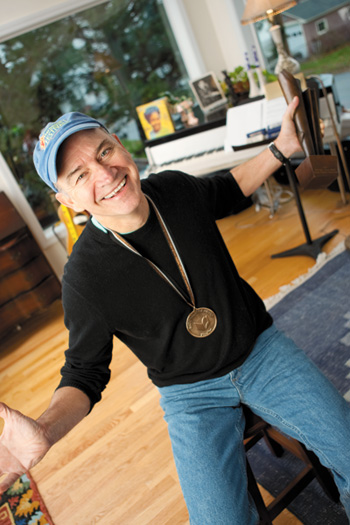
Photograph by Kevin Brusie
Talk about chutzpah. It took Phillip Hoose four years to track down Claudette Colvin, but it was worth the wait. Last November, Hoose’s Claudette Colvin: Twice Toward Justice, the true story of a teen who refused to surrender her seat to a white passenger on a segregated bus in Montgomery, AL, in 1955, won the National Book Award for young people’s literature. Although Colvin’s courageous act took place nine months before a similar stand by Rosa Parks sparked the Montgomery Bus Boycott, her contributions to the civil rights movement were virtually dismissed until Hoose came along. Hoose (pronounced “hose”), of course, is no stranger to the world of literary honors. His We Were There, Too! Young People in U.S. History was a contender for the 2001 National Book Award and The Race to Save the Lord God Bird (all Farrar/Melanie Kroupa Bks.) nabbed the Boston Globe-Horn Book Award as the best nonfiction book of 2005. SLJ recruited author-editor Marc Aronson, a guy who knows a thing or two about the civil rights movement and creating top-notch books for young readers, to interview the 62-year-old award winner. —Rick Margolis Marc Aronson (MA): Congratulations, you’re the first nonfiction author to win the young readers’ National Book Award. Phillip Hoose (PH): Wow! That is fantastic. I had no idea. MA: Were you surprised? PH: What a question! I was surprised. When my name was called, my heart raced, but I thought I had a decent chance to win. I had been a finalist before in 2001 for We Were There, Too! But that book had 66 stories, so I didn’t think it had sufficient focus to win. This time, because the story was about one person and was a dramatic personal story, not like a textbook, I thought it had a better chance than before. MA: The New York Times reported that Claudette Colvin’s appearance at the 60th annual National Book Awards ceremony in New York was the highlight of the night. PH: We were all at table 28. Claudette was on my left; my wife, Sandi, was on my right. Our kids were at the next table over. Just before the award was announced, I turned to Claudette and said, “We have one chance in five. If we win, will you go on stage with me?” “Yes,” she whispered, “I will.” Then when they called out my name, the problem was, how could we do it? How could she come with me? Claudette has arthritis and walks very slowly. I told her, “It’s alright, this is our moment. We have all the time we need.” She walked in front of me, moving slowly through the crowd. And as we passed, you could hear the words rushing through the room. “That’s her… that’s the woman… that is Claudette Colvin.” Recognition spread through the room. And when we got to the podium, she just glowed. She was so radiant. I was so worked up, I forgot to grab the award. MA: How did you first find out about Claudette? PH: I wrote We Were There, Too!, a large collection of the great contributions young people made to our national story. That book took me six years to research and write. As I got to the civil rights movement, it became clear that young people had made an enormous contribution. After all, Brown v. Board of Education was all about schools, all about young people. I saw that thousands of young people had been heroic; they took all sorts of risks and abuse. I was looking for stories to bring that experience alive for my readers, and I had a wide network of people helping me. I started hearing about this one riveting story: a 15-year-old in Montgomery who did what Rosa Parks famously did but a year before Rosa; a teenage girl who was arrested and fought charges but was not celebrated. In fact, she was shunned. I thought, wow, if this is true, what a story—especially if I could find her, and if she could remember and describe what it was like to be 15 and have the courage to challenge Jim Crow. If she could still remember what it felt like, what a tremendous story. Here was a person who was not known, not credited—even as Rosa’s story has become part of the national canon. MA: What did you end up doing? PH: I made every effort to find Claudette. I was not even sure if she was still alive. There were a few articles about her, starting in the 1970s. I discovered she lived in New York City, but her phone number was not listed, and no trick I could think of allowed me to find it. But in 1995, USA Today did a big article on her—it was the 40th anniversary of the Montgomery Bus Boycott—and that article had quotes from her. So I knew she was alive and that the reporter had made contact with her. I called the reporter. We got talking, and I asked if he could relay a message to her. “I will,” he said. A few weeks later, he told me she’d said, “Maybe I’ll talk with him, when I retire.” Claudette was still working as a nurse’s aide at night. For the next four years, I’d check in with the reporter once or twice a year, to see if Claudette had changed her mind. I never gave up, but my focus was on other projects. But one fall night I came home, and there was a red light flashing on the phone—and there was just one message: “Claudette says she will talk with you. Here is her number. Good luck.” I couldn’t sleep all night. I stayed up writing down the questions I wanted to ask her. And the next morning, we spoke for an hour. We hit it off and arranged to meet in the city. MA: Your story of tracking down Claudette points to one of the book’s real strengths—that personal, investigative quality. In the past, most nonfiction books for young readers have aimed at being well written, engaging, and well illustrated. But the actual information in them was a précis of work that originally appeared in adult books. But in your biography of Claudette, as in Betsy Partridge’s new book, Marching for Freedom, you are the pathfinder. What did it feel like to be the first one to break the story? PH: I’ve done my own original research in a lot of my other books. In We Were There, Too!, I was so glad to reach the mid-20th century when I could start interviewing people, obscure people who had never, or rarely, ever told their stories. When I was working on The Race to Save the Lord God Bird, I was able to find the last people who had seen the Ivory-billed Woodpecker. They had seen it as kids and were now in their 70s. But it was a searing experience for them. Those direct, personal interviews are the way for me to write nonfiction. I’m not very interested in secondary or tertiary sources. I want to use primary sources as much as I can. I want to talk to the people. MA: What’s the mission of nonfiction books for kids? And what is the balance between transmitting what’s known elsewhere and what you yourself discover? PH: Nonfiction and fiction writing are the same. We have the same tools as writers and the same challenge: to induce the reader to turn the next page. We can use all of Shakespeare’s tricks, but nonfiction writers have a huge advantage in storytelling, because what we are describing is true. It really happened. I didn’t make it up. Human experience is profound, exciting, dramatic. Think of Claudette Colvin. As a teenager, she risked her life several times—refusing to give up her seat in that tight little bus with all the people yelling at her; her name printed in the paper in those times when violence was a very real possibility; going to court to challenge Jim Crow, the whole Southern way of life; being part of a federal lawsuit, a class-action suit with only four names on it—making a public case that the whole way of life violates the Constitution. Talk about stuff that will get you killed. That is better than fiction, because it really happened. My challenge was to find the feelings, the emotional part, inside the story. MA: The key to what makes this such an outstanding book is found in your author’s note at the very end of the book. You wrote, “Claudette Colvin’s life story shows how history is made up of objective facts and personal truths, braided together.” The book is brilliant because when you quote from your interviews with Claudette, her voice is so vivid and immediate. It’s so much closer to the teenage experience—of being liked or not liked, trusted or not trusted, making mistakes in your personal life but also having the courage and passion to stand up for what you believe is right—than a perfect adult exemplar like Rosa Parks. But to make that voice resonate, you needed to surround it with a historical context—terms, definitions, beliefs, locale. And that’s what you’ve done—you’ve braided her voice with the larger context. PH: I had to establish the context. The memory of how painful segregation was is starting to fade. Every child gets the stories of Rosa Parks and the words and deeds of Martin Luther King, Jr. But they no longer know the everyday pain of how blacks were degraded, humiliated. The whole point of the system was to convince them every day that they were inferior, that they did not count. And the trump card behind this system of degradation was violence. MA: More than in any book that I can think of, and that includes adult books, you’ve made it clear that segregation was not really about who sat where on a bus. It was about enforcing and reinforcing the humiliation of African Americans. And part of the reason that experience comes across so clearly is because we see it through Claudette’s eyes and ears. PH: Yes, there is a girl inside this story. When Claudette and I travel and speak with young people, this is reinforced. We recently spoke to a huge crowd, largely African American, in Birmingham. When we were finished, a boy of about 10 or 11 came up to the microphone and asked a question: “Ms. Colvin, when you were let out of jail, did your parents ground you?” To him, she was a young person just like him—and that’s what her story brought to the book. She is not just a heroine, she was a real teenager, and she can answer the questions teenagers ask: What did your parents think? What was it like at school? What did your friends say? What did your boyfriend think? Claudette was involved in this crucial historical event, and she is a real person who can remember what it felt like to be a teenager. MA: What was the hardest part of working on this book? PH: The one really hard part was finding images. Like many poor people at the time, Claudette’s family did not own a camera. We only had two personal pictures: a school snapshot and a family photo taken when she was younger—and that came about because her father was picked as employee of the month, and the prize was having a family photo taken. If not for that, we would have no visual record. The challenge then was to find surrounding images of the time that were not clichéd, not overly familiar—how to make this story visually fresh when we did not have any personal images to use. MA: I think you pulled that off very well. And that brings up the other person who is also often involved in making a strong nonfiction book, the editor. What’s your relationship with your editor, Melanie Kroupa, like? PH: I have done three or four books with Melanie, and we are really a team. She is with me every step—from the idea, through acquisition, design, to marketing it in the end. I love working with her. She is brave, smart, a good red-pencil editor—helpful but not discouraging. I think she is brilliant, one of the best editors in the history of children’s literature. MA: What’s your next project? PH: I’m working on another book with Melanie for FSG, a YA book. And this is, again, about a bird. That is all I will say. But I can tell you I am fascinated by extinction. That is a tragedy we can prevent. I want to rope readers into caring. I do what I do. I write the kinds of books I write. Each one leads to the next. Kids are deeply involved with their families. I want to tap into that and tell stories that matter.
Added To Cart
RELATED


RECOMMENDED
CAREERS
The job outlook in 2030: Librarians will be in demand
CAREERS
The job outlook in 2030: Librarians will be in demand
ALREADY A SUBSCRIBER? LOG IN
We are currently offering this content for free. Sign up now to activate your personal profile, where you can save articles for future viewing
ALREADY A SUBSCRIBER? LOG IN
Thank you for visiting.
We’ve noticed you are using a private browser. To continue, please log in or create an account.

Add Comment :-
Be the first reader to comment.
Comment Policy:
Comment should not be empty !!!