


2018 School Spending Survey Report
The Family Romanov Redux
In the original post on this title, Jonathan and Leonard Kim got into a little back and forth comparing it to REVOLUTION, so it seems apt to take this one up next. How does it compare in prose, in structure and context setting? Each book of course has a different ultimate goal: Wiles’s is [...]
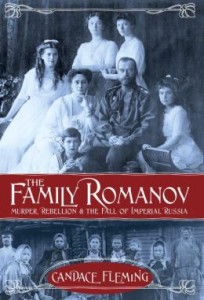 In the original post on this title, Jonathan and Leonard Kim got into a little back and forth comparing it to REVOLUTION, so it seems apt to take this one up next. How does it compare in prose, in structure and context setting? Each book of course has a different ultimate goal: Wiles’s is to take readers inside a time from a fictional character’s perspective; Fleming’s is to craft and arrange as much available comment and scholarship on a time to give readers a variety of perspectives.
As Jonathan is not the reader for REVOLUTION, I am not the reader for FAMILY ROMANOV, so my appreciation is tempered. My reader-perspective problem continues to be that I don’t care to spend so much time with characters (the Romanovs) who seem so unlikeable, but putting that aside, I find so much to like here. Fleming’s done a remarkable job of weaving rich primary source material in with her own prose; while her writing may not stand out in as writerly a way as I appreciated in WEST OF THE MOON or REVOLUTION, nor in the journalistic author-present call-to-action voice in PORT CHICAGO 50, it is fluid and evocative, so that even if my tastes make it hard for me to get into the story, once I am on the page the writing draws me in instantly. Her pacing and layering of the different perspectives is also well-done, and while her nonfiction angle allows for more flexibility in this regard that the “documentary fictional” one does for Wiles’, I’d argue that Fleming comes out far on top for any of our shortlist titles in craft of structure and context-setting.
Finally, while there are many who are concerned about the graphic violence and scandal throughout this story in regards to “a child audience,” this is the aspect of the story that I think most clearly hits its mark. What else better engages a child audience with history, honestly? I don’t think that young readers who can’t handle this story will stick with it. It’s pretty dark and gruesome throughout, so it’s not as if Fleming is unveiling any shockers. Think of those 10 year olds who can’t deal with a contemporary “chapter book” but will pick up 500+ page tomes of adult history in an instant. This work is for them, finally, not for adults, and as such it is rare, and so: distinguished.


Added To Cart
RELATED


RECOMMENDED
CAREERS
The job outlook in 2030: Librarians will be in demand
CAREERS
The job outlook in 2030: Librarians will be in demand
ALREADY A SUBSCRIBER? LOG IN
We are currently offering this content for free. Sign up now to activate your personal profile, where you can save articles for future viewing
ALREADY A SUBSCRIBER? LOG IN
Thank you for visiting.
We’ve noticed you are using a private browser. To continue, please log in or create an account.

Add Comment :-
Be the first reader to comment.
Comment Policy:
Comment should not be empty !!!