


2018 School Spending Survey Report
School Library Journal's 10 Best Digital Resources for 2009
The must-have products for next fall
American Indian Experience
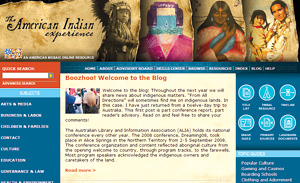 American Indian Experience from Greenwood is possibly one of the best digital resources available for school and public libraries serving patrons interested in Native American cultures. Designed, developed, and indexed under the guidance of Loriene Roy, the first Native American to serve as president of the American Library Association, along with a team of American Indian librarians and scholars, this database exposes unique subject content not found elsewhere. As students and teachers continue to explore issues in American history, and begin their search for more in-depth content, this type of resource will become a definite supplement to the curriculum. (Reviewed February 2009, p. 62.)
 Animoto
 Animoto (animoto.com/education) may have single-handedly resuscitated the art of booktalking. It allows users to quickly mix book-cover images, photos, text, and music to create a 30-second online video that will definitely grab the attention of most middle or high school students. Aside from the obvious uses of Animoto to create interest in books, library programs, or activities, this program can also be easily used with students without requiring instructors to have any previous experience with video-production software. While the cost is extremely low for individual accounts (free for a short 30-second video or $30 for a yearlong subscription, allowing for more creative expression and longer videos), educators can utilize the program free by creating classroom accounts, if they also provide Animoto creators with input into how the product is being used by their students. As one of the more eye-catching and easy-to-use programs available in this remixed 2.0 world, this is a definite must-have, must-share tool for every school librarian’s toolkit. (Reviewed July 2008, p. 64.)
 Big Universe
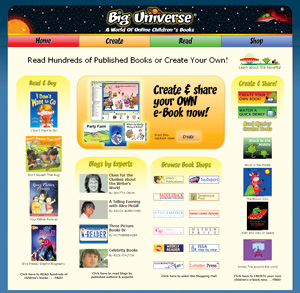 Big Universe (www.biguniverse.com), created by Anil Hemrajani, offers teachers and librarians a program that allows readers and writers of every age to create digital content. Big Universe expands the writing curriculum by providing the tools necessary for students to create and share their own ebooks. With over 7,000 books already created by current users and over 900 additional titles available for purchase from publishers such as Weekly Reader, Saddleback Educational Publishing, and Tanglewood Press, students can literally spend hours reading, writing, and sharing their favorite books. For teachers and librarians who have been searching for the perfect medium to proudly showcase the literary talents of their young authors, Big Universe is one program that is out of this world. (Reviewed October 2008, p. 82.)
 Books and Authors
Books and Authors by Gale Cengage pushes the envelope for reader’s advisory databases by providing one of the most visually attractive and socially interactive databases available. By reinventing their own What Do I Read Next? database and providing 2.0 functionality, allowing users to add their own reviews, notes, and content information, Books and Authors exceeds expectations. Through administrative rights available to librarians, this database can also provide a unique front page for school libraries by allowing content to be displayed on the home page, showcasing particular resources or sharing information regarding reading assignments or other important book-related information. As one of the most enjoyable and user-friendly resources available for those searching for new titles, the latest book reviews, the most up-to-date information, or simply to share a series favorite, Gale Cengage’s Books and Authors wins hands down. (Reviewed January 2009, p. 67.)Britannica Online School Edition
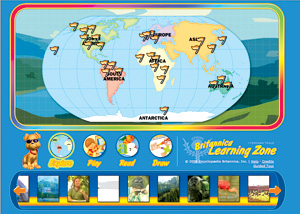 Britannica Online School Edition has tipped the scales of online encyclopedias by including four different products within their Online School Edition. Through each of the age-appropriate resources, Britannica provides instructional and research content that will fit the needs of every user from one simple access point. Contained within is the Encyclopedia Britannica for high school students, Compton’s by Britannica for middle school students, Britannica Elementary, and Britannica’s latest program for PreS–2 called Britannica Learning Zone. With the addition of this latest product, Britannica has expanded their encyclopedic line to reach every user at every level, while still providing educators with Teacher Resources, additional learning materials, digital images, video clips, maps, and much more. It only takes a few minutes of online research (or maybe some interactive fun) within any of the Britannica modules to discover why this online encyclopedia has advanced to the head of the class. (Reviewed November 2008, pp. 79–82.)
 Global Issue in Context
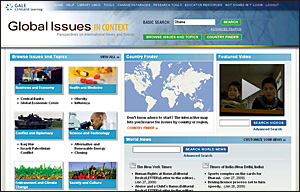 Global Issues in Context from Gale Cengage provides today’s classrooms and libraries with up-to-date contemporary perspectives on global issues. Through the combination of over 400 global newspapers, magazines, academic journals from news sources such as NPR, PBS, NBC, UPI, and AP, Global Issues in Context provides unique perspectives and information. Using a design similar to an iGoogle’s webpage model, Global Issues in Context allows students to customize their home page of search content and resources, including downloaded MP3 files and streaming video content. As world events continue to play a major factor in the daily lives of American students, it is essential that information is represented from various venues and points of view. To encourage students to thoroughly evaluate information from a wide range of information sources, while providing them with the resources to examine information critically, Gale’s Global Issues in Context is a must-have. (Reviewed March 2009, pp. 71–72.)
 H.W. Wilson Core Collection
The H.W. Wilson Core Collection includes the Children’s Core Collection, the Middle and Junior High Core Collection, and the Senior High Core Collection. Whether you’re just starting out or you’ve had years of experience selecting materials, these resources are (and I’ll say it again) the “Mother of All Selection Tools.” Unlike the book suppliers that provide school librarians with free access to their online ordering programs with reviews and reading levels, the Core Collection provides a detailed listing of the must-have resources that all school libraries should have on their shelves—with the ability to search by title, author, reviews, copyright dates, and even reading levels. Complete with reviews, annotations, pricing, subject headings, and bibliographic data, the H.W. Wilson Core Collection databases should be the very first resource purchased by every school librarian this fall. (Reviewed June 2008, p. 83.)Novelist K–8 Plus
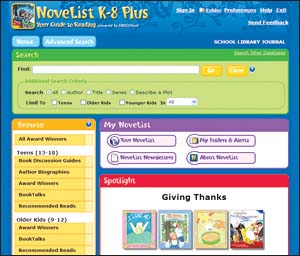 EBSCO’s Novelist K–8 Plus is perhaps the best reader’s advisory database available for students in elementary through junior high school. By providing over 17,000 nonfiction titles, 9,000 fiction and nonfiction series titles, 450 award lists, and over 700 booktalks, Novelist K–8 Plus is the cornerstone in assisting students searching for just the right book. This database not only provides librarians with hundreds of curriculum-based titles, but it also allows for searching by reading levels, grade levels, popular titles, and genres. In addition, users can generate book lists to be printed immediately or create a personal folder for later use. One of the most satisfying aspects of the database is the ability to easily create book lists based upon various search options, curricular topics, or reading levels. Even with the ability to search the online catalog for resources, I know that there are many items that are missed. However, with Novelist K–8 Plus, I not only found most (if not all) of the resources that were needed and that we owned, but I also located materials that might be missing from our collection and could be added later. (Reviewed December 2008, p. 76.)
 One More Story
One More Story (www.onemorestory.com) is much more than just an electronic bookshelf of picture books for children. It is an interactive instructional program that can meet the literary needs of children from those sitting on a parent’s lap to those sitting at the library’s laptop. Over 50 award-winning children’s books, such as Ezra Jack Keats’s A Snowy Day, are available within this digital bookshelf for children to select, listen to, read along with, or read independently. Created by Carl Teitelbaum, a former Sesame Street producer, and Rona Roth, a kindergarten teacher, One More Story remixes elements of the classroom and the library to create an electronic book program that allows younger users to control their story time content as they bridge their way toward independent reading. As one of the more uniquely designed, simple to use, and utterly adorable digital book databases for beginning readers, One More Story should definitely be on every library’s digital bookshelf. (Reviewed October 2008, p. 81.)Pop Culture Universe
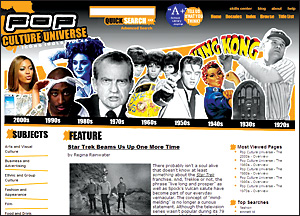 Pop Culture Universe from Greenwood is all about fun. Or maybe it’s the excitement this database generates that makes it seem that way. With a strong online visual presence, Pop Culture Universe makes researching the decades or exploring our cultural history exciting for students (and their teachers). Through the exploration of cultural content such as famous people, the arts, fashion, film, food, literature, music, sports, television, and radio, users will easily locate information that amazes, astounds, or perhaps simply reminds them of a time past but not forgotten. Through colorful research Web pages that include links to top ten categories and top searches lists, as well as over 300 print titles within the database, students can easily explore content, locate obscure or forgotten facts, and investigate history through popular culture. (Reviewed September 2008, p. 79.)
 Shonda Brisco (sbrisco@gmail.com) is assistant professor/curriculum materials librarian at Mary L. Williams Curriculum Materials Library at Oklahoma State University in Stillwater.

Added To Cart
RELATED

RECOMMENDED
CAREERS
The job outlook in 2030: Librarians will be in demand
CAREERS
The job outlook in 2030: Librarians will be in demand
ALREADY A SUBSCRIBER? LOG IN
We are currently offering this content for free. Sign up now to activate your personal profile, where you can save articles for future viewing
ALREADY A SUBSCRIBER? LOG IN
Thank you for visiting.
We’ve noticed you are using a private browser. To continue, please log in or create an account.
Add Comment :-
Be the first reader to comment.
Comment Policy:
Comment should not be empty !!!