


2018 School Spending Survey Report
Sandbox Science on the iPad
Generations of kids have been introduced to science concepts at sand and water tables. Today, they can also explore sandbox apps.
 As any educator will tell you, exploration is key; witness the generations of children who have been introduced to basic math and science concepts at sand and water tables. Tinybop, a Brooklyn, NY, based developer, has taken this principle to heart with their sandbox apps. In The Human Body, viewers watch as the cookie that they deliver to a child's mouth travels through the X-ray view of the figure's digestive system, or learn how the body reacts to an insect bite (an insect they have let loose). In Plants, children can observe how the landscapes and denizens of various biomes change as day becomes night, the seasons change, and various user-triggered weather systems move in. In Simple Machines (iOS, $2.99; K-Gr3), kids have an opportunity to explore the forces at work in the lever, wheel and axle, pulley, inclined plane, screw, and wedge. For each one, viewer-controlled interactive options allow them to see how various adjustments impact the machines' mechanics or force. For example, by altering the location of the lever's fulcrum, the distance a load can be projected will change, while the height, base, and height from which a wedge is driven will affect its efficiency. In "Wheel & Axle," users can try four bicycles or scooters and adjust the speed at which the creature riding them travels; at a fair clip, rider and vehicle sail over a narrow stream of water or up and over a ramp, but if they're moving too slowly the front wheel will plunge into the water or the creature will fall forward. The colorful settings (art by James Gilleard) are pure whimsy and add to the game-like activities: the inclined plane page is designed as a pinball machine, the load of the lever is aimed at a castle, and the pulley screen (which allows kids to try four different arrangements of fixed and movable pulleys) resembles an arcade game. Users can switch scenes from day to nighttime lighting, which changes the view in various, mostly small, ways (colors of arrows change, or on one page, the view of fish becomes an x-ray view). There are no in-app instructions, but the activities are fairly intuitive and play and exploration are rewarded. Sound effects (chirping birds, whistling wind, etc.) and atmospheric music, add to the fun and offer an element of play as well, but can be switched off. The app contains no text, however, labels for the illustrations are provided in five languages (English, Spanish, French, German, and Chinese), and the iTunes store lists dozens more. A free, downloadable handbook (in seven languages) contains extensive notes on the science behind these machines, tips on using the app with kids, and additional suggested activities. For today's students, digital sandboxes create additional, hands-on opportunities to explore concepts. Use this app as an adjunct to science lessons, or download it onto the classroom iPad for some free play; understanding of basic physics concepts is sure to follow. A trailer is available.—Daryl Grabarek, School Library Journal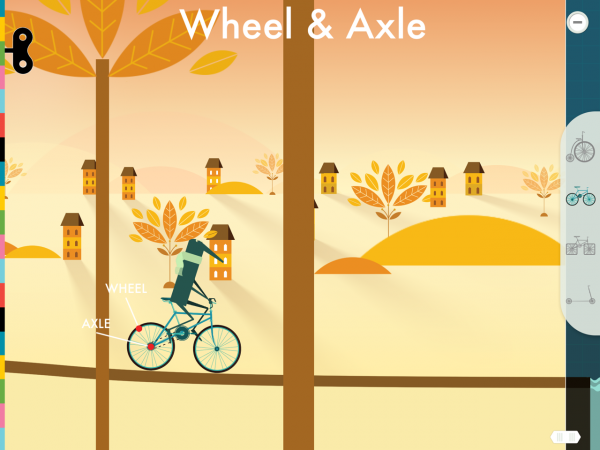
Screen from the "Wheel & Axle" page of Simple Machines (Tinybop) Gilleard
For additional app reviews, visit our dedicated webpage.
Added To Cart
RELATED


RECOMMENDED
CAREERS
The job outlook in 2030: Librarians will be in demand
CAREERS
The job outlook in 2030: Librarians will be in demand
ALREADY A SUBSCRIBER? LOG IN
We are currently offering this content for free. Sign up now to activate your personal profile, where you can save articles for future viewing
ALREADY A SUBSCRIBER? LOG IN
Thank you for visiting.
We’ve noticed you are using a private browser. To continue, please log in or create an account.

Add Comment :-
Be the first reader to comment.
Comment Policy:
Comment should not be empty !!!