


2018 School Spending Survey Report
Flipped!: Want to get teens excited about summer reading? Just add video.
Want to get teens excited about summer reading? Just add video.
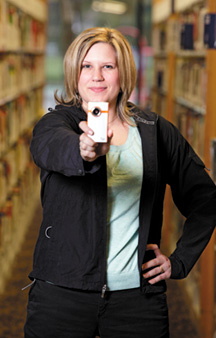
Jennifer Wooten; All photos by Meryl Schenker
“They’re not doing legitimate work” complains the agitated woman, pointing at a group of teens on the public library’s computers. “They should be doing schoolwork, not watching YouTube.” I remind her that they are patrons, too, and what they do with their computer time is up to them. The woman stomps off in a huff and waits impatiently in the corner for her turn. Sound familiar? Like it or not, YouTube looms large in teens’ lives. Fully 57 percent of youth online watch videos, according to a Pew Internet & American Life study. And more and more are creating and sharing clips of their own making. With online engagement such an integral part of their world, Washington state’s King County Library System (KCLS) decided to meet kids on their own turf by launching Read.Flip.Win., a video component of its summer reading program for teens. Summer reading initiatives are core services at many public libraries and KCLS is no exception. Our program, “Read Three, Get One Free” in which teens write three reviews and receive a complimentary book, has been a successful one. But in 2008, we decided to ramp things up with Read.Flip.Win. (RFW). We invited teens to create and submit their own video book review or a trailer promoting a title, much like a feature film. “Flip,” of course, refers to the popular point-and-shoot camcorder of the same name, two of which were offered as prizes for our contest winners. As with any new program, we weren’t sure what kind of response we would get. We knew teens were online—a lot—but we weren’t sure if this would translate into submissions to our contest. We hoped for five entries and thought 10 would be spectacular. In the end, we received a whopping 38 entries. But prior to getting all those submissions, we had to work hard to create this new program from scratch. With any new initiative, getting the word out is oftentimes the hardest part. So from the beginning, I knew communication was critical, but a particular challenge for a large library system. At KCLS, our 44 branches are spread across a huge, diverse county, from the Redmond Regional library which serves 51,530 residents in the city that is home to Microsoft, to the Skykomish branch, a small mountain town (pop. 207) known for kayaking. With in-person staff meetings less than practical, we turned to online tools that fostered both communication and collaboration—blogs and wikis. Fortunately, we had a staff wiki already in place, so we created a page on it devoted to RFW, providing all the details, everything from contest rules to instructions on how to submit videos. This transparency allowed staff to see the program as it was developing and encouraged their input. For example, our stated rules originally had teens uploading their contest submissions to their YouTube accounts. But one of our librarians, via the wiki, advised us that kids under 13 were prohibited from opening their own accounts. So we set up a library YouTube page for teens to use instead, with the help of their local teen librarian. Our staff blog also came in handy. For example, one week before the contest began, I used it to post a reminder to staff about the upcoming event and referred them to the wiki page if they had questions.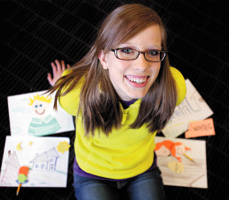
Adrienne Dunham with collage work from her winning video.
But nothing beats face-to-face, especially when it comes to reaching out to kids. As with many public libraries across the country, school visits are perhaps the number-one way in which librarians connect with students about what their institution has to offer and to encourage summer reading. It was no different with RFW. In fact, many of the contest participants said they first heard about the program when the local teen librarian came to class. School visits are so essential that without them, I believe, participation in summer reading programs, including RFW, would suffer greatly. After spreading the word about the program, we thought: Now what? Kids seemed up for participating, according to librarians who visited the schools. And we had secured great prizes: Flip camcorders and MuVo MP3 players for winners and runners-up in both categories, courtesy of the KCLS Foundation, a nonprofit organization that funds library initiatives. Still, we weren’t sure what to expect in terms of how teens would execute their projects or what kinds of videos they would produce. From the beginning, I was concerned that some young patrons might not have access to video equipment (sophisticated or otherwise). So, tapping into KCLS’s online services budget, we purchased some Flip camcorders so some branches could host video shoot events where teens could work on their projects. While this was a good idea, in practice, it didn’t work so well. Most branches reported low or no attendance at these events. For one, a single two-hour event is not enough time to create and edit a video. But mainly, we realized, kids simply didn’t need our help. This was evident as soon as the entries started coming in, revealing the comfort level teens had with the medium. Beyond technical proficiency, the videos impressed us with their creativity and enthusiasm for the books. In one entry, two girls consider the high—and low—points of the novel Twilight in a spirited debate that would have made Ebert & Roeper proud.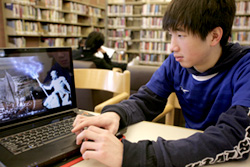
Ryan Lee, 15 created The Odyssey, a video trailer for Homer's epic poem, using clip art and software.
We also received some amazing trailers, so good we believe they would have any viewer snatching up those books. Interestingly, both the winner in this category, Flipped, and the runner up, The Odyssey, were created using only a computer. Ryan Lee, 15, a freshman at Thomas Jefferson High School in Federal Way, fashioned The Odyssey, a suspenseful teaser for Homer’s epic poem, as a collage made entirely of clip art and other still images using Sony Vegas and Adobe Premier software. The sophistication of his work so impressed me, I asked Ryan about his future plans, assuming this talented young man aspired to become the next Steven Spielberg. His modest reply: no, I just like making videos. Adrienne Dunham, 15, a 10th grader at Auburn Mountainview High School, in Auburn, is the talented videographer behind Flipped, a charming trailer for the 2001 romantic novel of the same name by Wendelin Van Draanen. To make her winning entry, Adrienne drew the pictures, crafted collage figures, and then animated them using the stop motion technique. For some of us, the goal of library programming may be to simply get kids into the library, while others strive to serve existing patrons. The idea behind our contest was a bit of both. We know that many teens in our community see the library as just a place to sit and read or study after school and the last place they’d think of to engage in technology. We librarians know differently and consistently strive to alter this misconception. So, did our program succeed? Well, let me say that our greatest satisfaction came from seeing teens participate in the contest who were not prior library users. Michael Fishman, a senior at Mercer Island High School, a runner up for his Fahrenheit 451 video, was one such kid. Michael, who describes himself as “not much of a reader,” heard about RFW from a friend who is a library volunteer. “I love film, and I try to find any way to showcase it and earn some dough or a prize in the process,” he says. Since last summer’s contest, Michael has begun attending our teen advisory board meetings and is now a more regular patron. The bottom line? Joining reading with an opportunity for creative expression got teens excited about the library and books. As one of our judges, Rick Orsillo, a librarian at the Shoreline branch, says, “RFW makes teens examine the books they choose. Because they have to focus on creating the elements of a movie, such as scripts, sets, costumes, etc., they’re forced to wrestle aspects of the story they may not otherwise consciously examine….” Getting teens to think about books in a new way—I consider that a huge success.Jennifer Wooten (jwooten@kcls.org) is an online services advocate and teen librarian for the Newport Way branch of the King County Library System, in Bellevue, WA.

Added To Cart
RELATED
RECOMMENDED
CAREERS
The job outlook in 2030: Librarians will be in demand
CAREERS
The job outlook in 2030: Librarians will be in demand
ALREADY A SUBSCRIBER? LOG IN
We are currently offering this content for free. Sign up now to activate your personal profile, where you can save articles for future viewing
ALREADY A SUBSCRIBER? LOG IN
Thank you for visiting.
We’ve noticed you are using a private browser. To continue, please log in or create an account.
Add Comment :-
Be the first reader to comment.
Comment Policy:
Comment should not be empty !!!