


2018 School Spending Survey Report
Chicago High School Hosts Citywide Maker Faire, Coproduced by the School’s Library Director
Can you imagine having a Maker Faire at your school? That’s the case at Schurz High School in Chicago, where students are helping host the annual Chicago Northside Mini Maker Faire, which draws 2,000 attendees.

Squishy Circuits (home-made conductive play-dough for building simple circuits)
presented by the Harold Washington Public Library and YOUMedia.
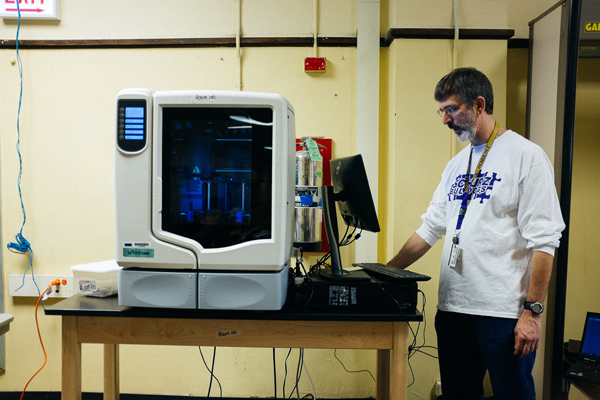
Schurz Pre-Engineering program teacher, Peter Schoedel, with 3D printer.
The event launched four years ago when Christina Pei, a self-described “amateur lockpicker,” felt “bummed out.” There wasn’t a Maker Faire event in Chicago, she says. After approaching Maker Faire, the organization offered her a license to the name for free. She then approached Schurz principal Daniel Kramer about hosting the fair on campus, she says. More than 94 percent of the students at the high school either on free or reduced price lunch, receiving public aid or living in substitute care such as a foster home, according to the Illinois State Board of Education. Pei felt the partnership was perfect. “I wanted it to be for those who were not getting resources,” says Pei, producer of the event. “And I wanted it to make it free for everyone.” Those who attend never pay a fee and Pei volunteers her time, as does Kunc, with the school picking up the tab for security and running the site, says Pei. Sponsors, including the Chicago-based The Urban School Foundation, are also involved. Kunc joined up the second year after she was hired at the school, and “got thrown into the mix,” she says. Never having been to a Maker Faire, Kunc says she didn’t know what to expect, but Pei and others believed she would figure it out. “Obviously, as a school librarian, I had heard the buzz words like maker space and 3-D printing,” she says. “So I dove in and realized this was amazing and had huge implications for our library programming.”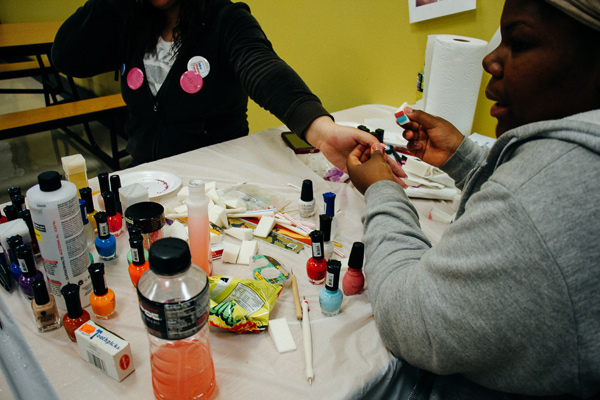
Funky nails exhibit.
One of Kunc’s jobs is helping students flesh out ideas so they’re more interactive: One group sourced origami books from the library, teaching attendees how to make their own paper art. The Gay Straight Alliance built a “Make a Message” booth using old library books, magazines, pens and glitter letting students create custom buttons. The engineering program set up computer stations for printing 3-D designs. Meanwhile, other attendees made bubbles, shot catapults, and even got a chance to don “funky nails,” at one of the 75 exhibits this past spring. Pei, who has embarked on a Ph.D. program in learning sciences, wants to see the event grow even bigger. She notes that just 10 percent of the school’s space is used—and believes the site could host more exhibits, and more attendees, particularly from the student side, whether they are enrolled at Schurz or not. “The Maker Faire has been unique since day one because of where we held it,” she says. “Every year, about 50 percent of those involved are young makers and we want to grow that number.”
Added To Cart
RELATED


RECOMMENDED
CAREERS
The job outlook in 2030: Librarians will be in demand
CAREERS
The job outlook in 2030: Librarians will be in demand
ALREADY A SUBSCRIBER? LOG IN
We are currently offering this content for free. Sign up now to activate your personal profile, where you can save articles for future viewing
ALREADY A SUBSCRIBER? LOG IN
Thank you for visiting.
We’ve noticed you are using a private browser. To continue, please log in or create an account.
Add Comment :-
Be the first reader to comment.
Comment Policy:
Comment should not be empty !!!