


2018 School Spending Survey Report
A "Completely and Utterly Disgusting" Game, Among Others | Touch and Go
With only a few weeks left before summer is over, it's time to download a few playful apps. While fun and games rule, you’ll discover that planning, strategy, and skill also come into play. Oh, yes, and then there's that "completely and utterly disgusting" game for fans of Roald Dahl.
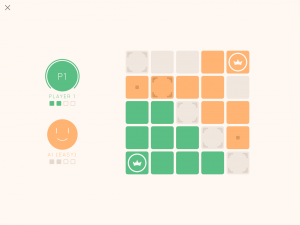
Screen from Kindo (Space Bears)
Billed as a “medieval game for the 21st century,” Kindo (Space Bears S.A.S., iOS $1.99; Gr 2 Up) is an abstract strategy game that’s easy to learn but difficult to master. The goal is similar to that of chess and Go: to capture the opponent’s king—located here in the opposite corner of the player's on a 5 x 5 grid. Each player is allowed two moves per turn to place a tile, fortify an existing one, or claim one from the opponent; it sounds easy, but Kindo played well requires careful planning and tactical maneuvering. Fortunately, the game includes an interactive, easy-to-understand tutorial explaining the rules. Players also have the option to select a local, artificially intelligent (AI), or online/Game Center opponent and to control the level of difficulty. Stylish yet understated, the sparse design and minimal color scheme complement the overall aesthetic of the game and allow players to focus on their strategy. Available in multiple languages.—Audrey Sumser, North Canton, OH.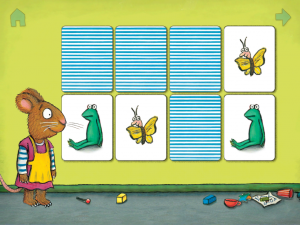
Interior screen from Pip and Posy: Fun and Games (Nosy Crow) Scheffler
In Axel Scheffler’s Pip and Posy: Fun and Games (Nosy Crow, iOS $2.99; PreS-K) the endearing and inseparable friends share an entertaining selection of activities designed especially for young children. “Matching Pairs” allows users to test their observation skills through three levels of difficulty. Posy provides just the right amount of encouragement as children flip over cards in search of a pair. “Jigsaw Jam,” another three-level activity, offers puzzles ranging from six to 12 pieces. Pieces are dragged into place; placed incorrectly they'll float to the side of the screen as Pip prompts kids to try again. The “Coloring Book” provides eight images for children to paint. The palette offers a wide selection of colors and a few brush options. Children can shake their device to erase the page and start over, if desired. Finally, “Spot the Difference” presents two pictures and asks children to find five differences. The differences are subtle, so this activity will likely present the greatest challenge for the app's intended audience. This cheerful production with colorful artwork is loads of fun; expect children to clamor to play with it. A trailer is available.—Stephanie Rivera, Naperville Public Library,, IL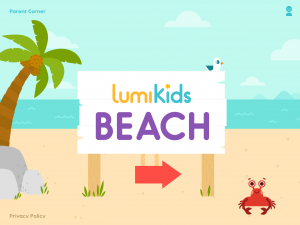 The bright, bold graphics and friendly sound effects of two new Lumikids apps create engaging environments that will encourage children to stay and play. Both productions offer three deceptively simple activities. In the award winning LumiKids Park (Free, iOS and Android), users can play with cheery monsters nom-noming (eating) circles by color, giggly monsters playing hide and seek, or sort shapes by color and size. In LumiKids Beach (both Lumosity/Lumos Labs, Inc., Free in iOS and Android), children help crabs build a sandcastle, match tones with turtles, and color various marine creatures to bring them to animated life. What sets these apps apart from others that claim educational components is that these activities require children to engage in more complex thinking as they work to complete each increasingly difficult round within activities. For example, in Park, the dot-shaped snacks that the smiley critters swallow change in color and location as obstacles are added. In the other activities children need to locate two giggling monsters that simultaneously hide behind playground toys and match an increasing number of shapes by color, shape, and size. These activities offer practice in visual-motor coordination and challenge a child's "divided attention" skills and "cognitive flexibility." In Beach, similar activities seek to steadily improve the user’s fine-motor coordination, planning ability, "response inhibition," and "auditory processing." When opening the apps for the first time, parent information is requested. Collecting email addresses, etc., makes them less than ideal for group sharing; however, the educational value, intuitive navigation, kid-friendly graphics, and skill-building activities far outweigh the one-time nuisance.—Cindy Wall, Southington Public Library, CT.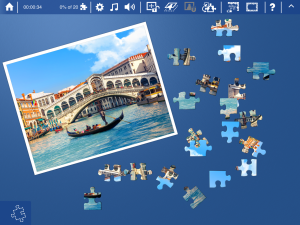
Interior screen Ravensburger's Puzzle—The Jigsaw Collection (Ravensburger Digital)
No more missing puzzle pieces! Ravensburger’s Puzzle—The Jigsaw Collection (Ravensburger Digital GmbH, iOS $2.99; additional in-app purchases available; K Up) offers virtual puzzles that mimic actual puzzles in almost all aspects. Ravensburger is known for its quality products and the same vibrant and attractive images associated with the company's physical puzzles are displayed in this digital production. For each image users can customize the number of pieces that will appear on the screen (20 to 500), making the app suitable for a wide range of players and skill levels. Step-by-step tutorials on the basics and tools for pros are accessible from any screen. Users can tap a piece to turn it 90 degrees or adjust the settings to rotate pieces freely. Other tools allow users to align pieces in the right direction or slide a completed image of the puzzle onto the working space. By placing the completed image under the pieces and enabling the magnet tool, users can snap the correctly positioned pieces into place. Alternatively, they may choose to move only border pieces to the playing table to set up the image frame. A musical background and a timer are also available. Traditionalists may feel that some of the tools diminish the challenge of the actual jigsaw experience and choose not to use them. Completing a puzzle is more rewarding than the stars awarded by the app since it's unclear if stars actually amount to free puzzles or coins. Individual puzzles and puzzle packages are available for purchase in the built-in app shop. These puzzles are ideal for independent play and will provide users with plenty of opportunity to sharpen visual and spatial acuity.—Deirdre Reddington, Uniondale High School Library Uniondale, NY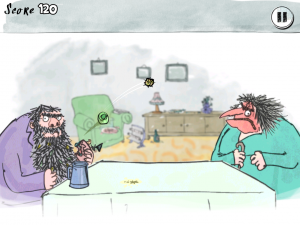
Interior screen from Roald Dahl's Twit or Miss (Penguin)
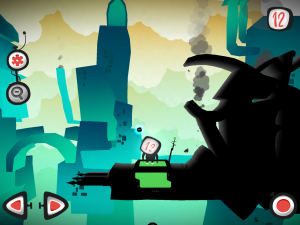
Interior screen from Twelve a Dozen (Amplify)
Twelve a Dozen (Bossa Studios/Amplify, iOS $3.99; Gr 6 Up) is a story game that requires a knowledge of addition, subtraction, multiplication, and division to advance through a sequence of 30-plus increasingly difficult challenges. The challenges exist inside a black pixel of a calculator, in "a universe of numbers" in a place called Dozenopolis, As players venture deeper and deeper into this dark and forbidding landscape, they must help a character named Twelve on a mission to find her family members and put this universe back together after a cataclysmic event. There is no tutorial, but narrated word clues and occasional tips in the form of ghost-like finger movements that appear on the screen. Voice, sound, music options and adjustments can be made. The game, which could potentially take hours to complete, has already picked up one educational game award and been nominated for a 2015 BAFTA (British Academy Family Games Award). The developer notes that the app is first in a series of six math games that will be included in Amplify Math, a core digital curriculum available to schools in this fall.—Daryl Grabarek, School Library Journal
Added To Cart
RELATED


RECOMMENDED
CAREERS
The job outlook in 2030: Librarians will be in demand
CAREERS
The job outlook in 2030: Librarians will be in demand
ALREADY A SUBSCRIBER? LOG IN
We are currently offering this content for free. Sign up now to activate your personal profile, where you can save articles for future viewing
ALREADY A SUBSCRIBER? LOG IN
Thank you for visiting.
We’ve noticed you are using a private browser. To continue, please log in or create an account.

Add Comment :-
Be the first reader to comment.
Comment Policy:
Comment should not be empty !!!