


2018 School Spending Survey Report
Survey Shows "No Discernible" Progress Diversifying Publishing
Lee & Low Books' Diversity Baseline Survey 2.0 shows the publishing industry has not become measurably more inclusive since 2015.
Lee & Low Books released the results of its updated survey on diversity in the publishing industry today. Diversity Baseline Survey (DBS) 2.0 is a continuation of the publisher's 2015 DBS. It gathers gender, race/ethnicity, sexual orientation, and disability information on publishing staff, literary agents, and reviewers to see if the industry is becoming more inclusive over time.
(SLJ and Library Journal participated in the study, sending the survey to the approximately 1,200 reviewers for the publications.)
The DBS results do not show much change since 2015.
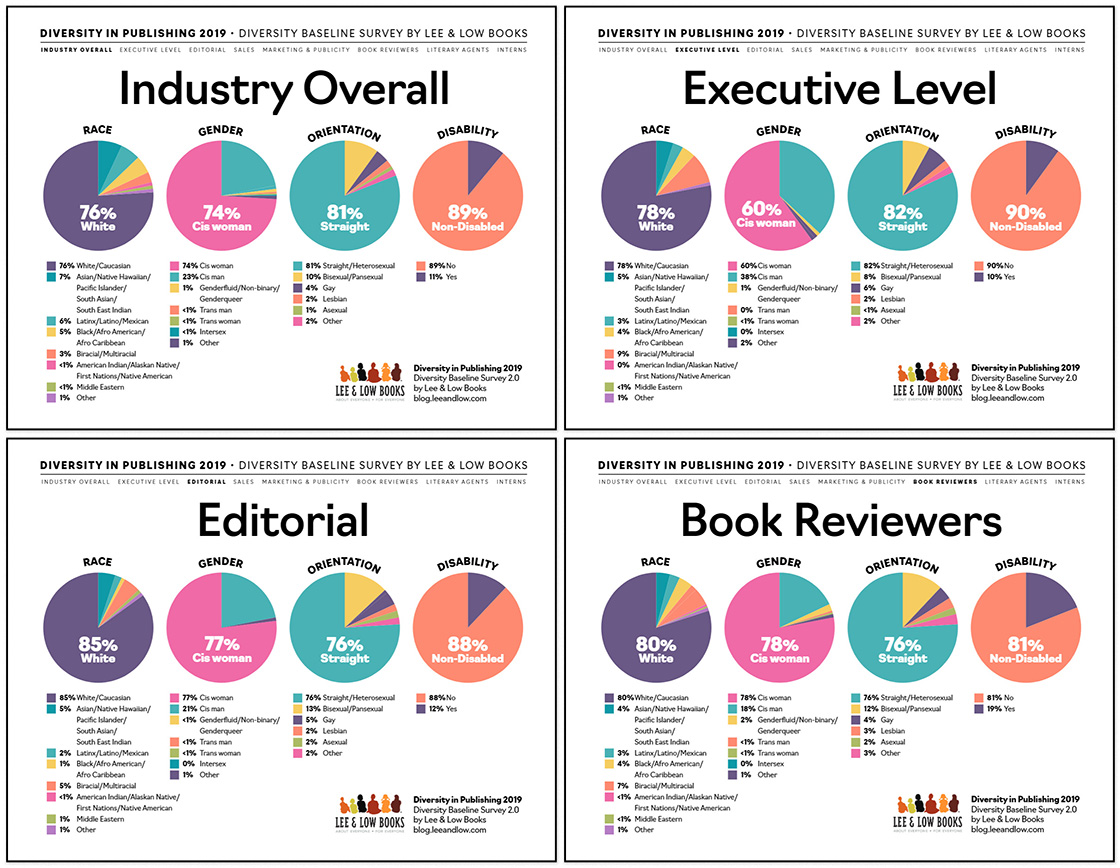
"Given the sample size difference, this 3 percent change in White employees does not meet the bar for statistically significant change," according to the Lee & Low post analyzing the survey results. "There is no discernible change to any of the other racial categories. In other words, the field is just as White today as it was four years ago."
As these Lee & Low graphics show, the decision-makers in the publishing world and everyone involved in creating the books—and those who critique them—are still predominantly white. Only among interns do the numbers show any kind of diversity, with 51 percent white and 51 percent straight.
It is a hard truth for the children's literature world to take in while still basking in the glow of the 2020 Youth Media Awards (YMA) and its inclusive list of winners.
"My reaction overall is disappointment," says Kiera Parrott, reviews director at SLJ and LJ, who created a cultural competency professional development program that she facilitates with other SLJ staffers.
The work of the YMA committees to recognize more diverse and inclusive titles is worthy of celebration, said Parrott, but this is no time for the industry to pat itself on the back and say, job well done. This survey, along with the work of K.T. Horning and the Cooperative Children's Book Center at the University of Wisconsin-Madison, shows there's still a long way to go.
Parrott says she sees publishers shying away from creating more inclusive books for children, opting instead for anthropomorphic animals and machines because they are afraid to make a mistake.
"As publishers, editors, and authors, you can't be afraid to make a mistake," she says. "I'd rather see [them] take a risk. At the end of the day, we are serving these children and need to give them mirrors and windows that reflect and affirm.
"We’ve got a lot of work to do."
Read Lee & Low's full press release on the survey below.
|
January 28, 2020—New York, NY —As conversations intensify regarding diversity in book publishing, children’s publisher Lee & Low Books has released an updated study of staff diversity within the industry. More than 150 companies participated in the 2019 Diversity Baseline Survey, four times the number of participants included in the initial survey, which was released in 2016. The new survey includes all of the “Big Five" Publishers as well as small and medium publishers, book review journals, and two new additions: university presses and literary agents. A continuation of the first study, Diversity Baseline Survey (DBS) 2.0 gathers statistics on publishing staff, literary agents, and reviewers in four major categories—gender, race/ethnicity, sexual orientation, and disability—with the new goal of ascertaining whether the industry is becoming more inclusive over time. Despite frequent conversations regarding the need for diversity and inclusion, the results show little change from the initial survey deployed four years ago. The updated Diversity Baseline Survey results reveal that 76% of publishing professionals identify as White/ Caucasian, slightly down from 79% in 2016—a change that data analysts have deemed not statistically significant. 7% identify as Asian American, 6% as Latinx, 5% as Black/African American, 3% as multiracial, and 1% as Other. Less than 1% of staff identified as Middle Eastern, Native American, or American Indian/Alaskan Native. The survey also reveals that less than 1% of publishing staff identifies as transgender or intersex, and about 1% gender non-conforming. Regarding sexual orientation, about 81% of survey respondents identify as straight or heterosexual, while 10% identify as bisexual or pansexual and 6% as gay or lesbian. Employees who have some type of disability are 11%. The survey was initiated by Lee & Low Books, the largest multicultural children’s book publisher in the United States. The company was inspired by a similar movement in the technology industry to create the original Diversity Baseline Survey. The Lee & Low Marketing team reached out to over two hundred publishers, literary agencies, and review journals. The company partnered with experts at several universities and disciplines to parse the data and vet the survey questions. See the full results of the survey, including breakdowns by department, here: http://blog.leeandlow.com/2020/01/28/2019diversitybaselinesurvey/. ABOUT THE COMPANY: Founded almost thirty years ago, Lee & Low Books publishes award-winning children’s books that are “about everyone, for everyone.” The company is committed to fostering conversations about race, gender, and diversity in publishing and beyond. For more information, visit leeandlow.com. |


Added To Cart
RELATED


RECOMMENDED
CAREERS
The job outlook in 2030: Librarians will be in demand
CAREERS
The job outlook in 2030: Librarians will be in demand
ALREADY A SUBSCRIBER? LOG IN
We are currently offering this content for free. Sign up now to activate your personal profile, where you can save articles for future viewing
ALREADY A SUBSCRIBER? LOG IN
Thank you for visiting.
We’ve noticed you are using a private browser. To continue, please log in or create an account.
Add Comment :-
Be the first reader to comment.
Comment Policy:
Comment should not be empty !!!