


2018 School Spending Survey Report
Students Renovated This Library
At Stone Bridge High School in Ashburn, VA, students proposed ideas for a library makeover—and carried out every aspect of the job, from furniture reupholstery to decoupage.

Students present design proposals.
When the huge Northeastern snowstorm nicknamed Snowzilla kept schools in our district closed for a week last January, a group of dedicated student volunteers had one worry: Could they still come to school to paint, repurpose, and generally “crash” their outdated school library? Although the answer to that question was no, the workday was rescheduled. This group of more than 30 energetic students at Stone Bridge High School in Ashburn, VA, spent their day completing creative DIY projects to enhance the library interior. However, the job didn’t start or end there. A year ago, we embarked on an initiative to transform our library space for 21st-century teaching and learning. After 16 years, the library was showing its age: the wall decor and furnishings were stale and dated; the tables and chairs were heavy, bulky, and hard to move; and the physical layout was basically one huge room punctuated by rows and rows of tall bookshelves. We needed adaptable, multifunctional spaces to facilitate collaboration, content creation, and sharing.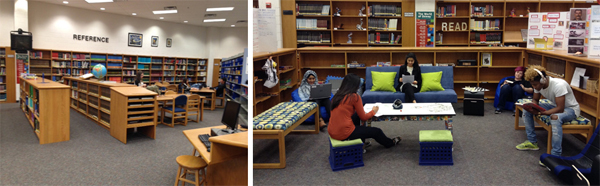
The library, before and after the makeover.
A happy convergence of library dreams and our district's newly implemented “One to the World” (OTTW) learning framework gave us an opportunity to set the rehab wheels in motion. OTTW incorporates project-based activities for students that take on authentic problems and tasks in a real-world context via connections beyond the classroom. Teaming with a housing design class for our makeover project fulfilled our OTTW requirement and was mutually beneficial: students got an authentic audience and task, and we got a design plan, student input, and free student labor.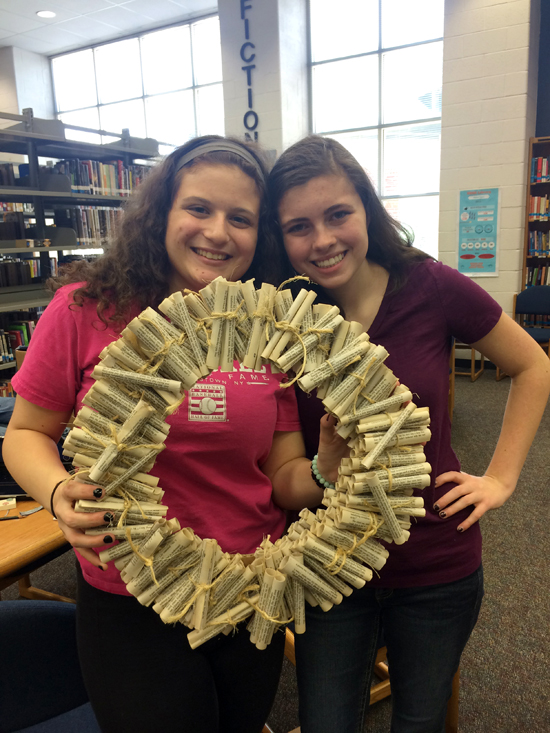
This wreath was made with pages from a discarded paperback book. Each page was rolled and tied with twine, and then the rolls were glued onto a cardboard circle.
Through a combination of user surveys, a review of standards in library space planning, and a needs analysis with their “clients,” design students identified a list of potential improvements. We librarians wanted wall art, updated colors and furnishings, and adaptable zones; students wanted charging stations, laptop stands, private study areas, and trendy and cool social spaces. The design class did a fantastic job melding our needs with their creative ideas. They presented design proposals to an audience that included teachers and administrators. We then devised a makeover plan incorporating as many of their concepts as we could. Since we received no financial support from our administration or district for the project, we raised funds, won grants, and requested donations. With just over $2,300 in our pockets, we scheduled our makeover event.
Left: Students get creative on makeover day. Right: Refinishing a donated table using dry erase paint
to create a “doodle board.” For best results, lightly sand your piece before painting and let paint dry
completely between coats (we learned the hard way).
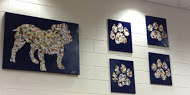
Wall canvases decorated with paint and magazine clippings. Students spray painted blank art canvases and traced on the bulldog and paw-print shapes. They filled the outlines by gluing on torn pieces from magazine pages.
• Design strategy In addition to using student proposals, we mined Pinterest and DIY websites for project ideas. We are happy with our results but could have benefited from professional advice and a master design plan for cohesion in such a large space. Some library supply vendors offer a free design consultation; you could also put out a call for pro bono decorating advice from your parent community.
• Planning the event Definitely enlist students to help out. In addition to the design students, our library’s TAG Team (a teen advisory group) were invaluable in helping out. They set up a form in Sign Up Genius and solicited volunteers by advertising on social media and through our school’s clubs and service organizations. Offer students volunteer service credit, and be sure to feed them! Ask for gift cards or donations from local businesses to provide snacks, beverages, and lunch.
• Task management We were thrilled to have more than 30 volunteers come to help, but we needed more adult supervisors. Be sure to set up stations and prep work areas before students arrive. Instead of putting out all supplies at once, it helps to dole out brushes, paint, and other supplies as needed to curb wastefulness.
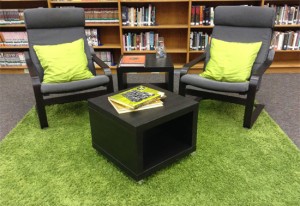
New comfy seating with a splash of color.
• Quality control Although we gave students a general idea of what we wanted, we allowed them much creative control over the projects they chose. Some will turn out better than others, but just relax, step back, and let the teenagers create. Display some sample projects to energize students and get the creative juices flowing. Our excellent building engineer was on hand to help students use tools, plus he hung artwork, installed a countertop, and put wheels on furniture.
• Cost Our major cost was new furniture items, with fabric for benches and memo boards running second. Be sure to consider all supply expenses, since little things add up quickly. Reuse and repurpose items you already have, but remember that even freebies cost money to rehab. Save coupons and use teacher rewards programs to offset expenses.
• Funding Our TAG Team students sponsored several fundraisers. We also received money from our parent-teacher organization, won a grant, and requested item donations from parents. We were reluctant to use crowdfunding sites, in deference to needier recipients, but have since evolved in our thinking. Donors have a choice, after all. We also plan to explore partnerships with local businesses going forward.
• Time and effort A great amount of our professional and personal time was required to plan projects, compare prices, purchase supplies, and raise money. We hope to recruit a dedicated parent volunteer or booster to manage future fund-raisers and events.
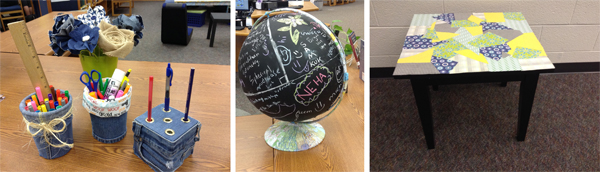
Left: Denim do-overs as functional accessories: students covered yogurt containers and a Styrofoam cube with old jeans they had donated. Center: To up-cycle an outdated globe, volunteers disassembled it, spray-painted it with blackboard paint, and decoupaged the frame with pages from an old atlas. Some use the finished globe for a daily mood check-in. Right: A donated table transformed with decoupage. This was one of our favorite projects. Irregular shapes were cut from scrap-booking paper and glued onto the tabletop with Mod Podge. We finished the top with three coats of a clear polyurethane sealer.
Karen Farzin and Cassandra Donahue are co-librarians at Stone Bridge High School in Ashburn, VA. They tweet as Bulldog Librarians: @sbhslibrary.

Added To Cart
RELATED


RECOMMENDED
CAREERS
The job outlook in 2030: Librarians will be in demand
CAREERS
The job outlook in 2030: Librarians will be in demand
ALREADY A SUBSCRIBER? LOG IN
We are currently offering this content for free. Sign up now to activate your personal profile, where you can save articles for future viewing
ALREADY A SUBSCRIBER? LOG IN
Thank you for visiting.
We’ve noticed you are using a private browser. To continue, please log in or create an account.

Add Comment :-
Comment Policy:
Comment should not be empty !!!
Jim
Howdy would you mind letting me know which hosting company you're working with? I've loaded your blog in 3 different web browsers and I must say this blog loads a lot quicker then most. Can you recommend a good web hosting provider at a honest price? Thanks a lot, I appreciate it!Posted : Jun 18, 2016 04:41
Peggy Ellis
What a wonderful project!! It is hard for me to believe that it is 16 years old. Great librarians, great school and great kids.Posted : Jun 11, 2016 08:10
Rosan Cable
Wonderful ideas! Great resources: the patrons who use the space. I can't wait to share this with some of my colleagues.Posted : Jun 10, 2016 12:37