


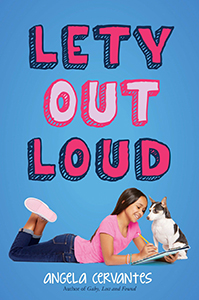
 Lety Out Loud
 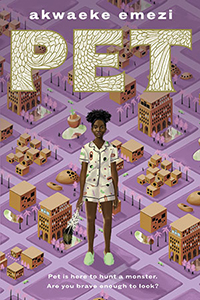 Pet
Pet 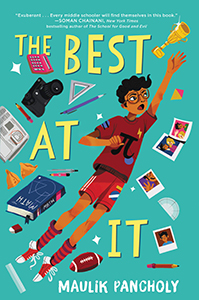 The Best at It
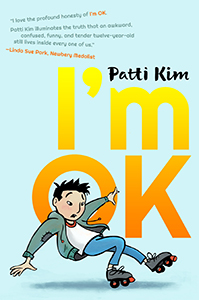 I'm Ok
 Frankly in Love
 Song for a Whale
 Each Tiny Spark
 The Silence Between Us
2018 School Spending Survey Report
SLJ Reviews of the 2020 Newbery, Caldecott, and Printz Award Winners
SLJ's reviews of the Youth Media Award winners (YMAs) announced at a press conference at the American Library Association’s Midwinter conference in Philadelphia.
The Youth Media Award (YMA) winners were announced this morning at a press conference held at the American Library Association’s Midwinter conference in Philadelphia. Below are SLJ’s reviews of titles that won medals or honors, in addition to past coverage of the authors and illustrators. Many of our Best Books of 2019 were acclaimed by the various committees, and most of the winning titles received positive or starred reviews. You'll find additional coverage on the Youth Media Awards here.
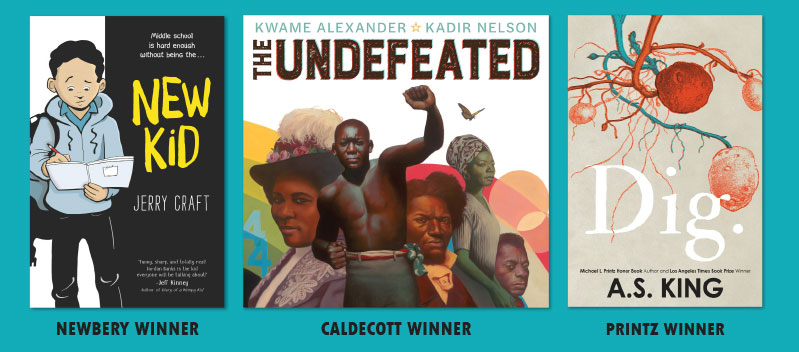
JOHN NEWBERY MEDAL
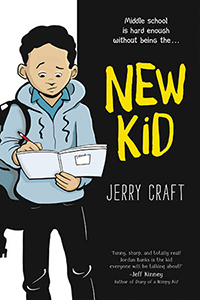 New Kid
by Jerry Craft
illus. by Jerry Craft. 256p. HarperCollins. Feb. 2019. Tr $21.99. ISBN 9780062691200.
 Gr 4–7—Jordan Banks is anxious about being the new kid at Riverdale, especially since he'd rather be going to art school. He's even more nervous when he realizes that, unlike in his Washington Heights neighborhood, at Riverdale, he's one of the few kids of color. Despite some setbacks, Jordan eventually makes a few friends and chronicles his experiences in his sketch pad. This is more than a story about being the new kid—it's a complex examination of the micro- and macroaggressions that Jordan endures from classmates and teachers. He is regularly mistaken for the other black kids at school. A teacher calls another black student by the wrong name and singles him out during discussions on financial aid. Even Jordan's supportive parents don't always understand the extent of the racism he faces. This book opens doors for additional discussion. Craft's illustrations are at their best during the vibrant full-page spreads. The art loses a bit of detail during crowd scenes, but the characters' emotions are always well conveyed. Jordan's black-and-white notebook drawings are the highlight of this work, combining effective social commentary with the protagonist's humorous voice. VERDICT Highly recommended for all middle grade shelves.–Gretchen Hardin, Sterling Municipal Library, Baytown, TX
An SLJ Best Book of 2019.
CHECK OUT: Jerry Craft on Being "The New Kid"
JOHN NEWBERY MEDAL HONORS
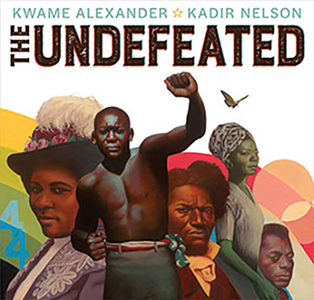 The Undefeated
by Kwame ALEXANDER
illus. by Kadir Nelson. 40p. HMH/Versify. Apr. 2019. Tr $17.99. ISBN 9781328780966.
Gr 3 Up—This inaugural title from Newbery Medalist Alexander's new imprint is a poignant and powerful ode to the resilience and strength of black life and history in America. Originally performed for ESPN's The Undefeated in 2016, the poem adopts a picture book format with a new title, accompanied by stunning oil paintings in Nelson's trademark photorealistic style. The evocative illustrations stand out against stark white backgrounds and vary in their composition. On some spreads, the focus is on a single expressive portrait; others feature collages of African American icons from various disciplines, or refer to significant historical moments. The art functions in perfect harmony with the poet's spare, striking verse to electrify the Black American experience, and to celebrate black athletes, writers, musicians, activists, and heroes. From the unspeakable trauma of American slavery and the transatlantic slave trade to the brave service of black troops during the Civil War, from the fierce and unwavering fight for civil rights to the Black Lives Matter movement, from Selma to Birmingham to Harlem, this book is both a soaring tribute to the enduring perseverance and achievements of the past and a stirring call to action to "the dreamers and the doers" of the present and the future. Back matter includes an afterword from the author as well as additional information about the historical figures and events featured in the book. VERDICT Alexander and Nelson present an exceptionally moving and triumphant work. This book is an essential first purchase for all libraries.–Lauren Strohecker, McKinley Elementary School, Elkins Park, PA
An SLJ Best Book of 2019.
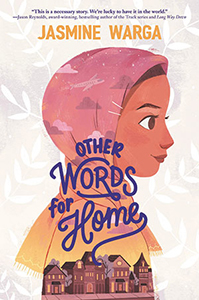 Other Words for Home
352p. HarperCollins/Harper. May 2019. Tr $16.99. ISBN 9780062747808.
Gr 4–8—Twelve-year-old Jude lives in a coastal tourist town in Syria where many people go to get away. While Jude wants to become a movie star, her older brother, Issa, wants more from their future than the oppression overtaking their beloved country. As the tumult crawls closer to Jude's home, Issa yearns to join the revolution in Aleppo, Baba refuses to leave his seaside store, and Mama believes the safest place for Jude, herself, and the baby she is carrying is with Jude's Uncle Mazin and Aunt Michelle in America. Leaving a possible war behind is easy, but leaving Baba, Issa, and everything she knows is hard. Adjusting to life in Cincinnati alongside her less-than-welcoming cousin, Sarah, is almost as difficult, especially with school play tryouts looming and Jude feeling that a girl like her would never get, or even merit, the spotlight. With the help of her fellow immigrant classmates and new Arabic-speaking American friend, Layla, Jude adjusts to her new home and family while never forgetting what she left behind. Told in verse and divided into five sections chronicling Jude's flight from Syria and adjustment to America, this powerful middle grade novel explores the complicated concepts of war and corruption, home, family, belonging, and how, in Jude's own words, "It is strange to feel lucky/for something that is making my heart feel so sad."VERDICT Highly recommended for all libraries, this title will easily find a home next to books like Refugee by Alan Gratz and Inside Out and Back Again by Thanhha Lai.
An SLJ Best Book of 2019.
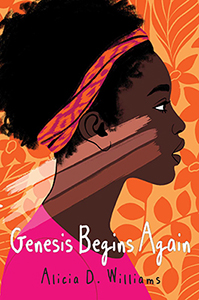 Genesis Begins Again
384p. Atheneum/Caitlyn Dlouhy Bks. Jan. 2019. Tr $17.99. ISBN 9781481465809.
Gr 5–8—Genesis comes home from school to find her family's belongings on the lawn; they've been evicted again. Her father promises that this next time will be different, renting a house in the suburbs and promising that he will get a promotion at work so they can afford it. At school, Genesis makes friends for the first time and is mentored by Mrs. Hill, the choir teacher, but Genesis's father still drinks too much and her parents' marriage is unraveling. Genesis tries lightening her skin, begs to be able to use relaxer in her hair, and keeps a list of things she hates about herself, believing that if she only looked like her light-skinned mother and not her dark-skinned father, the situation at home would improve. This message is hammered home by her father's cruel comments and her grandmother's story of the "brown paper bag" test. Genesis escapes by singing; she is inspired by greats like Billie Holiday and Etta James. When she has the opportunity to sing in the school talent show, Genesis must find the power in using her voice to speak her truth. Genesis' struggles are age appropriate but do not shy away from the hard truth about colorism within the Afro American community. Through each character, readers come to understand the significance of how one's story plays out in reactions and interactions with the people around them. The hopeful but not happy ending adds to the realism and emotional impact of this powerful story.VERDICT This is a sensitive and nuanced portrayal of a girl grappling with hard truths about her family and her own feelings of self-worth. A must for all collections.
An SLJ Best Book of 2019.
CHECK OUT: Alicia D. Williams on Genesis Begins Again
RANDOLPH CALDECOTT MEDAL
The Undefeated
illus. by Kadir Nelson. 40p. HMH/Versify. Apr. 2019. Tr $17.99. ISBN 9781328780966.
Gr 3 Up—This inaugural title from Newbery Medalist Alexander's new imprint is a poignant and powerful ode to the resilience and strength of black life and history in America. Originally performed for ESPN's The Undefeated in 2016, the poem adopts a picture book format with a new title, accompanied by stunning oil paintings in Nelson's trademark photorealistic style. The evocative illustrations stand out against stark white backgrounds and vary in their composition. On some spreads, the focus is on a single expressive portrait; others feature collages of African American icons from various disciplines, or refer to significant historical moments. The art functions in perfect harmony with the poet's spare, striking verse to electrify the Black American experience, and to celebrate black athletes, writers, musicians, activists, and heroes. From the unspeakable trauma of American slavery and the transatlantic slave trade to the brave service of black troops during the Civil War, from the fierce and unwavering fight for civil rights to the Black Lives Matter movement, from Selma to Birmingham to Harlem, this book is both a soaring tribute to the enduring perseverance and achievements of the past and a stirring call to action to "the dreamers and the doers" of the present and the future. Back matter includes an afterword from the author as well as additional information about the historical figures and events featured in the book. VERDICT Alexander and Nelson present an exceptionally moving and triumphant work. This book is an essential first purchase for all libraries.–Lauren Strohecker, McKinley Elementary School, Elkins Park, PA
An SLJ Best Book of 2019.
RANDOLPH CALDECOTT MEDAL HONORS
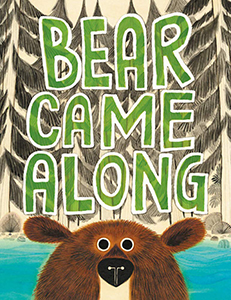 Bear Came Along
by Richard T Morris (text) & illus. by LeUyen Pham
Little, Brown . Jun. 2019. 40p. Tr $17.99. ISBN 9780316464475. POP.
PreS-Gr 2–The dramatic cover, featuring a large hand-lettered title and a close-up of an alarmed-looking bear, sets the stage for a spirited adventure. Venturing out of his cave, a curious bear climbs out on a tree that breaks off and falls into a river. Starting what becomes a natural “log flume” ride, Bear initially moves slowly, picking up Froggy and the Turtles, then a string of various animals. Each creature gains specific knowledge through the quest. Bear doesn’t know he was on an adventure until he finds Froggy. Froggy doesn’t realize she has friends, until the Turtles join them, etc. Watercolor, ink, and gouache illustrations are well-designed to expand the text, using each animal’s expressions and body language to convey their individual roles. Front and back end pages both act as maps of the river, but also provide an introduction and an epilogue to the tale. A dramatic spread, positioned from the animals’ point of view, shows them on the edge of a precipice about to take the plunge. A page turn shifts to a facing view and all the creatures’ wide-eyed expressions. One more turn pulls the focus out to long range, showcasing the river, the drop, and the animals perched precariously. As they fall, however, their expressions are mostly cheerful, then exuberant, ending with “Oh, what a ride!”
VERDICT Full of messages about seizing the day and learning from one another, this jaunty tale and its large-scale, immersive pictures expansively invite readers to come along, too
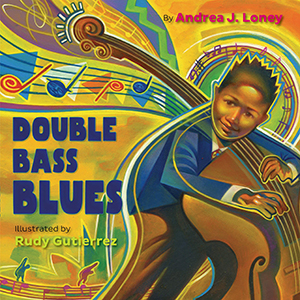 Double Bass Blues
by Andrea J Loney (text) & illus. by Rudy Gutierrez
Knopf . Oct. 2019. 32p. Tr $17.99. ISBN 9781524718527.
Gr 1-3–In an explosion of vibrant color (thanks to Rudy Gutierrez’s liquid acrylics), young Nic wins kudos for his double bass solo with the school orchestra, but faces a tough journey home. Lugging his beloved (but bulky) bull fiddle, the boy is harassed and taunted on his long trip, and is finally faced with an out-of-service elevator and multiple flights of stairs. Happily, he finds not only his loving grandfather waiting for him, but some of granddaddy’s jazz-playing buddies sitting with their instruments at the ready, sorely in need of that boy and his bull fiddle. Colorful, full of movement, limited in text but loaded with emotion, this is an ode to the diversity of music and the determination of a talented kid.
VERDICT A dramatic and emotional selection for older readers than the usual picture book audience, particularly kids who love music and have had their own tough journeys home.
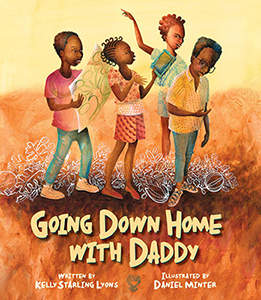 Going Down Home with Daddy
illus. by Daniel Minter. 32p. Peachtree. Apr. 2019. Tr $16.95. ISBN 9781561459384.
Gr 2–5—Inspired by the author's family heritage and traditions, this title follows an African American family as they travel "down home" for a family reunion. Lil' Alan is excited to see his extended family and visit his great-grandma and her farm but is anxious about how he might contribute to the celebration. Sis is planning to sing Granny's favorite song, and cousin Isaiah will read a poem by Langston Hughes, but what can Lil' Alan do? As he goes on a tractor ride, enjoys "love-made" family meals, attends church services, and listens to his father and other relatives share memories and ruminate on the importance of family, Lil' Alan realizes that the answer is in the precious family land, the gifts of which he uses in a heartfelt tribute to his family and its roots. Minter's illustrations, rendered in an acrylic wash, work in beautiful harmony with Lyons's joyful portrait of a deeply loving multigenerational family. Carefully layered images, patterns, and textures reinforce the narrative links between family history, American history, ancestral land and nature, and the bonds of family: "When we go down home with Daddy, everything we see holds a piece of him and us."VERDICT Readers will enjoy this moving celebration of familial love, history, and tradition. Highly recommended.
An SLJ Best Book of 2019.
MICHAEL L. PRINTZ AWARD
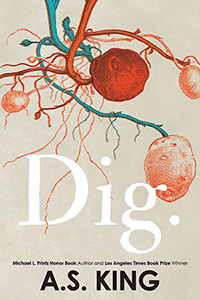 Dig
Dig
by A.S. KING
400p. Dutton. Mar. 2019. Tr $17.99. ISBN 9781101994917.
Gr 9 Up—Once there was a family who grew and dug potatoes for generations, but family disagreements led to the selling of the land. One of the brothers took his portion, developed the land, and grew money instead of potatoes. He and his wife also grew a family of five children, then decided not to pass their money on to the generation who left home young and rarely or never spoke with their parents. Each of these children had one child, cousins who had no connection with one another—if they even knew that they had cousins at all. Then in a confluence of events, all five of the cousins found themselves living within a few miles of their grandparents—the Freak, the Shoveler, CanIHelpYou?, Malcolm, and Loretta. They each have difficult family lives, and all of them are loners—until they find one another. King's delightful surrealism flows effortlessly back and forth against the stark realism of the five teens' lives, touching on issues of abuse, prejudice, white privilege, and loneliness. Gottfried and Marla, the grandparents, and each of the teens are well-developed, well-rounded characters with multiple interwoven chapters building to the climax. Even minor characters are well-drawn portraits. This combination of masterly storytelling, memorable characters, and unexpected twists and turns make this book into an unforgettable, lingering read. VERDICT A first purchase for all libraries that has great discussion potential.–Janet Hilbun, University of North Texas, Denton
MICHAEL L. PRINTZ HONORS
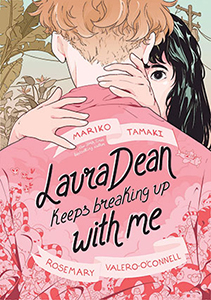 Laura Dean Keeps Breaking Up with Me
illus. by Rosemary Valero-O'Connell. 304p. First Second. May 2019. Tr $24.99. ISBN 9781250312846; pap. $17.99. ISBN 9781626722590.
Gr 9 Up—Frederica Riley's tall, confident, and effortlessly cool girlfriend Laura Dean is the most popular girl in school. Laura breaks Freddy's heart over and over again, but Freddy still takes her back each time. Doodle, Freddy's BFF, introduces her to Seek-Her, a mysterious medium who echoes what Freddy's friends have been saying: stay away from Laura. But Freddy continues to sacrifice friendships for the sake of a destructive relationship, and consulting advice columnist Anna Vice may be the teen's last chance to listen to reason. Valero-O'Connell's artwork is the best part of this graphic novel. Soft, sweeping lines emphasize Freddy's emotional torment, the unconventional paneling lending itself to the tone of the story. It's not easy for someone in a toxic relationship to be objective, but Freddy manages not only to help herself but also to be there for Doodle, who arguably has the biggest problems of the entire novel. In fact, teenage Doodle's relationship with an adult is glossed over and should have been addressed. However, Tamaki and Valero-O'Connell do bring to life an artful narrative of relationships—old, new, harmful, and healing—and what happens when you learn to navigate them.
VERDICT It's frustrating to watch Freddy flounder, making bad decision after bad decision, but there's something endearingly vulnerable about her beautifully drawn experiences that will resonate with teenagers. Consider for medium and large collections.
Reviewed by Michael Marie Jacobs, Darlington School, GA
An SLJ Best Book of 2019.
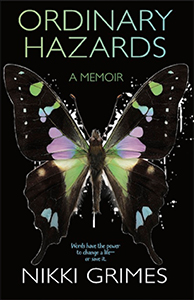 Ordinary Hazards: A Memoir
by Nikki Grimes
Wordsong . Oct. 2019. 336p. photos. Tr $19.99. ISBN 9781629798813.
Gr 7 Up–Grimes offers young adult readers the special treat of literary ingenuity in her new memoir. “Time to grab my flashlight / and step into the tunnel,” Grimes writes in an early poem—making reference to her task with this new work. In long poems, short poems, and the occasional prose poem, Grimes guides us through her past tragedies and triumphs while keenly observed moments build her inner world. Readers spend time with three different points of view: child Grimes, adolescent Grimes, and burgeoning adult Grimes. Though the circumstances and characters change as she moves and grows, her voice is consistently spare and warm. The poems about experiencing neglect as a five-year-old carry the same powerful simplicity as those written about high school. A memoir that doesn’t demand a time line, this work is a personal history in poems that you can read backward and forward.
VERDICT This nontraditional memoir from a long-working and highly acclaimed author will speak deeply to young readers harboring their own interest in writing or otherwise squeezing art out of life’s spiky fruit.
CHECK OUT: Nikki Grimes Explains Why Mental Illness Is Not A Weakness
CORETTA SCOTT KING (AUTHOR) BOOK AWARD
New Kid
by Jerry Craft
illus. by Jerry Craft. 256p. HarperCollins. Feb. 2019. Tr $21.99. ISBN 9780062691200.
Gr 4–7—Jordan Banks is anxious about being the new kid at Riverdale, especially since he'd rather be going to art school. He's even more nervous when he realizes that, unlike in his Washington Heights neighborhood, at Riverdale, he's one of the few kids of color. Despite some setbacks, Jordan eventually makes a few friends and chronicles his experiences in his sketch pad. This is more than a story about being the new kid—it's a complex examination of the micro- and macroaggressions that Jordan endures from classmates and teachers. He is regularly mistaken for the other black kids at school. A teacher calls another black student by the wrong name and singles him out during discussions on financial aid. Even Jordan's supportive parents don't always understand the extent of the racism he faces. This book opens doors for additional discussion. Craft's illustrations are at their best during the vibrant full-page spreads. The art loses a bit of detail during crowd scenes, but the characters' emotions are always well conveyed. Jordan's black-and-white notebook drawings are the highlight of this work, combining effective social commentary with the protagonist's humorous voice. VERDICT Highly recommended for all middle grade shelves.–Gretchen Hardin, Sterling Municipal Library, Baytown, TX
An SLJ Best Book of 2019.
CHECK OUT: Jerry Craft on Being "The New Kid"
CORETTA SCOTT KING (AUTHOR) BOOK AWARD HONORS
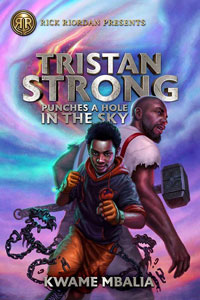 Tristan Strong Punches a Hole in the Sky
by Kwame Mbalia
Disney-Hyperion/Rick Riordan Presents . Oct. 2019. 496p. Tr $16.99. ISBN 9781368039932.
Gr 5-8–Tristan is reluctantly on his way to spend the summer with his grandparents on the family farm. In his pocket he carries the journal of his best friend Eddie, killed in a bus accident. Tristan’s survivor guilt means he hasn’t read the journal, and he is trying very hard to ignore the strange green glow coming from its cover. When Gum Baby, a figure from West African legend, tries to steal the journal, Tristan races to retrieve it, breaking a bottle on his grandmother’s bottle tree and falling through a flaming hole into a parallel world. Here, the stories Tristan’s grandmother tells are solidly real: in the course of breathless chases, close escapes, and mounting stakes, he meets John Henry, Brer Fox, High John the Conqueror, and other figures from African and African American folklore. A race to retrieve Anansi’s story box reveals Tristan’s destiny as an Anansesem, a storyteller of power, and makes him a pivotal figure in the saving of this strange new world. While the novel is lengthy, the pace is quick, secondary characterizations are nicely delineated, and the folkloric figures are heroic and true to their legends. The world-building includes evocative descriptions of skeleton ships, manacled monsters, and deadly villains. In addition to being rife with action, the story is rooted in the emotional journey of the protagonist; between making friends and losing them, Tristan finally makes peace with Eddie’s death.VERDICT Part of the “Rick Riordan Presents” series, this debut novel offers a richly realized world, a conversational, breezy style, and a satisfying conclusion that leaves room for sequels.
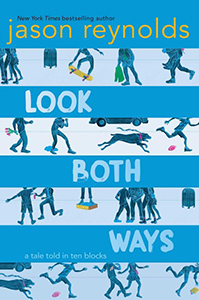 Look Both Ways: A Tale Told in Ten Blocks
S. & S./ /Atheneum. Oct. 2019. 208p. Tr $17.99. ISBN 9781481438285.
Gr 5-8–Ten short stories paint a picture of what happens one particular afternoon after the dismissal bell at Latimer Middle School. Each tale focuses on one student or group of friends. The magic of this book is Reynolds’s ability to weave the same teachers and various students in and out of the ten stories. Students after school swirl and eddy. Ms. Post the crossing guard helps everyone cross the street while her son looks on from his spot by the stop sign; Ms. Wockley, the principal, stands in the hall yelling at students; and Ms. CeeCee sells penny candy from her house. Some backstory in each piece puts the characters’ actions into perspective, with each entry ending with a bit of a surprise. The very last one ends where the first one begins, with a mythical flying school bus. Poetic language is used throughout to help distinguish one character from the next.VERDICT The perfect book to hand to reluctant middle grade readers, who will relate to the hectic and uncertain lives of these characters.
An SLJ Best Book of 2019.
CORETTA SCOTT KING (ILLUSTRATOR) BOOK AWARD
The Undefeated
illus. by Kadir Nelson. 40p. HMH/Versify. Apr. 2019. Tr $17.99. ISBN 9781328780966.
Gr 3 Up—This inaugural title from Newbery Medalist Alexander's new imprint is a poignant and powerful ode to the resilience and strength of black life and history in America. Originally performed for ESPN's The Undefeated in 2016, the poem adopts a picture book format with a new title, accompanied by stunning oil paintings in Nelson's trademark photorealistic style. The evocative illustrations stand out against stark white backgrounds and vary in their composition. On some spreads, the focus is on a single expressive portrait; others feature collages of African American icons from various disciplines, or refer to significant historical moments. The art functions in perfect harmony with the poet's spare, striking verse to electrify the Black American experience, and to celebrate black athletes, writers, musicians, activists, and heroes. From the unspeakable trauma of American slavery and the transatlantic slave trade to the brave service of black troops during the Civil War, from the fierce and unwavering fight for civil rights to the Black Lives Matter movement, from Selma to Birmingham to Harlem, this book is both a soaring tribute to the enduring perseverance and achievements of the past and a stirring call to action to "the dreamers and the doers" of the present and the future. Back matter includes an afterword from the author as well as additional information about the historical figures and events featured in the book. VERDICT Alexander and Nelson present an exceptionally moving and triumphant work. This book is an essential first purchase for all libraries.–Lauren Strohecker, McKinley Elementary School, Elkins Park, PA
An SLJ Best Book of 2019.
CORETTA SCOTT KING (ILLUSTRATOR) BOOK AWARD HONORS
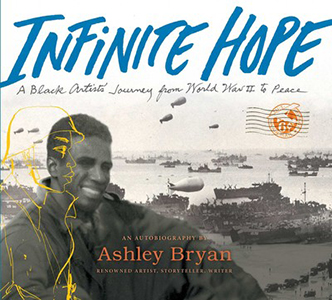 Infinite Hope: A Black Artist’s Journey from World War II to Peace
by Ashley Bryan (text) & illus. by Ashley Bryan
Atheneum/Caitlyn Dlouhy . Oct. 2019. 112p. bibliog. index. photos. Tr $21.99. ISBN 9781534404908.
Gr 6 Up–Part memoir, part social history, part artist’s sketchbook, this title offers a rare insight into the treatment of black soldiers serving in World War II. Bryan, a renowned children’s book creator and Newbery Honoree and Coretta Scott King Award winner, offers an impressionistic work. After facing discrimination when he applied to college, Bryan earned a scholarship to Cooper Union in New York. Just when he thought he was on his way to achieving his dream of working as an artist, 19-year-old Bryan was drafted into the United States Army in 1943. Although he’d encountered prejudice before, Bryan was surprised by the level of segregation he experienced in the military. Black recruits were immediately separated from white ones; they were assigned dangerous “service” jobs and were not offered the same opportunities to advance. Bryan used art as a way to feed his spirit as he faced perilous assignments, including taking part in the D-Day invasion and sleeping in a foxhole on Omaha Beach for months. Unlike his 2009 autobiography, Words to My Life’s Song, this book focuses on one period of Bryan’s life and touches upon larger social issues, namely the treatment of black soldiers.VERDICT This unique book, at times both beautiful and sadly horrifying, deserves to be studied and savored.
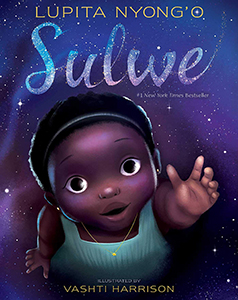 Sulwe
Sulwe
by Lupita Nyong’o (text) & illus. by Vashti Harrison
S. & S . Oct. 2019. 48p. Tr $17.99. ISBN 9781534425361.
PreS-Gr 2–A sweet story that discusses colorism and emphasizes self-love. In lyrical prose, actress-writer N’yongo tells the tale of young Sulwe, “born the color of midnight.” Sulwe feels isolated from her lighter-skinned family, and from the children at school who call her racist names. She resorts to trying to lighten herself by wearing makeup, eating light foods, and even using an eraser to rub away her dark skin. Though her mother reassures Sulwe (whose name means ‘star’ in the Luo dialect) that she is beautiful and her brightness is internal, the young girl remains sad and skeptical. That night, she is taken on a journey by a shooting star and told the tale of Night and Day, two sisters who brought light and darkness to earth. Bullied for her darkness, Night disappears, leaving earth to suffer in perpetual sunlight. Eventually, Day brings her back, apologizing and assuring Night that she’s exactly who she’s meant to be. Sulwe wakes up from her nighttime adventure energized and confident, “dark and beautiful, bright and strong.” Readers who are familiar with this experience will feel seen, while others will relate to feelings of being an outsider while learning about colorism. Harrison’s art is captivating: warm golden tones blend flawlessly into rich, purple-hued night scenes, gorgeously accented with iridescent blues and galactic sprinkles of white. Youngsters who may miss parts of the lesson will remain enthralled with the artwork.
VERDICT Though a bit uneven in its storytelling, this beautiful book covers an important topic rarely addressed for young audiences, with tenderness and joy. Sure to gain attention in picture book collections.
Reviewed by Ashleigh Williams, School Library Journal
CORETTA SCOTT KING/JOHN STEPTOE NEW TALENT AUTHOR AWARD
Genesis Begins Again
384p. Atheneum/Caitlyn Dlouhy Bks. Jan. 2019. Tr $17.99. ISBN 9781481465809.
Gr 5–8—Genesis comes home from school to find her family's belongings on the lawn; they've been evicted again. Her father promises that this next time will be different, renting a house in the suburbs and promising that he will get a promotion at work so they can afford it. At school, Genesis makes friends for the first time and is mentored by Mrs. Hill, the choir teacher, but Genesis's father still drinks too much and her parents' marriage is unraveling. Genesis tries lightening her skin, begs to be able to use relaxer in her hair, and keeps a list of things she hates about herself, believing that if she only looked like her light-skinned mother and not her dark-skinned father, the situation at home would improve. This message is hammered home by her father's cruel comments and her grandmother's story of the "brown paper bag" test. Genesis escapes by singing; she is inspired by greats like Billie Holiday and Etta James. When she has the opportunity to sing in the school talent show, Genesis must find the power in using her voice to speak her truth. Genesis' struggles are age appropriate but do not shy away from the hard truth about colorism within the Afro American community. Through each character, readers come to understand the significance of how one's story plays out in reactions and interactions with the people around them. The hopeful but not happy ending adds to the realism and emotional impact of this powerful story.VERDICT This is a sensitive and nuanced portrayal of a girl grappling with hard truths about her family and her own feelings of self-worth. A must for all collections.
An SLJ Best Book of 2019.
CHECK OUT: Alicia D. Williams on Genesis Begins Again
CORETTA SCOTT KING/JOHN STEPTOE NEW TALENT ILLUSTRATOR AWARD
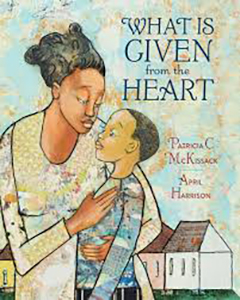 What Is Given from the Heart
illus. by April Harrison. 40p. Random/Schwartz & Wade. Jan. 2019. Tr $17.99. ISBN 9780375836152.
K-Gr 3—Although he and his mama are poor, James Otis struggles to find something he can give the Temple family, who have lost everything in a fire. After his daddy dies suddenly, the boy and his mom lose their farm and move into a "run-down shotgun house." A flood further adds to their misery. Yet when Reverend Dennis announces the congregation will deliver "love boxes" to needy families for Valentine's Day, the boy and his mother decide to provide gifts for the Temples. "Stitchin' with a loving heart," mama turns her one treasure, a tablecloth, into an apron for Mrs. Temple. Considering several of his possessions unsuitable, James Otis finally decides to make a book for Sarah Temple. The delighted Temples receive their box with the congregation looking on. Their hearts filled with joy at having given to others, James Otis and mama return home to discover a love box has been delivered to them. Textured backgrounds that bleed to the edges and often include spreads form the backdrop for the folk-art illustrations rendered in mixed media and found objects. All the figures are elongated, and the brightest colors appear in a striking scene of the close-knit African American community walking to church dressed in their Sunday best. There are depictions of the modest neighborhood and touching close-ups of the boy and his mom in loving embrace and Sarah clutching her treasured book to her chest.VERDICT This story of the joy of giving despite one's own needs is a must-have for group discussions of empathy. A treasure from a marvelous storyteller.
PURA BELPRÉ (ILLUSTRATOR) AWARD
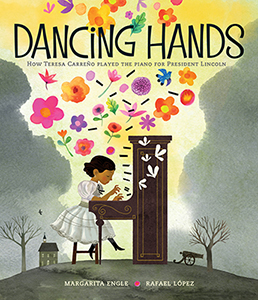 Dancing Hands: How Teresa Carreño Played the Piano for President Lincoln
by Margarita Engle (text) & illus. by Rafael López
Atheneum /S. & S./. Aug. 2019. 40p. Tr $17.99. ISBN 9781481487405.
PreS-Gr 2–Teresa Carreño achieved global fame as a performer, composer, pianist, and opera singer. By the age of six, she was composing. At the age of seven, she began performing. Revolution in Venezuela forced the Carreño family to migrate to New York, an unfamiliar place where few people spoke Spanish and her family felt out of place. But war would follow them—in 1863 the United States was in the midst of the Civil War. At the age of 10, Carreño was invited to play for President Abraham Lincoln and his family at the White House. But will a poorly tuned piano diminish her performance? This is a story of overcoming fear and using one’s talents to spark joy despite unforeseen obstacles. Author and illustrator are well paired in this interesting narrative. Darks and lights, whether representing world events or the colors of the piano keys, are recurring themes that Engle cleverly entwines in her at times poetic writing. López’s illustrations practically leap from the page as they mirror the tone of events—bright and beautiful when the story is light; dark, drab, and gray when echoing conflict. A historical note in the back matter provides slightly more insight, but Engle’s writing occasionally seems to take liberties with individual characters’ thoughts and emotions with little supporting evidence.
VERDICT Despite the efficacy of the author and illustrator collaboration, the historical facts remain somewhat sketchy throughout the narrative. A gentle title to add cultural insight to any collection, though possibly best for larger budgets
Reviewed by Rebecca Gueorguiev, New York Public Library
PURA BELPRÉ (ILLUSTRATOR) AWARD HONORS
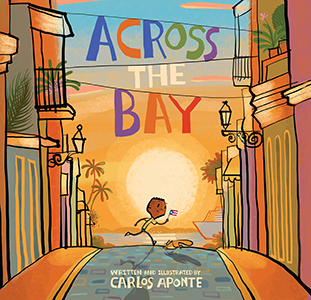 Across the Bay
by Carlos Aponte (text) & illus. by Carlos Aponte
Penguin Workshop . Sept. 2019. 32p. Tr $17.99. ISBN 9781524786625.
PreS-Gr 2–Missing a father in his life, a young boy goes searching for him. Carlitos lives in the town of Cataño in Puerto Rico, a town just across the bay from the capital city of San Juan. Carlitos leads a happy life with his mother, abuela, and cat, Coco. But he doesn’t like going to the barbershop, where he feels left out when he sees all of the other boys accompanied by their dads. Knowing his father lives in San Juan, the boy finds an old photo of him, grabs some money, and tiptoes out of the house and to the ferry terminal. Predictably, he doesn’t find his father but instead realizes how important the family he does have is to him. Aponte’s color-filled illustrations capture the vibrancy and warmth of Carlitos’s environment. As the boy walks the streets of San Juan, readers familiar with the city will easily recognize it. The text, however, is inconsistent. For example, the absence of a father is explained as, “most families in Carlitos’s town looked the same. His family didn’t look like the others.” It is also somewhat jarring when the barber greets Carlitos’s mother as “Doña Carmen” but she responds with a simple “Francisco.” Is she asserting social privilege?
VERDICT Though not without flaws, this book with a Puerto Rican setting may be considered as a secondary purchase.
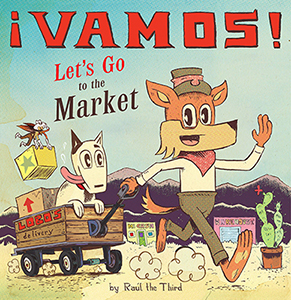 ¡Vamos! Let's Go to the Market
illus. by Raúl Gonzalez III. 40p. HMH/Versify. Apr. 2019. Tr $14.99. ISBN 9781328557261.
K-Gr 2—It is an exciting day for Little Lobo. Today, he is going to the market with his dog, Bernabé. The desert town is vibrant with commerce, street vendors, and an array of animal inhabitants. For Little Lobo there is no stopping; he absolutely enjoys greeting acquaintances, delighting in street performances, and fulfilling his job of delivering supplies at the market. Gonzalez has created a simple narrative that includes Spanish vocabulary, which is playfully positioned surrounding the many streets, food stores, and buildings, encouraging readers to say the Spanish words as they turn the pages. The cartoon images set a festive tone, inspired by El Mercado Cuauhtémoc in Juárez, Mexico, with a soft- toned autumnal palette. The book contains a glossary with the vocabulary words and their respective pronouns.VERDICT This picture book entertains and informs readers through fresh and engaging art, advancing Spanish vocabulary and cultural references. A winner.
Reviewed by Kathia Ibacache, Simi Valley Public Library, CA
An SLJ Best Book of 2019.
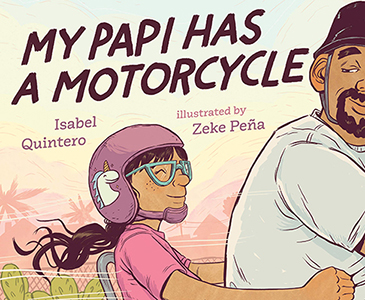 My Papi Has a Motorcycle
illus. by Zeke Peña. 40p. Penguin/Kokila. May 2019. Tr $17.99. ISBN 9780525553410.
K-Gr 2—A radiant ode to a young girl's father and her L.A. neighborhood. Every evening, Daisy and her papi snap on their helmets (hers is purple with a unicorn, his a black vintage variety) and begin their ride on his electric blue motorcycle through Corona, CA. At times they "roar past" taquerias and murals, and other times they "cruise," greeting family and neighbors as they pass by. All the while, Daisy absorbs the sights, sounds, and smells of her beloved hometown, imprinting its idiosyncrasies into memory. Daisy's experiences mirror Quintero's childhood memories, recounted through tender language and vivid sensory details. Recalling the motorcycle rides with her papi is an exercise in familial love, but also a way to honor a hometown and present the changes from gentrification. Although the topic is touched upon lightly, its complexity percolates and becomes much more vivid with multiple reads. The illustrations faithfully capture the merriment and love through careful details and a low-key color palette that alludes to warm memories being made and recollected. Peña makes felicitous use of his comics chops, incorporating speech balloons with Spanish phrases, onomatopoeia, and panels to convey movement. Quintero's writing and Peña's art coalesce most beautifully in the infectious look of joy on Daisy's face throughout.VERDICT A book that radiates sheer happiness without shying from reality. Highly recommended for all libraries.
Reviewed by Jessica Agudelo, New York Public Library
An SLJ Best Book of 2019.
PURA BELPRÉ (AUTHOR) AWARD
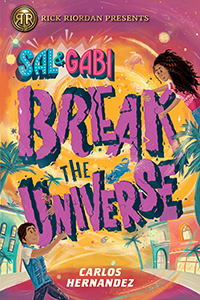 Sal and Gabi Break the Universe
400p. (A Sal and Gabi Novel: Bk. 1). Disney-Hyperion. Mar. 2019. Tr $16.99. ISBN 9781368022828.
Gr 4–8—Sal Vidón is attending a new school, with new bullies and new teachers who don't understand the needs of a student with Type 1 diabetes. He also causes rips in time and space by transporting objects from other universes. Sometimes he transports harmless prank items, but sometimes he goes home to find his long-dead mother cooking yucca in the kitchen. When Sal meets Gabi Reál, student body president and all-around firebrand, they begin a friendship that may break the universe—or save it. Delightfully weird, this is unlike any other book in the middle grade canon. Hernandez has managed to include conflict and excitement into his first novel for young people, without falling into the trap of unrealistic villainy. Every character is doing their best, even when that best doesn't turn out well. Readers need to be comfortable with a suspension of disbelief and accept unexplained backstories. Many elements of the story, like Sal's superpowers and Gabi's family dynamics (including a robot parent,) are left mostly unexplained. Fans who enjoyed Madeleine L'Engle's A Wrinkle in Time and Rick Riordan's works will love Sal and Gabi, as will readers looking for upbeat fiction with Spanish-speaking characters.VERDICT Hernandez offers a rip-roaring and emotionally resonant sci-fi adventure. A must-have for middle school or upper elementary libraries, especially where there are science fiction and fantasy fans.
PURA BELPRÉ (AUTHOR) HONORS
Gr 3–6—Cervantes returns to the Furry Friends Animal Shelter (the setting of Gaby, Lost and Found) in this new title. Ever since she moved to Kansas from Tlaquepaque, Mexico, Lety Muñoz has spent her summers at school with the other ELL students working to improve her English; but after finishing fifth grade, she's trying something new and attending a summer camp at the animal shelter. She's immediately drawn to both Spike, a dog she wants to adopt, and the job of shelter scribe, the person who writes profiles of the adoptable dogs and cats for the shelter's website. But Hunter also wants the job, and thinks he can do a much better job than Lety, since she's still learning English while he is already reading and writing at a high school level. Encouraged by their friends, the two end up in a secret competition to determine who gets to be the sole scribe. Lety is an admirable protagonist; she faces challenges, tries new things, and finds her voice. The focus on language, writing, and vocabulary will make this a good fit for a classroom read, and the premise and setting should entice young animal lovers. This novel is also a potential "mirror" book for young immigrants to the U.S. and ELL students, and one that can be an empathy-building "sliding glass door" book for other readers.VERDICT Compelling and relatable, this is highly recommended for all middle grade collections.
Reviewed by Kacy Helwick, New Orleans Public Library
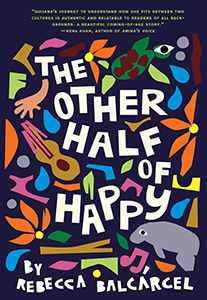 The Other Half of Happy
Chronicle . Aug. 2019. 332p. Tr $16.99. ISBN 9781452169989.
Gr 4-7–American-born 12-year-old Quijana lives in Texas and is the child of a Guatemalan father and a white mother. When Quijana starts sixth grade at a new school, her Spanish teacher mistakenly believes that Quijana is a native speaker. Spanish-speaking classmates call her a “coconut,” their slang term for a Latino person who “acts white.” Luckily, Quijana befriends Jayden and Zuri and quickly develops a crush on Jayden. Outside of school, Quijana struggles with her immediate and extended family. Her paternal family moves to the area, and Quijana’s parents pressure her to engage with her Guatemalan side; they want her to wear a handmade garment called a huipil, which her abuela gives her, and speak Spanish with her on the phone. Inspired by her choir class, Quijana secretly learns to play her father’s guitar, writing her own music instead of playing the Spanish songs he wants to teach her. The family grows concerned about her younger brother Memito, who may have autism, and her maternal grandmother, Grandma Miller, who lives in Florida and has cancer. When Quijana’s parents arrange a family trip to Guatemala over the holiday break, she feels overwhelmed by family expectations and secretly buys a bus ticket to Grandma Miller’s house. At its core, Balcárcel’s novel is a story of identity within one’s self and within a broader community. Quijana wants to embrace the pieces of her Guatemalan identity on her own terms and at her own pace, which gradually brings her closer to her family. Zuri and Jayden also navigate their cultural and sexual identities, respectively. Quijana struggles with being named after Don Quixote, perceiving him, and herself, as people who rarely succeed. The narrative moves at a quick and steady pace, leaving each component of the plot with a satisfying ending and believable loose ends.VERDICT Balcárcel’s well-rounded characters, complex friendships, and nuanced family dynamics will resonate with many readers. This is a title that will remain relevant long past its publication date. A must-have for all library collections
Reviewed by Liz Anderson, DC Public Library
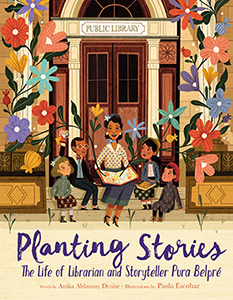 Planting Stories: The Life of Librarian and Storyteller Pura Belpré
illus. by Paola Escobar. 40p. bibliog. filmog. further reading. HarperCollins/Harper. Jan. 2019. Tr $17.99. ISBN 9780062748683.
K-Gr 3—A picture book biography of one of the most significant and inspiring figures in library history. Pura Belpré, the first Puerto Rican librarian in New York City, initially arrived in Manhattan to attend her sister's wedding. Intrigued perhaps by the "hustle and bustle" of this "new island," she decided to stay, finding temporary work as a seamstress. Belpré truly found her calling when she took a position as a bilingual assistant (the text notes that was she was, in fact, trilingual) at a neighborhood library, and went on to transform library services through culturally diverse storytelling, published books, and targeted outreach. Denise sprinkles her lyrical verse with Spanish, and emphasizes Belpré's love of stories, plucking the title of the book from her desire "to be like Johnny Appleseed...plant my story seeds across the land." Escobar's warm illustrations enliven the subject and carry the motif by depicting Belpré in impeccably stylish outfits and accessories detailed with floral patterns. Because of the composition style, readers are given only brief depictions of significant moments in Belpré's personal and professional life, but Denise provides a detailed author's note, summarizing Belpré's lasting impact, and includes a great amount of back matter.VERDICT An appealing tribute and successful remedy to the lack of titles about the groundbreaking librarian. This book pairs nicely with Lucia Gonzalez's The Storyteller's Candle, and is a must-have for all libraries.
Reviewed by Jessica Agudelo, New York Public Library
An SLJ Best Book of 2019.
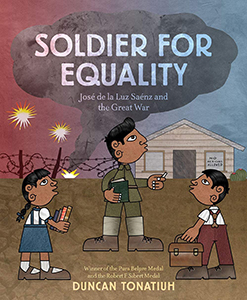 Soldier for Equality: José de la Luz Sáenz and the Great War
by Duncan Tonatiuh (text) & illus. by Duncan Tonatiuh
Abrams . Sept. 2019. 40p. bibliog. chron. glossary. index. Tr $18.99. ISBN 9781419736827.
Gr 1-3–José de la Luz Sáenz knew that many people who had roots in Mexico were hard workers, just like his father, and he did not understand why people were mistreated simply because of their heritage. Luz, who was born in Texas, experienced discrimination firsthand and made it his goal to help others of Mexican descent. After working as a teacher, Luz joined the army to fight in World War I in the hopes that others would realize that Mexican Americans were also willing to sacrifice for the United States. Although Luz faced discrimination, even from some of his fellow soldiers, he made close friends and spent his time studying French, which helped him earn a position in communications receiving, translating, and sending messages. Upon his return to the States, Luz was disappointed to learn that the discrimination faced by Mexican Americans had not changed. Together with other war veterans in Texas, Luz worked to improve the rights of Mexican Americans, ultimately forming the League of United Latin American Citizens (LULAC)—an organization that fought for democracy, justice, and equality. Tonatiuh’s traditional hand-drawn and collage-style illustrations depict Luz and his fellow Mexican Americans’ trials and victories, as well as the tragedies of the war. Clear, descriptive text traces Luz’s life and provides insight into his thoughts, feelings, and determination.VERDICT A culturally and historically important work focusing on an inspirational Mexican American soldier who fought for America during the Great War, as well as for equal rights for his fellow Mexican Americans. An essential purchase for all children’s nonfiction collections.
AMERICAN INDIAN YOUTH LITERATURE PICTURE BOOK AWARD
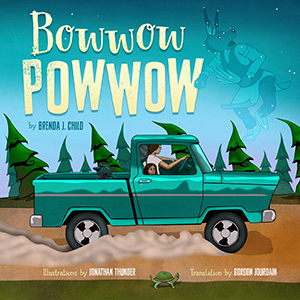 CHILD, Brenda J. Bowwow Powwow. tr. from Ojibwe by Gordon Jourdain. illus. by Jonathan Thunder. 32p. Minnesota Historical Society. May 2018. Tr $16.95. ISBN 9781681340777.
PreS-Gr 2 –Windy Girl tells about finding her dog, Itchy Boy, and the various activities they do with her uncle. She enjoys the stories that Uncle shares as they ice fish or travel to a powwow. One such story is about tribal members going door to door singing, “We are like dogs,” before a powwow. Windy Girl falls alseep and dreams of a dog powwow, with canine elders, veterans, various dancers, and drummers. When she wakes, “Windy Girl understood the powwow is always in motion, part old and part new, glittering and plain, but still wonderful, almost like a dream.” Ojibwe text in italics is shown below the English in italics. Most of the vibrantly colored, energetic illustrations are spreads. The peoples’ faces are simplistic, but expressive. The dogs’ powwow attire highlights the intricacy of the dancers outfits. The end pages are the northern lights. A brief author’s note explains how the customary song and dance were called a “Begging Dance” by anthropologists, when in fact it was an exchange of gifts. VERDICT A simple, but imaginative story celebrating Ojibwe powwow heritage. This is a good first purchase for large libraries, or an additional purchase for smaller ones.–Tamara Saarinen, Pierce County Library, WA
PICTURE BOOK HONORS
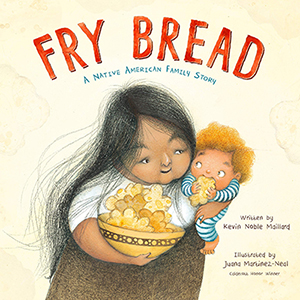 Fry Bread: A Native American Family Story
by Kevin Noble Maillard (text) & illus. by Juana Martinez-Neal
Roaring Brook . Oct. 2019. 48p. Tr $18.99. ISBN 9781626727465.
PreS-Gr 2–Maillard explores the rich and varied cultures of modern Native Americans through the lens of fry bread. Each section opens with “Fry Bread” in red capital letters, followed by a short lyrical verses tying the food to different aspects of Indigenous life. For example, the verse for “Fry Bread Is Time” reads “On weekdays and holidays/Supper or dinner/Powwows and festivals/Moments together/With family and friends.” The verse for “Fry Bread Is History” explains, “The long walk, the stolen land/Strangers in our own world/With unknown food/We made new recipes/From what we had.” Double-page color sketches in muted tones show the diversity of tribal members, with thoughtful details. As elders tell about the Trail of Tears, dark birds turn into sad people in the background. The author, a member of the Seminole Nation, shares his family recipe for fry bread and provides an extensive and thoughtful Author’s Note, providing more information on each topic covered and occasionally calling out special details in the drawings. These notes deal with and dispel many stereotypes associated with Native peoples, while providing historical and contemporary facts.VERDICT This warm and charming book shows and affirms Native lives. The informational text and expressive drawings give it broad appeal, making it a first purchase for all libraries.
Reviewed by Tamara Saarinen, Pierce County Library, WA
An SLJ Best Book of 2019.
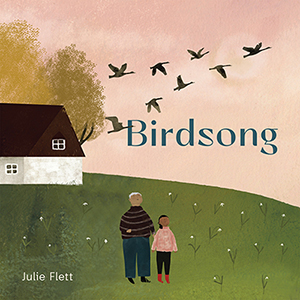 Birdsong
by Julie Flett (text) & illus. by Julie Flett
Greystone Kids . Sept. 2019. 48p. Tr $17.95. ISBN 9781771644730.
K-Gr 2–When a young girl moves to a new home in the country, her initial loneliness is soothed by a new friendship. It’s spring and she is packing up her home in the city by the sea and moving to a new house. Her new home in the country has two trees, snowdrops, creaky stairs, and a older neighbor named Agnes. When summer comes, the girl begins her friendship with Agnes, who shows her the garden and all her clay things, shaped like birds and flowers. She visits Agnes often and they become great friends, and teach each other much as the seasons change. After the winter, Agnes can’t get out as much and the little girl finds a way to bring the outside world to her. The story is made up of short scenes punctuated by chapter headings naming the changing seasons. This format provides a perfect backdrop to the growing friendship between Agnes and the young girl. In the summer, Agnes teaches the child about berries and plants; in the fall, they bury leaves in the soil to prepare it for spring and to feed the worms. The young girl learns about waxing and waning moons from Agnes and in turn she tells Agnes about the Cree seasons. This is a beautiful portrait of an intergenerational friendship where both parties have something to share and learn. Each episode is written in spare and poetic verse, with the small text placed carefully on each beautiful spread. Simple and elegantly composed, the digital illustrations highlight the soft fuzzy texture of the girl’s bird drawings and the hazy, winter air filled with snow. Small details abound, such as the crisp dark lines of the kitchen cabinets in an intimate kitchen scene that become fuzzy behind a cloud of steam rising from the pot of salmon stew. The Cree words used by the characters are given context within the text and a phonetic glossary at the beginning is a helpful tool for readers unfamiliar with the language.VERDICT Simple and profound, this tender story is a reminder that finding a new friend can make a new place feel like home. Highly recommended for purchase.
Reviewed by Laken Hottle, Providence Community Library
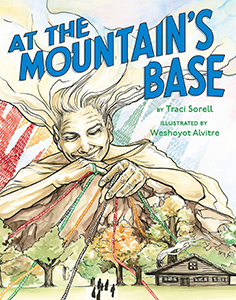 At the Mountain’s Base
by Traci Sorell (text) & illus. by Weshoyot Alvitre
Kokila /Penguin/. Sept. 2019. 32p. Tr $17.99. ISBN 9780735230606.
K-Gr 3–A military family awaits the return of their loved one in this lyrical tribute to modern warrior women. At the mountain’s base, beneath a hickory tree, sits a cabin, and inside, next to a cozy stove, a grandmother weaves and prays, surrounded by family members singing. Within their song, a pilot flies into danger seeking peace, and Sorell’s simple yet poetic text circles back to the family in the cabin, huddled together, “waiting for her return.” Individual color strands woven throughout Alvitre’s watercolor and ink illustrations come together to form a striking tapestry encircling the cabin, linking its inhabitants to the pilot. Generous white space and colorful frames focus attention on the connections between the human figures. An afterword summarizes the achievements of Indigenous women in the armed forces and briefly mentions the career of Ola Mildred Rexroat, an Oglala Lakota pilot and member of the WASPs in World War II.VERDICT Accessible to a wide range of young audiences and military families, this picture book is also a unique and specific recognition of the strength and courage of Indigenous women. A first-purchase for any library.
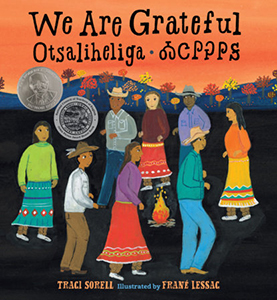 We Are Grateful: Otsaliheliga
by Traci SORELL
illus. by Frané Lessac. 32p. Charlesbridge. Sept. 2018. Tr $17.95. ISBN 9781580897723.
K-Gr 2—Sorell, a citizen of the Cherokee Nation, offers readers a look at contemporary Cherokee life as she follows a family through the seasons of the year as they take part in ceremonies and festivals. The book opens, "Cherokee people say otsaliheliga to express gratitude. It is a reminder to celebrate our blessings and reflect on struggles—daily, throughout the year…." Beginning in the fall (uligohvsdi) with the Cherokee New Year, a variety of rituals and cultural symbols are introduced, all in spare, lyrical, accessible language. Traditional foods, crafts, and songs are part of the engaging narrative, as is the refrain, "we say otsaliheliga." Once through the calendar, Sorell circles back to the Cherokee National Holiday (Labor Day weekend), "when we recall the ancestors' sacrifices to preserve our way of life…. to celebrate nulistanidolv, history, and listen to our tribal leaders speak." Cherokee words are presented both phonetically and written in the Cherokee syllabary. Lessac's lovely gouache folk-art style paintings bring the scenes to life. Back matter includes a description of the various ceremonies, notes, and a page devoted to the Cherokee syllabary.VERDICT This informative and authentic introduction to a thriving ancestral and ceremonial way of life is perfect for holiday and family sharing.
Reviewed by Luann Toth, School Library Journal
AMERICAN INDIAN YOUTH LITERATURE MIDDLE SCHOOL AWARD
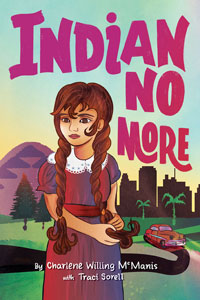 Indian No More
Tu Bks . Sept. 2019. 224p. Tr $18.95. ISBN 9781620148396.
Gr 4-7–Regina Petit and her family are Umpqua, living on the Grand Ronde Tribe’s reservation in Oregon, until the U.S. government enacts a law saying that her tribe no longer exists. Ten-year-old Regina can’t comprehend what is happening to her family and how they can have their Indian heritage taken away from them. Forced to move with her parents, grandmother, and younger sister, PeeWee, to Los Angeles, Regina finds her world turned upside down. Daddy believes that the 1957 Indian Relocation Program will provide their family with a home, schooling, a good job, and opportunities, while Chich (Grandma) is more doubtful, calling their relocation an eviction. Mama tries to keep her chin up for her family, but she just wants to go back home. Regina and PeeWee try to acclimate to their new neighborhood and school but find ignorance and racism toward Indians prevalent. New friends Keith and Addie are a bright spot for the Petit children, but as black children, Keith and Addie also face racism. Daddy tries to put on a brave face for his family, working hard to get ahead, only to discover that education and hard work aren’t necessarily enough. The family’s struggles are not sugarcoated; readers see the reality of Daddy’s despair and anger as Mama tries to hold the family together. In the midst of it all, Chich carries forward their tribal stories. In this book based on McManis’s own childhood experiences, the family is fictionalized to show how older children might react to being uprooted and plopped down in a foreign world—McManis was one year old when the government declassified her family’s tribe. McManis died before finishing the novel, entrusting Sorell to finish her story. A lengthy author’s note from McManis offers relevant history with which readers may be unfamiliar, along with family photos from this time. Also discussed in the note is the relevance of President Ronald Reagan changing the laws in 1983, enabling the restoration of tribes that had been terminated.VERDICT Readers will be moved as they become invested in Regina’s predicament. Is she still Indian, American, or both--and what does that mean for her and her family?
MIDDLE SCHOOL HONORS
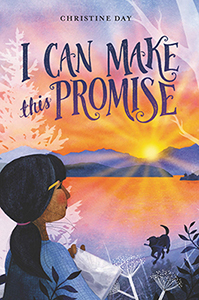 I Can Make This Promise
HarperCollins /Harper. Oct. 2019. 272p. Tr $16.99. ISBN 9780062871992.
Gr 3-7–In this debut novel, a young girl discovers her grandmother’s Hollywood aspirations and her mother’s Suquamish and Duwamish ancestry. Edie knows that her white Dad is American and that her Native American mom was adopted into a white family, but that’s almost all she knows of her heritage. Then, a casual excursion to the attic unearths pictures of Edith, a stranger who resembles Edie, and hard truths her family has kept hidden for years start to emerge. Day (tribally enrolled, Upper Skagit) captures the angst, embarrassment, and uncertainty of many Indigenous people whose parents or grandparents were separated from their communities by adoption or residential school placement. Day details Indigenous culture with skill and nuance and crafts complex relationships between multidimensional characters. The depiction of the painful history of Native peoples who were separated from their families and taken from their ancestral homeland is straightforward and honest. The use of text messages between Edie and her close friends moves the story along and gives the book an intimate feel.VERDICT Readers will be drawn into Edie’s emotions as she copes with overprotective parents and honesty in relationships. Keep an eye out for Day, as her writing is powerful. Highly recommended.
An SLJ Best Book of 2019.
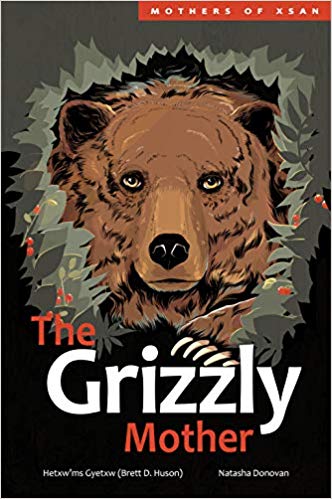 The Grizzly Mother
by Hetxw’ms (Brett D. Huson) Gyetxw (text) & illus. by Natasha Donovan
Highwater Pr . (Mothers of Xsan: Bk. 2). Oct. 2019. 32p. Tr $23. ISBN 9781553797760.
Gr 3-7–A mother grizzly bear awakens and spends three years caring for her cubs near the Gitxsan Territories in northwest British Columbia in this informational picture book. Donovan’s beautifully colored digital illustrations evoke traditional form line art and woodcuts to help tell the story of the bears and their relation to the Gitxsan people. While some vocabulary words are defined in numbered yellow footnotes on the pages on which they appear, there are many words of similar difficulty that are not defined. There is no pronunciation guide for the Gitxsan words used, and while some are defined in the text, not all are. Gyetxw’s text is lyrical and thoughtful and will be engaging to readers who wish to learn more about the grizzly or the Gitxsan people’s relationship with nature. The illustrations are captivating and meticulous two-page spreads—they are carefully laid out with keen attention to detail and inspire a close look.
VERDICT This is a gorgeous book best suited for avid bear fans or collections needing more books about the Gitxsan Nation. Recommended for larger collections.
AMERICAN INDIAN YOUTH LITERATURE YA AWARD
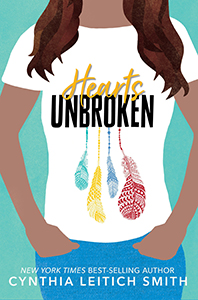 Hearts Unbroken
304p. Candlewick. Oct. 2018. Tr $17.99. ISBN 9780763681142.
Gr 9 Up—An aspiring journalist navigates friendship, first love, and racial politics in this absorbing novel. Louise Wolfe regrets dumping her first real boyfriend via email instead of face-to-face, but his offensive remarks about Native Americans crossed a line for this proud Muscogee (Creek) teen. As senior year begins, she's focused on helping her little brother, Hughie, adjust to high school life, and on earning her desired beat on the school newspaper. Competing against and falling for Joey, a new kid with a passion for photojournalism, is an added bonus. But when Hughie finds himself at the center of a divisive community conflict centered on the casting of the school production of the Wizard of Oz, Louise struggles to balance her responsibilities as a journalist with a desire to protect her family. Louise is an immediately relatable and authentic teenage voice. Bighearted, ambitious, intelligent, she also has plenty of blind spots, particularly where her relationships are concerned. While most of the secondary characters are only lightly sketched, Louise's quirky, loving family dynamic comes through strong. Realistic profanity and age-appropriate sexual situations are depicted.VERDICT Blending teen romance with complex questions of identity, equality, and censorship, this is an excellent choice for most collections.
YA HONORS
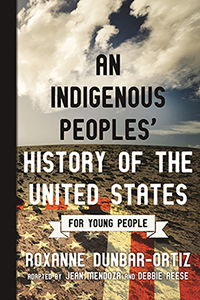 An Indigenous Peoples’ History of the United States for Young People
Beacon . (ReVisioning American History for Young People: Bk. 2). Jul. 2019. 272p. adapted by Debbie Reese & Jean Mendoza. further reading. index. maps. notes. photos. pap. $18.95. ISBN 9780807049396.
Gr 9 Up–This adaptation offers an Indigenous perspective of U.S. history. Beginning with an introduction and moving into the first chapter, which discusses the Indigenous peoples who populated the land and their domestication of corn before Europeans arrived, the narrative follows a chronological track. The adapters’ use of language successfully conveys the complexities of Indigenous societies. Engaging sidebars with headers such as “To Do” or “Did You Know?” provide additional details about the chapter’s topic or suggest critical thinking activities. Proclamations and legislation (Doctrine of Discovery, Proclamation of 1763, and the Morrill Act) that affected Indigenous peoples are contextualized well. Some terms or phrases are defined within a sentence while others are separated out from the text in footnotes. Excerpts from primary sources, by U.S. presidents and other government officials and Indigenous men and women, are interspersed with photographs, paintings, and maps. Each visual is captioned and relevant to the corresponding text. Source notes and a recommended list of fiction and nonfiction titles, picture books, and novels by Indigenous authors are in the back matter.VERDICT Dunbar-Ortiz’s narrative history is clear, and the adapters give readers ample evidence and perspective to help them to engage with the text. A highly informative book for libraries serving high school students.
Reviewed by Hilary Writt, Sullivan University, Lexington, KY
An SLJ Best Book of 2019.
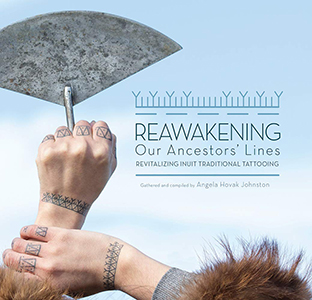 Reawakening Our Ancestors' Lines: Revitalizing Inuit Traditional Tattooing
80p. glossary. photos. Inhabit Media. Apr. 2018. Tr $29.95. ISBN 9781772271690.
Gr 7 Up—Johnston chronicles her mission of learning about and preserving Inuit traditional tattoos and methods of tattooing while also profiling the women, young and old, living in Kugluktuk, Nunavut, who embarked on this journey with her. The volume opens with a moving introduction from Johnston, who details the many motivations behind the Inuit Tattoo Revitalization project, including her desire to have tattoos like those of her ancestors and to continue a tradition that colonizers, missionaries, and residential schools tried to erase. She also discusses the inking methods she adapted based on research and the stories of elders before segueing into the individual profiles of those who participated. In photo journal style, the book contains personal narratives from each woman about her life, her connection to Inuit culture, and the inspiration behind her chosen tattoos, with high-quality images documenting the process and the final results. The large format of the book also makes it perfect for browsing. There are few resources on this subject for this audience, and the prioritizing of Inuit women's voices further cements this as a necessary read.
VERDICT A deeply personal and empowering work that readers will return to again and again. For most YA nonfiction collections.
Reviewed by Meaghan Nichols, ASI Heritage, Ont.
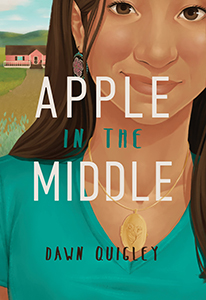 Apple in the Middle
264p. North Dakota State University. Aug. 2018. Tr $25.95. ISBN 9781946163073.
Gr 6 Up—This coming-of-age debut tackles what it means to belong. Apple is quirky, blurts things out to classmates, pretends to be a foreign exchange student, and feels responsible for her mother's death. She is Native, living with her nonindigenous family. Her dad and stepmom decide to send her to Turtle Mountain Chippewa Reservation to stay with her grandparents, strangers to her, over the summer. Apple's cousin Junior becomes her protector, and her cousin Nezzie, her first best friend. Apple is threatened by Karl, a man who knew her mother growing up and does not think she is "Indian" enough. The prologue sets readers up for a scene in which Karl's son chases her into an open grave, where she finally realizes that her mother has been with her all along. An accident at the end of the book challenges the protagonist to figure out her own misgivings and how she can bridge both worlds. Quigley shares the dynamics of reservation life—phrases, puckered lips to point, and extended families with aunties and cousins—with authenticity and warmth. The author drops nuggets of Native history and challenges readers to learn more.VERDICT A strong story with themes that resonate with many adolescents as they try to figure out who they are in life. Highly recommended.
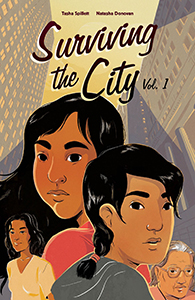 Surviving the City
illus. by Natasha Donovan. 56p. Highwater Pr. Mar. 2019. pap. $18.95. ISBN 9781553797562.
Gr 7 Up—A poignant look at the lives of two best friends, Miikwan and Dez. Miikwan is Anishinaabe; Dez is Inninew. Being Indigenous, they belong to one of the most marginalized populations in Canada, and every day they face the risk of experiencing violence, going missing, or even being murdered. Miikwan's mother is already missing, and Dez is worried about where she will live now that her grandmother has become too ill to be her guardian. Despite all their hardships, the teens endeavor to honor their cultures and navigate an unsafe urban environment. The main characters in this graphic novel are so expressive and authentic, it's impossible not to care for them. The earth-tone palette is appealing, and the backgrounds are dynamic—vivid yet subtle, with real-world places depicted and actual posters for books and albums on indoor walls. There are often spirits present, portrayed in transparent blues for the Indigenous ancestors, who always offer warmth and support, or stark grays and blacks for the alien spirits who identify the predators. The action moves through panels in a multitude of sizes, which advances the action smoothly and enhances the tension of the story line. Factual information is included at the end of the book, along with selected bibliographies for anyone interested in statistics and further reading.VERDICT An important title with first-rate storytelling and beautiful use of color and design. Pair with David A. Robertson's Will I See?? for timely accounts of the systemic violence impacting Indigenous women, girls, and two-spirit people and their families and communities.–Kelley Gile, Cheshire Public Library, CT
Reviewed by Kelley Gile
STONEWALL BOOK AWARD
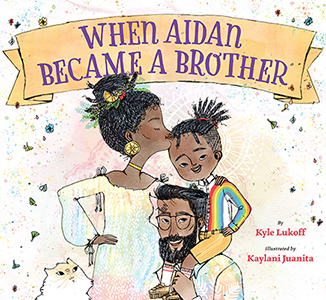 When Aidan Became a Brother
by Kyle Lukoff (text) & illus. by Kaylani Juanita
Lee & Low . May 2019. 32p. Tr $18.95. ISBN 9781620148372.
PreS-Gr 2–This well-illustrated and sweet family tale centers on the experiences of a transgender boy. Like Erica Silverman’s Jack (not Jackie), this title portrays parental support and love between siblings. In this story, Aidan has not yet met the baby who will be his sibling, and that’s what has him worried. Will the baby like sea horse or penguin-themed outfits better? If Aidan helps paint the nursery to look like the sky, maybe his new sibling won’t ever feel trapped the way Aidan did in his old room, before his parents knew he was a boy. Aidan does everything he can to prepare (short of accepting his dad’s offer to practice changing diapers), but his excitement shifts to anxiety. What if he’s making mistakes and the baby also ends up feeling misunderstood? Lukoff (himself a transgender man) nails the nuances of Aidan’s conflict, providing believable reassurance through Aidan’s mom, who offers support specific to her son’s experience and proves universally calming advice: “We made some mistakes but you helped us fix them....This baby is lucky to have you and so are we.” Juanita’s playful watercolors make great use of clothing patterns and nature motifs, airily fashioning the sunny world of Aidan’s mostly brown-skinned family and their friends, while framing curious or intrusive strangers from a child’s-eye view.VERDICT A much-needed and appealing addition to the picture book canon; both emotionally and visually satisfying.
Reviewed by Miriam DesHarnais, Towson University, MD
An SLJ Best Book of 2019.
STONEWALL HONORS
Gr 7 Up–The only world Jam has ever known is that of Lucille, a town where the angels have ostensibly banished the monsters and dismantled the structures that allowed monsters and monstrous deeds to pervade. Lucille is a post-prison, post–school shooting, post–police brutality society. A society where someone like Jam, a selectively mute transgender teen, can live with complete acceptance, support, and love. Still, she can feel the hard truths of the world, can sense them in the air, hear them in words unsaid. When Jam steals into her mother Bitter’s painting studio and unleashes Pet, a winged, horned, eyeless creature and monster hunter, from one of the paintings and into their world, life as she’s known it begins to dissolve. Jam must confront the harsh realities of her world as she tentatively partners with Pet and ventures forward to avenge a wrong not yet discovered. This is a heart-stirring atmospheric page-turner, a terrific and terrible yet quiet adventure. Emezi spins a tale that defies categorization as strikingly as their characters, forcing readers to deeply rethink assumptions about identity, family structure, and justice.VERDICT A riveting and important read that couldn’t be more well timed to our society’s struggles with its own monsters
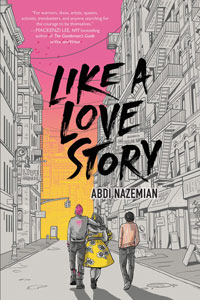 Like a Love Story
Balzer + Bray /HarperCollins/. Jun. 2019. 432p. Tr $17.99. ISBN 9780062839367.
Gr 9 Up–A story of three teens who come together in New York City during the AIDS crisis in 1989–90. Reza is an Iranian immigrant who is trying to come to terms with being gay at a time when all that seems to promise is disease and death. Judy is a blossoming fashion designer with her eyes set on first love as she begins dating Reza. Art is Judy’s out, proud, and dramatic best friend, who also shares feelings for Reza. Guided by Judy’s uncle Stephen, whose health is failing from the disease, the three become involved in the ACT UP movement, which stages protests in support of better treatment for those diagnosed with AIDS. Eventually, Reza admits his feelings for Art and the two begin dating, causing a rift between them and Judy. Reza’s fear of being physically intimate with Art is a major factor in their relationship, but there is some sexual content. Despite the heavy topic, the novel also brings joy as it celebrates gay culture and a shared love of Madonna. Well-developed split narration among the three friends demonstrates their equal importance to the story, and Uncle Stephen is just as fully explored. The urban setting is richly realized and integral to the story. In this highly emotional work, the teens’ feelings are fully expressed and appropriate to their experiences.
VERDICT Give to fans of alternative historical fiction or LGBTQ+ romance.
Reviewed by Alex Graves, Manchester City Library, NH
Gr 3-7–When rising seventh grader Rahul Kapoor panics about fitting in at middle school, his grandfather tells him to find something he’s really good at and be the best at it. But Rahul finds that difficult. Could he be the best at football? At acting? At math? Adding to Rahul’s anxiety, his macho Indian uncles keep suggesting that he might be gay, and neighborhood bully Brent taunts him about it, too. Rahul’s struggles will resonate with many kids. He works hard to come to terms with liking boys while having anxiety about being good at things, being well liked, and being Indian American in a small, predominantly white town. Rahul is a compelling protagonist, and his challenges ring true. Sometimes Pancholy talks around topics: though the book ends with Rahul coming out to his friends and family, his being gay was only previously mentioned in vague terms, primarily as an insult from Brent. Similarly, though Rahul exhibits some signs of obsessive-compulsive disorder and anxiety, they are only briefly addressed near the end, when Rahul’s dad decides to take him to a therapist. While the writing is always engaging, it is at times challenging to hold on to the many narrative threads.
VERDICT Hand this to middle grade readers who are navigating changing social dynamics as they come of age.
ASIAN PACIFIC AMERICAN AWARD FOR LITERATURE—PICTURE BOOK
 Queen of Physics: How Wu Chien Shiung Helped Unlock the Secrets of the Atom
by Teresa Robeson (text) & illus. by Rebecca Huang
Sterling . Oct. 2019. 48p. bibliog. further reading. glossary. Tr $16.95. ISBN 9781454932208.
K-Gr 2–This biographic picture book chronicles the life of Wu Chien Shiung, with a focus on her career success in physics, as well as obstacles she overcame as an Asian woman, her political advocacy, and her contributions to science. The book also contains a lot of history specific to the last turn of the 20th century. Huang’s pictures are in full color. On each page, the text amounts to less than a quarter of the page. The vocabulary and text concepts are advanced for a picture book, but key terms can be found in the glossary. The book’s format seems best suited for second to third grade readers.
VERDICT This book would make an excellent supplement to support diverse representation, especially about women scientists and/or Asian women battling and overcoming sexism and racism. However, the difficulty of the language and the grade level of the text make it a bit out of reach for the average picture book reader.
PICTURE BOOK HONOR
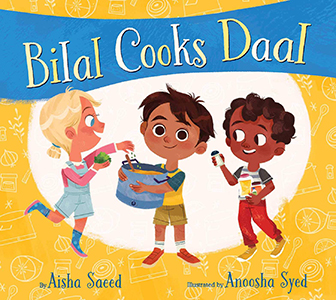 Bilal Cooks Daal
by Aisha Saeed (text) & illus. by Anoosha Syed
Salaam Reads . Jun. 2019. 40p. Tr $17.99. ISBN 9781534418103.
PreS-Gr 1–Bilal is excited to introduce his favorite food, daal (South Asian lentils), to his friends. As the story unfolds, it maintains a flow of events that keeps readers in step with the time it takes to cook the dish. The anticipation builds throughout the story and keeps the interest focused on the result. The author uses food as a way to create common ground and bridge cultures. The illustrations are charming and the facial expressions of the children are endearing. The relationship between the dad who enlists his son for assistance in preparing the dish is beautifully captured. The book also shows that the deepest flavors come with ingredients that simmer gently; this teaches patience to youngsters. The story can prompt discussions about friendship, expanding one's palate, measurements, and spices. A fun introduction to cross-cultural sharing but any South Asian cook will testify that it takes no more than two hours to produce the perfect daal, not four to five hours as stated.
VERDICT A warm and inviting story, perfect for sharing before or after enjoying some home-cooked daal.
Reviewed by Noureen Qadir-Jafar, Syosset Library, NY
ASIAN PACIFIC AMERICAN AWARD FOR LITERATURE—CHILDREN'S
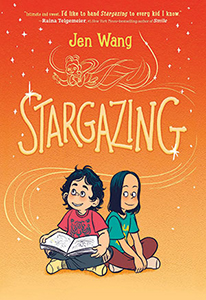 Stargazing
by Jen Wang (text) & illus. by Jen Wang
First Second . Sept. 2019. 224p. Tr $21.99. ISBN 9781250183873; pap. $12.99. ISBN 9781250183880.
Gr 3-6–With her surreal drawings, her penchant for bright nail polish, her lax study habits, and her inability to speak Chinese, Moon Li is nothing like the other kids in her Chinese American community. And she couldn’t be more different from perfectionist Christine Hong. But when Christine’s parents rent a property to Moon and her mother, who are having trouble making ends meet, it’s the beginning of a beautiful friendship. Free-spirited Moon fascinates Christine. However, when Moon tells Christine that she has visions of celestial beings who will one day take her with them to the skies, where she’ll finally fit in, Christine realizes that her new pal’s confidence masks pain. And when Moon starts to connect with other classmates, Christine’s own insecurities threaten their bond. Relying on a muted palette and careful linework, Eisner Award nominee Wang has crafted an understated, poignant tale of the joy and turmoil of budding friendship. She artfully laces her narrative with questions about identity as Christine and Moon quietly wonder about what it means to belong to a community. Though Wang doesn’t provide pat answers, her characters do manage to carve out a place for themselves.VERDICT With this spot-on glimpse into the emotional landscape of tweens, Wang joins the ranks of middle grade masters Shannon Hale, Raina Telgemeier, and Cece Bell
Reviewed by Mahnaz Dar, School Library Journal
An SLJ Best Book of 2019.
CHECK OUT: Jen Wang Draws from Reality
CHILDREN'S HONOR
Gr 5–7—When Ok's beloved father dies in a construction accident, his mother works several jobs but can't make ends meet. Determined to help pay their bills, Ok writes a business plan for a braiding business. He doesn't make much at first, but he gets the attention of lots of girls, including the retro-fashion obsessed Mickey McDonald. Ok thinks things are under control until the suspiciously nice Deacon Kohl from the First Korean Full Gospel Church begins courting his mom. Ok becomes convinced that no one needs him anymore and he hatches a plan to run away. Ultimately, Ok learns he's not alone, friendless, or unwanted. Things might not go the way he wants them to, but he's going to be fine. Ok's hilarious observations shine in this realistic fiction title about conformity, individuality, and loving people for who they are, not who you want them to be. The Korean American characters stand out as the most nuanced and compelling throughout. The culturally authentic details Ok shares in his first-person narration bring his relationship with his parents into sharp focus. Unfortunately, Ok's friends Mickey and Asa speak in pronounced dialects, perhaps to indicate their belonging to uneducated families. Consequently, their dialogue seems exaggerated and their character development suffers. Although the plot has a few logistical holes and the character development is uneven, Ok's sincerity will hook many young readers.
VERDICT The compelling, funny protagonist makes this a solid general purchase for school and public libraries.
Reviewed by Amy Seto Forrester, Denver Public Library
ASIAN PACIFIC AMERICAN AWARD FOR LITERATURE—YA
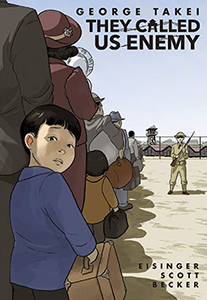 They Called Us Enemy
by Takei, George, Justin Eisinger & Steven Scott (text) & illus. by Harmony Becker
Top Shelf Productions . Jul. 2019. 208p. pap. $19.99. ISBN 9781603094504.
Gr 7 Up–In the wake of the 1941 attack on Pearl Harbor, 120,000 Japanese Americans were rounded up, incarcerated in camps, and stripped of freedoms in the name of national security. Among them was future television star and political activist Takei, who as a child was imprisoned along with his family by the U.S. government. Takei, joined by writers Eisinger and Scott, tells a powerful, somewhat nonlinear story spanning 80 years of U.S. history, starting right after Executive Order 9066 was enacted in 1942. The Takeis quickly lost everything they couldn’t carry with them and were treated as criminals, but they persevered and eventually made it out of the camps. As the narrative draws to a close, the writing team strategically refers to the imprisonment of children at the U.S. southern border, the Supreme Court ruling Trump v. Hawaii (which upheld the “Muslim travel ban”), and President Barack Obama’s inaugural address, calling upon readers to ensure that history does not repeat itself. Becker’s grayscale art makes heavy use of patterned hatching to add focused textural intrigue but also casts the individuals in a shadow that reflects what became of their lives. Japanese, used minimally throughout the text, is presented in italics, with translations denoted by an asterisk, though there is at least one occurrence of untranslated Japanese. There is infrequent cursing and violence.VERDICT This evocative memoir shares stories of the nation’s past, draws heartbreaking parallels to the present, and serves as a cautionary tale for the future. For all readers old enough to understand the importance of our collective history.
Reviewed by Alea Perez, Elmhurst Public Library, IL
CHECK OUT: “We Are Better Than This” | SLJ Talks to George Takei
YOUNG ADULT HONOR
Gr 9 Up–Identity, family, secrets, sacrifice, first love, and transitions all come together in Yoon’s sparkling debut. Frank Li is one of the “Limbos,” a group of second-generation Korean-American children who are forced to hang out once a month when their parents organize dinners that are part support group, part competition. The Limbos are caught between two worlds, a sense Frank keenly feels as he begins dating his first girlfriend, who is white. After his sister is disowned for marrying a Black man, Frank decides to enter a fake relationship with Joy, another Limbo, so that they can both date the people they want without parental involvement. Frank’s romantic relationships change along with his relationship with his family, as he grapples with hard family news. This is an outstanding novel where the emotions are deeply felt but honestly earned. The characters are complex and nuanced, and all are on their own authentic journeys. The highlight of the book is Frank’s voice—he is a sharp observer who is funny, insecure, and deeply conflicted. Yoon’s writing is filled with highly specific descriptions that make Frank’s world feel fully realized, from the fruit-named phone chargers sold at his parents’ store, to his group of unique and nerdy friends, dubbed the “Apeys” for their Advanced Placement course load. This will be a hit with teens who like introspective realistic fiction, romance, and humor.VERDICT Full of keen observations about love, family, and race with a winning narrator, this is a must-purchase (multiple copies!) for any teen-serving library
WILLIAM C. MORRIS AWARD
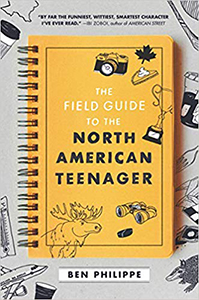 The Field Guide to the North American Teenager
by Ben PHILIPPE
384p. HarperCollins/Balzer + Bray. Nov. 2018. Tr $18.99. ISBN 9780062824110. POP
Gr 7 Up–Seventeen-year-old Norris Kaplan has just had his world turned upside-down. When his mother has to relocate to find work in her field, Norris finds his identity as a Black, French-Canadian hockey fan challenged by his new existence in the suburbs of Austin, Texas. While on the surface this is a classic fish-out-of-water tale, there are many more layers to the story. Lots of different elements of identity are brought to bear in Norris's narration: his Haitian/immigrant heritage, racial identity, and viewpoint on American high school stereotypes. The protagonist's smart and funny demeanor will engage readers, even when he makes obviously bad decisions. Norris is particularly adept at letting his assumptions about his peers impact his ability to relate to them as individuals, either as friends or romantically. The authorial decision to have the "outsider" be the character influenced by stereotypes rather than the opposite makes for a very compelling reversal that ultimately works. The unresolved ending allows teens to revel in the messiness of high school social blunders and see the value in doing the hard work of making amends.VERDICT A witty debut with whip-smart dialogue that will find much love among fans of authors like John Green and Jason Reynolds.
WILLIAM C. MORRIS FINALISTS
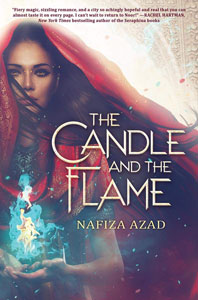 The Candle and the Flame
by Nafiza AZAD
416p. glossary. Scholastic. May 2019. Tr $18.99. ISBN 9781338306040.
Gr 7 Up—Eighteen-year-old Fatima is a human who carries the fire of the djinn within her. She's a devout Muslim raised by her adopted Hindu family in Noor, a city along the Silk Road, when her parents and all but two other of the city's inhabitants are slain in a massacre by the Shayateen, a class of djinn who thrive on chaos and destruction. Noor emerges from the ashes to become a vibrant multicultural city where Muslims, Hindus, and others live together in a brokered peace maintained by human rule and the protection of the Ifrit Djinn, who value order and reason. There are signs, however, that this peace is under serious threat. When Fatima's presence at the violent death of Firdaus, a powerful Ifrit, transforms her into Fatima Ghazala, she is changed in ways that upend her identity, threaten her relationships, and thrust her into the center of the city's ruling class. Under the protection of the Ifrit's leader, Zulfikar, Fatima finds herself grappling with feelings she's never had before. In this sophisticated debut novel, Azad combines Islamic concepts and Middle Eastern mythology with a variety of other traditions to create a magical treatise on identity, community, friendship, and love. Readers will identify with female characters who struggle against limiting societal expectations. The themes of trauma and grief are treated with care. Azad's vivid depiction of the details of Noor's sights and sounds make the city come alive. Back matter includes a glossary of terms. Readers may also enjoy the forthcoming title We Hunt the Flame by Hafsah Faizal.
VERDICT A moving commentary on gender roles, identity, love, and loss, and a first purchase for school and public libraries.
Reviewed by Mahasin A. Aleem, Oakland Public Library, CA
Gr 9 Up–Identity, family, secrets, sacrifice, first love, and transitions all come together in Yoon’s sparkling debut. Frank Li is one of the “Limbos,” a group of second-generation Korean-American children who are forced to hang out once a month when their parents organize dinners that are part support group, part competition. The Limbos are caught between two worlds, a sense Frank keenly feels as he begins dating his first girlfriend, who is white. After his sister is disowned for marrying a Black man, Frank decides to enter a fake relationship with Joy, another Limbo, so that they can both date the people they want without parental involvement. Frank’s romantic relationships change along with his relationship with his family, as he grapples with hard family news. This is an outstanding novel where the emotions are deeply felt but honestly earned. The characters are complex and nuanced, and all are on their own authentic journeys. The highlight of the book is Frank’s voice—he is a sharp observer who is funny, insecure, and deeply conflicted. Yoon’s writing is filled with highly specific descriptions that make Frank’s world feel fully realized, from the fruit-named phone chargers sold at his parents’ store, to his group of unique and nerdy friends, dubbed the “Apeys” for their Advanced Placement course load. This will be a hit with teens who like introspective realistic fiction, romance, and humor.VERDICT Full of keen observations about love, family, and race with a winning narrator, this is a must-purchase (multiple copies!) for any teen-serving library
Genesis Begins Again
384p. Atheneum/Caitlyn Dlouhy Bks. Jan. 2019. Tr $17.99. ISBN 9781481465809.
Gr 5–8—Genesis comes home from school to find her family's belongings on the lawn; they've been evicted again. Her father promises that this next time will be different, renting a house in the suburbs and promising that he will get a promotion at work so they can afford it. At school, Genesis makes friends for the first time and is mentored by Mrs. Hill, the choir teacher, but Genesis's father still drinks too much and her parents' marriage is unraveling. Genesis tries lightening her skin, begs to be able to use relaxer in her hair, and keeps a list of things she hates about herself, believing that if she only looked like her light-skinned mother and not her dark-skinned father, the situation at home would improve. This message is hammered home by her father's cruel comments and her grandmother's story of the "brown paper bag" test. Genesis escapes by singing; she is inspired by greats like Billie Holiday and Etta James. When she has the opportunity to sing in the school talent show, Genesis must find the power in using her voice to speak her truth. Genesis' struggles are age appropriate but do not shy away from the hard truth about colorism within the Afro American community. Through each character, readers come to understand the significance of how one's story plays out in reactions and interactions with the people around them. The hopeful but not happy ending adds to the realism and emotional impact of this powerful story.VERDICT This is a sensitive and nuanced portrayal of a girl grappling with hard truths about her family and her own feelings of self-worth. A must for all collections.
An SLJ Best Book of 2019.
CHECK OUT: Alicia D. Williams on Genesis Begins Again
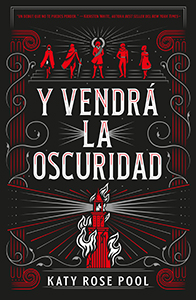 There Will Come a Darkness
Holt . (The Age of Darkness: Bk. 1). Sept. 2019. 496p. Tr $19.99. ISBN 9781250211750.
Gr 9 Up–Multiple viewpoints share the narrative in debut author Pool’s imagined world, constructed with hints of Greek and Middle Eastern influences. (For example, places named Pallas Athos, Herat, “the agora,” and Nazirah; meals of lamb stew and pomegranate; characters named Hassan and Ephyra). In this world, the Graced have heightened powers, which make them targets for jealous attacks each time they manifest their enhanced strength, senses, energy, and more. Working-class Anton (with his talent at gambling); prince-in-disguise Hassan; good-hearted Khepri; sisters Ephyra and Beru; and Jude, the Last Prophet and Keeper of the Word, twist in and out of one another’s orbits, caught up in their uncertain times. For the last 100 years, the Age of Darkness has been foretold, and now it looks like these older teens hold the keys to both destruction and salvation. First in a planned trilogy, the book sets the stage rather than concludes the story. The shifting narratives require attention, but there is ample payoff.
VERDICT Teens looking for epic fantasy can immerse themselves in Pool’s world, where the Witnesses have developed deadly Godfire, the Pale Hand is stalking, and the Age of Darkness appears just over the horizon.
THEODOR SEUSS GEISEL AWARD
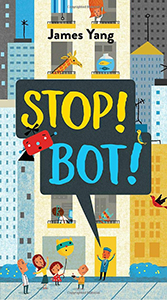 Stop! Bot!
by James Yang (text) & illus. by James Yang
Viking . Jul. 2019. 40p. Tr $17.99. ISBN 9780425288818.
PreS-Gr 1–In this book, a boy is enjoying flying his robot outside. He suddenly loses track of the flying bot and desperately wants to get it back. The residents of a building attempt to help him get his robot back as it sails higher and higher alongside the building. Each neighbor uses a unique method to try and stop the bot. These include a trombone, a brush, and silverware among others. These varying methodologies embody the diversity of the hobbies and identities of the people living in the building. The childlike nature of the book’s illustrations make them visually inviting for young children. Geometric shapes are used to illustrate the buildings and windows, and bright pastel colors are blended with vibrant primary colors to create a soft and pleasant look.
VERDICT Yang depicts a group of people from different backgrounds working together to complete a task in this eye catching text; a solid title on teamwork and unity.–
Reviewed by Deanna Smith, Pender County Public Library, NC
THEODOR SEUSS GEISEL HONORS
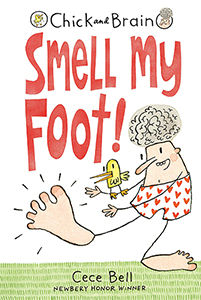 Smell My Foot!
by Cece Bell (text) & illus. by Cece Bell
Candlewick . (Chick and Brain: Bk. 1). Sept. 2019. 72p. Tr $12.99. ISBN 9780763679361.
K-Gr 2–Bell (El Deafo; I Yam a Donkey!; “Rabbit & Robot”) returns with another story about grammar, miscommunication, and odd couple friends. In this graphic novel send-up of the “Dick and Jane” primers, Brain, clad only in heart-patterned boxers and sporting either an external brain or a gray hairdo that resembles one, is trying to convince a politeness-obsessed chick to smell his foot. Chick criticizes Brain’s phrasing (“I will not smell your foot until you say PLEASE”) and intelligence (“Brain, you look very smart...But you are not very smart”). This focus on manners at the expense of kindness almost causes Chick to miss out on what turns out to be Brain’s truly alluring foot odor. When Spot the dog wanders by, sniffs Chick’s foot, and invites the oblivious bird to lunch (as the intended main course), Brain comes to Chick’s rescue by knocking Spot out with the aroma from his (apparently stinky) other foot. New readers may be thrown by the beats of Chick and Brain’s dialogue, since the humor relies on unexpected responses (as in the opening exchange: “HELLO, BRAIN.” “Yeah, I know. I am Brain.”) and discussion of conversational norms. However, the short length and engagingly goofy art—reminiscent of James Proimos’s “Johnny Mutton” series—will be a draw for kids who love quirky characters and the amusing premise.
VERDICT Although not as successful as Bell’s best work, and potentially confusing for some new readers, this hilariously wacky tale will resonate with many children
Reviewed by Miriam DesHarnais, Towson University, MD
ROBERT F. SIBERT INFORMATIONAL BOOK AWARD
Fry Bread: A Native American Family Story
by Kevin Noble Maillard (text) & illus. by Juana Martinez-Neal
Roaring Brook . Oct. 2019. 48p. Tr $18.99. ISBN 9781626727465.
PreS-Gr 2–Maillard explores the rich and varied cultures of modern Native Americans through the lens of fry bread. Each section opens with “Fry Bread” in red capital letters, followed by a short lyrical verses tying the food to different aspects of Indigenous life. For example, the verse for “Fry Bread Is Time” reads “On weekdays and holidays/Supper or dinner/Powwows and festivals/Moments together/With family and friends.” The verse for “Fry Bread Is History” explains, “The long walk, the stolen land/Strangers in our own world/With unknown food/We made new recipes/From what we had.” Double-page color sketches in muted tones show the diversity of tribal members, with thoughtful details. As elders tell about the Trail of Tears, dark birds turn into sad people in the background. The author, a member of the Seminole Nation, shares his family recipe for fry bread and provides an extensive and thoughtful Author’s Note, providing more information on each topic covered and occasionally calling out special details in the drawings. These notes deal with and dispel many stereotypes associated with Native peoples, while providing historical and contemporary facts.VERDICT This warm and charming book shows and affirms Native lives. The informational text and expressive drawings give it broad appeal, making it a first purchase for all libraries.
Reviewed by Tamara Saarinen, Pierce County Library, WA
ROBERT F. SIBERT INFORMATIONAL HONORS
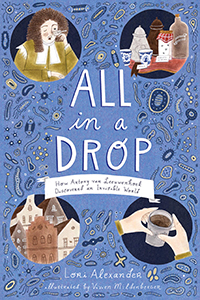 All in a Drop: How Antony van Leeuwenhoek Discovered an Invisible World
by Lori Alexander (text) & illus. by Vivien Mildenberger
HMH . Aug. 2019. 96p. bibliog. chron. glossary. index. notes. Tr $17.99. ISBN 9781328884206.
Gr 2-5–In this current era of the electron microscope, it is difficult to imagine when the microscopic world was not only unknown but unimagined. With no university education or formal training in the sciences, 36-year-old Antony van Leeuwenhoek (1632–1723) was exposed to English scientist Robert Hooke’s investigations during a London vacation. Galvanized by this blossoming curiosity, he taught himself to grind superior lenses in order to closely examine the hidden world of various objects. He then diffidently shared his findings with the Royal Society and despite initial skepticism was ultimately elected a Fellow. Alexander’s clear text, accompanied by simple black-and-white illustrations, outlines topics such as bubonic plague, scientific nomenclature, the perils of E. coli and giardia, and the physics of microscope lenses. All is rounded off by an extensive author’s note, a time line from van Leeuwenhoek’s birth to the development of the electron microscope, a glossary, source notes, and a bibliography.
VERDICT This pleasantly readable biography of Antony van Leeuwenhoek illuminates the unexpected journey of a Dutch draper from anonymity to becoming the “Father of Microbiology.” Readable, informative, and a celebration of dedicated curiosity
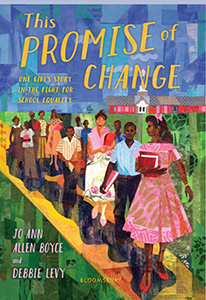 This Promise of Change: One Girl's Story in the Fight for School Equality
by Debbie Levy
BOYCE, Jo Ann Allen & . 320p. bibliog. chron. notes. photos. Bloomsbury. Jan. 2019. Tr $17.99. ISBN 9781681198521.
Gr 4–8—This evocatively told, carefully researched memoir-in-verse is the story of a group of 12 teenagers from Clinton, TN, who, in 1956, were among the first black students to pave the way for school integration. Free verse and formal poetry, along with newspaper headlines, snippets of legislation, and other primary sources about national and local history are mixed with Boyce's first-person narrative. The book opens with an overview of life in segregated Clinton and the national events leading up to the desegregation of Clinton High. The rest of the work follows the four months in the fall of 1956 when Boyce and the other 11 teens attended Clinton High. They faced angry white mobs outside the school, constant harassment from white classmates, and a hostile principal who viewed integration as a legal choice rather than a moral one. The book includes an introduction and epilogue, authors' notes, brief biographies of the involved students, photographs, a time line, and a bibliography. The writing invites readers to cheer on Boyce for her optimism and her stubbornness in the face of racism, without singling her out as a solitary hero. This story adeptly shows readers that, like the Clinton Twelve, they too can be part of something greater than themselves.
VERDICT A must-buy for tweens and teens, especially where novels-in-verse are popular.—Erica Ruscio, formerly at Rockport Public Library, MA
Reviewed by Jenna Friebel
Ordinary Hazards: A Memoir
by Nikki Grimes
Wordsong . Oct. 2019. 336p. photos. Tr $19.99. ISBN 9781629798813.
Gr 7 Up–Grimes offers young adult readers the special treat of literary ingenuity in her new memoir. “Time to grab my flashlight / and step into the tunnel,” Grimes writes in an early poem—making reference to her task with this new work. In long poems, short poems, and the occasional prose poem, Grimes guides us through her past tragedies and triumphs while keenly observed moments build her inner world. Readers spend time with three different points of view: child Grimes, adolescent Grimes, and burgeoning adult Grimes. Though the circumstances and characters change as she moves and grows, her voice is consistently spare and warm. The poems about experiencing neglect as a five-year-old carry the same powerful simplicity as those written about high school. A memoir that doesn’t demand a time line, this work is a personal history in poems that you can read backward and forward.
VERDICT This nontraditional memoir from a long-working and highly acclaimed author will speak deeply to young readers harboring their own interest in writing or otherwise squeezing art out of life’s spiky fruit.
CHECK OUT: Nikki Grimes Explains Why Mental Illness Is Not A Weakness
 Hey, Water!
Hey, Water! illus. by Antoinette Portis. 48p. Holiday House/Neal Porter Bks. Mar. 2019. Tr $17.99. ISBN 9780823441556. POP
PreS-Gr 2–This simple introduction to water is an ideal read-aloud for the youngest scientists. Bold, beautiful, and equally simple illustrations are rendered with brush, sumi ink, and digital color. In addition to the brief running narrative, each page or spread features a word that refers to a different form of water ("tear") and descriptive text ("sometimes you slide down my cheek without a sound"). The book makes for a fun guessing game—children will enjoy figuring out, for instance, that "I stomp in you and scatter droplets everywhere" refers to a puddle. The book explores ways water can be found in homes, yards, and neighborhoods (in faucets, hoses, sprinklers) but also describes streams, rivers, oceans, dewdrops, clouds, fog, and icebergs. The final page shows a girl in the bath and her toy whale spouting sprays of water. Appended are accessible explanations about water forms, the water cycle, and conservation. The endpapers sport thick brushstroke waves in grays and blues.VERDICT Both school and public libraries will want this striking first science book on their shelves.
Reviewed by Barbara Auerbach, Cairo Public Library, NY
MILDRED L. BATCHELDER HONORS
 When Spring Comes to the DMZ
by Uk-Bae Lee
tr. from Korean. illus. by Uk-Bae Lee. 40p. Plough. Mar. 2019. Tr $17.95. ISBN 9780874869729.
Gr 1–3—Illustrations inspired by traditional Korean painting techniques are the star of this picture book in translation. Lyrical text, reminiscent of free verse, describes the wildlife and weather of Korea's Demilitarized Zone (DMZ) during each season in turn. Readers might think the book is about a nature preserve until they examine the accompanying illustrations, which show barbed wire and floodlights in the background of idyllic scenes of animals native to Korea. Lee describes human activities in the DMZ each season, too, depicting military activities and a grandfather who longs for the unified Korea of his youth. Back matter includes a simplified land map of North and South Korea, along with a description of the DMZ's history that will be easy for young readers to grasp. The descriptions of separated families and war violence in this afterword may be difficult for sensitive readers to process, but Lee's message advocating for a unified, peaceful Korea gives the book an overall hopeful tone.
VERDICT Deftly tackling a topic that will likely be unfamiliar to many readers, this is sure to spark discussion among budding history enthusiasts.
SCHNEIDER FAMILY BOOK AWARDS—YOUNG CHILDREN
 Just Ask!: Be Different, Be Brave, Be You
by Sonia Sotomayor (text) & illus. by Rafael López
Philomel . Sept. 2019. 32p. Tr $17.99. ISBN 9780525514121.
PreS-Gr 2–Supreme Court Justice Sotomayor opens her celebration of diversity with a letter to readers in which she writes about her experience growing up in the 1960s and being diagnosed with juvenile diabetes. She compares communities to a garden in which each plant has a different purpose. Readers are then introduced to a diverse group of children who create a beautiful garden. Each child tells a bit about themselves and then asks a question that is answered by the following character. On the final spread, readers are shown the beautiful garden now completed and filled with all the children from the story. This is a hopeful and sunny exploration of the many things that make us unique. The clever question-and-answer structure and conversational tone encourages readers to answer the questions themselves, while the informative text gives caregivers a useful foundation of information to begin a conversation. López’s dynamic and vibrant illustrations emphasize each character’s unique abilities with inventive pairings of natural elements. On one page a young Sotomayor is shown sitting in the center of an enormous red rose with prominent thorns. The text explains that because she is diabetic, she must prick her finger several times a day to measure the sugar in her blood. Vijay, who is Deaf, is shown standing next to a young sapling and signing “tree” in American Sign Language.
VERDICT A thoughtful and empathetic story of inclusion that encourages readers to ask questions and educate themselves about their peers. A first purchase.
Reviewed by Laken Hottle, Providence Community Library, RI
YOUNG CHILDREN'S HONOR
 A Friend For Henry
by Jenn BAILEY
illus. by Mika Song. 36p. Chronicle. Feb. 2019. Tr $16.99. ISBN 9781452167916.
PreS-Gr 1—Henry is looking for a friend who is quiet, shares, and likes to read. Making friends can be difficult for anyone, but it is especially hard for Henry. He misreads social situations, believing that because a classmate has rainbow-painted nails, she would enjoy having her shoes painted. He lines the reading carpet squares up perfectly and melts down when another classmate's rambunctious, imaginative play disrupts the squares. One by one, classmates are ruled out as potential friends—until Katie. Katie is quiet and likes to read, too. However, Katie slides down the big slide, something Henry would never do. Still, the two bond over their love for the class fish, and Henry takes a chance and asks Katie to play with him. They play together both indoors and out, leading Henry to the realization that friends don't have to be exactly alike to appreciate each other. The ink-and-watercolor illustrations show a diverse classroom. Henry is Asian and Katie is African American. It is never stated that Henry has autism, but his actions and thought processes will be familiar to readers who know someone on the autism spectrum.
VERDICT A simple, upbeat story that might inspire readers to seek out friendship, and a good addition to general picture book collections.
SCHNEIDER FAMILY BOOK AWARDS—MIDDLE GRADE
Gr 4–6—Twelve-year-old Iris has a passion for electronics and repairing antique radios. She's a strong student, too, except when she is hampered by the frustrations of being the only Deaf student in her classes. One day, Iris's science class watches a video about a whale named Blue 55, a hybrid blue/fin whale with an extremely unique voice; the sounds he makes are around 55 hertz, unlike most other whales, which communicate at much lower frequencies. Moved by Blue 55's very familiar struggle to communicate, Iris becomes determined to compose a song for Blue 55 at his frequency, and to play it for him in person. This mission involves a journey from her Houston home to Appleton, AK, that, miraculously, her widowed Grandma agrees to secretly arrange. Readers will need to suspend some disbelief in order to buy Iris's adventure as realistic fiction, but the nuances of her personality make her a compelling protagonist. Iris's depth of empathy, the joy she feels working with radios, and the skillful way she navigates two different worlds of communication create an authenticity that will resonate with Deaf and hearing readers alike. The paralyzing effects of grief are also addressed through Grandma. Gradual healing is depicted in a natural, healthy way, as Grandma turns away from isolation and begins using her talents, doing things that make her happy, and spending time with a loved one (Iris).
VERDICT An uplifting tale that's a solid addition to most collections; especially recommended for libraries needing stronger representation of Deaf protagonists, which will be most.
MIDDLE GRADE HONOR
Gr 4-7–There’s a lot going on in Emilia Torres’s life. On the day her mom leaves town for a job interview, her dad gets home from a long deployment and something isn’t quite right with him. Abuela is trying to run her life, Emilia has an unusual type of attention deficit hyperactivity disorder, and, worst of all, a class assignment splits students down the middle and creates a rift between kids who have been friends for years. As difficult as it is for her to focus, can Emilia figure out how to placate her grandmother and help her dad heal while standing up against injustice? Cartaya excels at showing realistic tween drama—no explosions, jumping off cliffs, or magic fairies here. However, there’s a lot going on, and it may be as hard for younger readers to keep track of everything as it is for Emilia. Although Emilia’s problems are not all neatly resolved by the last page, she grows stronger as she moves forward, which is an inspiring conclusion for readers facing their own complicated life situations.
VERDICT Hand to tween fans of realistic fiction, especially those who have enjoyed Cartaya’s earlier books
Reviewed by Elizabeth Friend, Wester Middle School, TX
CHECK OUT: Finding the Kindling for Each Tiny Spark with Pablo Cartaya
SCHNEIDER FAMILY BOOK AWARDS—TEEN
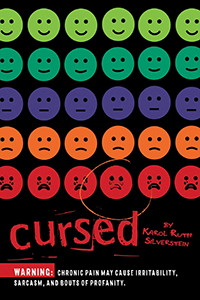 Cursed
Silverstein, Karol Ruth. Cursed. 320p. Charlesbridge Teen. Jun. 2019. Tr $17.99. ISBN 9781580899406.
Gr 9 Up–Recently diagnosed with arthritis, 14-year-old Ricky Bloom now lives in “the Batch Pad” with her dentist father and attends a new middle school in Philadelphia. Ricky begins “the Charade,” ditching school to avoid bullying and the pain of getting there. Instead she spends her time sleeping, taking hot baths, and daydreaming about Julio, a cute drummer. Embarrassed by her pain and limitations, she prefers to keep to herself; the only person she chooses to see is her older sister Dani, a college basketball player who lives with her girlfriend of three years. When Ricky’s truancy is discovered, she risks having to repeat ninth grade, which would bring more unwanted attention to her already miserable, angry days. Back to school (for real this time), she finds unlikely support from an English teacher and an adorkable guy named Oliver, a cancer survivor. These relationships and a new doctor who listens to her provide Ricky a sense of hope, allowing her to become a better version of herself. Silverstein’s debut young adult novel is an accurate portrayal of the challenging relationship between parents and teens, as well as the frustration of living with a chronic illness. VERDICT Readers will enjoy this contemporary coming-of-age story featuring a resilient protagonist and charming plot.–Laura Jones, Argos Community Schools, IN
TEEN HONOR
Gr 7 Up–Moving halfway across the country and changing schools senior year would be hard enough for anyone, but for Maya, moving from a Deaf school to a hearing school is one adjustment too many. At her Deaf school, people didn’t stare or shout at her, and all the misconceptions about the Deaf didn’t rear their ugly heads whenever she was signing to her interpreter or trying to lip-read. And then there’s Beau, who makes it his mission to learn to sign to her the first day of school. Maya assumes he’s one of the “populars” who only feels sorry for her and is trying to make himself look good. Besides, Maya doesn’t have time to make new friends. She is focused on getting into a good respiratory therapy program in college so she can help people like her little brother Connor, who has cystic fibrosis. Can Maya let go and trust someone to care about her just as she is? Gervais has written a captivating novel that sheds light on how hearing and Deaf cultures make assumptions about each other or are stereotyped, woven into a teen love story. American Sign Language is utilized throughout the book, with Maya’s thoughts and words easily discernible. Teens will relate to the issues of parental influence, peer pressures, and first loves, but also revealed is a deeper understanding of what it means to be different in a world where sameness is the standard.
VERDICT A solid addition to middle/high school fiction that allows for deep discussion about stereotypes concerning disabilities
Reviewed by Carol Connor, Cincinnati Public Schools, OH
SYDNEY TAYLOR BOOK AWARDS—PICTURE BOOK
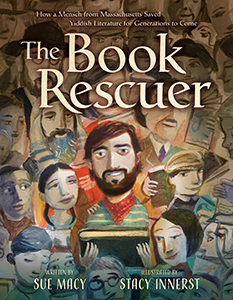 The Book Rescuer: How a Mensch from Massachusetts Saved Yiddish Literature for Generations to Come
by Sue Macy (text) & illus. by Stacy Innerst
S. & S./Paula Wiseman Bks . Oct. 2019. 48p. Tr $17.99. ISBN 9781481472203.
Gr 1-4–Aaron Lansky could not forget what his grandmother told him as a child. At the age of 16, she immigrated to the United States from Eastern Europe. In his twenties, Lansky decided to find out more about his grandmother’s stories, which set him on a journey to learn how to speak and read Yiddish and to also locate Yiddish books. The result is the Yiddish Book Center in Amherst, MA. Lansky’s story is a fascinating one, filled with book rescues and meeting older people who not only treasure books but what they represent. His disappointments and rewards in pursuing this passion are well portrayed. The narrative is both informative and engaging and includes Yiddish words, many of which have been incorporated into English. All appear in a glossary. An afterword by Lansky himself brings the Center and his work up to date. Illustrations intentionally call to mind the bold line and semi-abstraction of Russian-born artist Marc Chagall.
VERDICT A potentially valuable addition to both school and public libraries as well as Jewish schools. Echoing Carole Boston Weatherford’s Schomburg: The Man Who Built a Library, the book’s narrative shows that pursuing interests can lead to meaningful and long-lasting results.
PICTURE BOOK HONORS
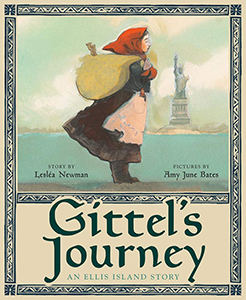 Gittel's Journey: An Ellis Island Story
illus. by Amy June Bates. 48p. Abrams. bibliog. glossary. photos. Feb. 2019. Tr $17.99. ISBN 9781419727474.
Gr 2–5—"What if Mama's cousin Mendel doesn't like me?…What if English is too hard to learn? What if I never see Mama again?" Nine-year-old Gittel is alone on a ship to America after her mother's eye infection causes a health inspector to refuse the woman passage. Finding comfort in Basha, a favorite rag doll, Mama's candlesticks, and some children on board, Gittel finally steps foot on Ellis Island only to learn that the precious folded paper with cousin Mendel's address is watermarked and illegible. Not even knowing Mendel's last name, the girl feels that her situation is hopeless until a kindly Yiddish interpreter comes up with the perfect solution. Newman based the book on two true family stories. An author's note includes photos as well as a brief history of the approximate three million Eastern European Jews who fled the shtetls and pogroms in the early 1900s. A short glossary of Yiddish words and phrases and a bibliography are also appended. The book is beautifully designed and illustrated; blue endpapers feature prints of the ship approaching Lady Liberty, while the other pages are light brown with black printed borders or classical arches. The watercolor illustrations artfully capture an era and people, from their simple woolen clothes to their expressive faces.VERDICT Pair this with Patricia Polacco's The Keeping Quilt for an historical look at early immigration.
Reviewed by Barbara Auerbach, Cairo Public Library, NY
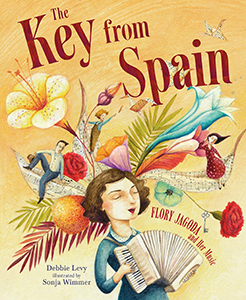 The Key from Spain: Flory Jagoda and Her Music
by Debbie Levy (text) & illus. by Sonja Wimmer
Kar-Ben . Aug. 2019. 32p. Tr $17.99. ISBN 9781541522183; pap. $7.99. ISBN 9781541522190.
Gr 2-5–Levy’s captivating picture book biography tells the story of Flory Jagoda, known today as the “Keeper of the Flame” of Sephardic culture and music. The narrative begins centuries after Flory’s descendants, the Altaras family, were expelled from Spain during the Inquisition due to their Sephardic identity. After centuries of living peacefully in Bosnia, Flory’s family had to escape the dangers of World War II for the same reason. Forced to flee her home for America, Flory relied on music to stay connected to her family’s heritage, even as war ravaged her home and stole away her loved ones. Levy’s writing and Wimmer’s mixed-media illustrations strike the perfect synergy, working together to celebrate music, heritage, and family histories. The writing is poetic and lyrical, effortlessly weaving centuries of history into the story while maintaining a strikingly intimate tone. Wimmer’s illustrations are nuanced, and readers will enjoy discovering new details upon each rereading of the book.VERDICT A beautifully crafted story that touches on a lesser-known historical topic. Together, the words and pictures convey musicality without a single note of harmoniku, Flory’s instrument of choice, having to be played. This work is a must-purchase for library collections
Reviewed by Lauren Hathaway, University of British Columbia
SYDNEY TAYLOR BOOK AWARDS—MIDDLE GRADE
 White Bird: A Wonder Story
by R.J Palacio (text) & illus. by R.J. Palacio
Knopf . Oct. 2019. 224p. Tr $24.99. ISBN 9780525645535.
Gr 4-6–This graphic novel expands on Grandmère’s childhood story, which was referenced in The Julian Chapter, a companion to Palacio’s Wonder. Grandmère tells Julian about her childhood in France. She describes how her comfortable, happy life changed in the summer of 1940, when the Germans occupied part of France. Though Grandmère, or Sara, and her family lived in the free zone, she tells Julian, “Nothing was really normal anymore. Not if you were Jewish, like us.” As the war progresses, it becomes more real to Sara, but she doesn’t understand the danger until the day that the Nazi soldiers arrive at Sara’s school to take the Jewish children. Sara hides to escape capture but doesn’t know what to do next until she is rescued by a classmate who leads her to safety. The boy, Julien, though she knows him by the cruel nickname Torteau (French for “crab”), uses crutches to walk because his legs were affected by polio. The two become friends, and their relationship even turns romantic as the years pass while Sara is in hiding, but Julien’s character doesn’t become more than a tragic hero. Moments set in the present featuring Julian and Grandmère frame the tale and draw parallels to family separation at the U.S. border, offering a powerful conclusion. An author’s note discusses Palacio’s connection to the story, and back matter provides further information about the war, the period, and more.
VERDICT Sure to be popular among fans of Wonder and educators who want to connect past to present.
Reviewed by Mindy Rhiger, Hennepin County Library, MN
MIDDLE GRADE HONORS
 Anya and the Dragon
HMH/Versify . Sept. 2019. 400p. Tr $16.99. ISBN 9780358006077.
Gr 4-7–Would you help kill what might be the last dragon in the world if it saved your family from being evicted? In a 10th-century Eastern Europe where magical creatures abound but human magic is all but illegal, 13-year-old Anya has just found out that she and her family are about to lose their home, and with her father recently conscripted into the Tsar’s army, there doesn’t seem to be any way out. The discrimination that Anya and her family experience for being Jewish makes things even worse. When a boy named Ivan, the youngest in a rambunctious gang of brothers (all named Ivan), introduces Anya to his father, she realizes she may have a way to earn money—by helping him find an elusive dragon. And then she meets the dragon himself, who turns out to be a sweet and friendly creature—basically the draconic version of Ivan, and connected in some mysterious way to the village blacksmith, Kin. Anya and Ivan struggle to save the dragon from three enemies, the worst of which is the cold-hearted and ambitious Viking Sigurd, with help from a variety of unlikely and unusual sources. Anya is smart and feisty, with more talent and courage than she realizes. She must keep secrets and decide for herself if it is ever right to kill. There is a fair amount of violence and depictions of anti-Semitism, but the story also has humor, a quick pace, and a keen sense of place.
VERDICT A strong heroine and an unusual setting make this worth adding to most crowded fantasy shelves.
Reviewed by Mara Alpert, Los Angeles Public Library
 Games of Deception: The True Story of the First U.S. Olympic Basketball Team at the 1936 Olympics in Hitler’s Germany
Philomel . Nov. 2019. 240p. Tr $17.99. ISBN 9780525514633.
Gr 7 Up–Readers will discover an incredible story where separate worlds from across the Atlantic collide. Maraniss traces the history of basketball including its invention and growing popularity in the United States leading up to the 1936 Olympic Games held in Berlin. By 1936 in Germany, Hitler had gained power and started to persecute Jewish people. But because the world was watching, the Germans projected the false image of an idyllic city in order to hide the true horrors of living under the Nazi regime. The 1936 games marked the first time basketball was featured at the Olympics, and the U.S. team saw firsthand the German’s propaganda surrounding this historical event and the state of the country. Maraniss’s well-researched book includes many period photographs that enhance the narrative.
VERDICT This book is a smart read-alike for fans of Daniel James Brown’s The Boys in the Boat or its young adult adaptation. It would also add to any student’s study of the origins of World War II and the eventual involvement of the United States. An exciting and overlooked slice of history.
SYDNEY TAYLOR BOOK AWARDS—YA HONORS
 Dissenter on the Bench: Ruth Bader Ginsburg's Life and Work
208p. appendix. bibliog. index. photos. Clarion. Jun. 2019. Tr $18.99. ISBN 9780544973640.
Gr 6 Up—This accessible and engaging biography of the Supreme Court Justice successfully weaves together information about her life and major court cases in which she had significant influence. Each of the 10 chapters highlights a different court case and a segment of Bader Ginsburg's life, including her academic pursuits, experiences as a woman facing blatant gender discrimination, and her marriage to Martin Ginsburg. The many challenges Bader Ginsburg faced as a person of the Jewish faith growing up during the time of World War II, and as a woman studying law in an overwhelmingly male field are described. Her ferocious determination to fight injustice and inequality stem from personal experience. The first three cases involve teens, (a 13-year-old girl who was strip-searched at school, a 16-year-old girl who fought random drug testing at school, and an 18-year-old boy who fought for his right to freedom of speech and expression at school), and should be particularly relatable to today's youth. Ortiz provides a good overview of how the court system works and how cases reach the Supreme Court. She also explains what it means to dissent and how Bader Ginsburg was encouraged from an early age through the teachings of Judaism to question, challenge, and disagree. Ample black-and-white photos show the subject throughout her life, including the people she defended and befriended. A lengthy bibliography is provided and the appendix includes the Bill of Rights.
VERDICT A straightforward and up-to-date biography about a groundbreaking American icon.
Reviewed by Madeline J. Bryant, Los Angeles Public Library
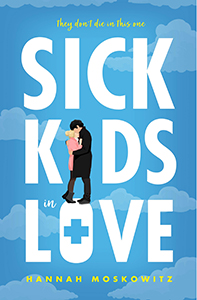 Sick Kids In Love
Entangled Teen . Nov. 2019. 320p. Tr $17.99. ISBN 9781640637320.
Gr 8 Up–Isabel, aka “Sick Girl” according to her weekly column in the school’s newspaper, has one self-imposed rule—absolutely no dating. Life is just easier that way for her and everyone else. Isabel has rheumatoid arthritis, a chronic, invisible illness that she’s been trying to manage for the past few years. Her friends often forget and have difficulty understanding her experiences because she struggles with opening up and depending on others, and her doctors don’t always take her complaints seriously. Enter Sasha, who Isabel meets in the infusion room at the hospital. Sasha has Gaucher Disease—a genetic illness that affects his spleen and liver—and he understands her better than anyone else in her life. He does everything he can to woo her, convince her to break her own rule, and take a chance even if she doesn’t know the outcome. Moskowitz’s newest novel is a refreshing and poignant look at chronic illnesses that aren’t often represented in young adult literature. The story offers a unique take on finding your person and contains an array of representation.
VERDICT Recommend to fans of Rachael Lippincott’s Five Feet Apart and Nicola Yoon’s Everything, Everything. Readers may appreciate a book about illness that doesn’t end with character death.
Reviewed by Alicia Kalan, The Northwest School, Seattle
EXCELLENCE IN NONFICTION AWARD
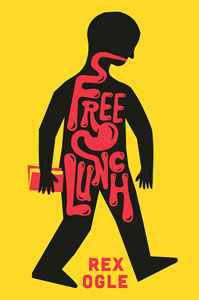 Free Lunch
by Rex Ogle
Norton Young Readers . Sept. 2019. 208p. Tr $16.95. ISBN 9781324003601.
Gr 6-8–Heart-wrenching, timely, and beautifully written, this is a powerful and urgent work of autofiction. Telling his own story of growing up in Texas, Ogle looks back at starting middle school while navigating the crushing poverty and intermittent violence of his home life. It is especially humiliating to sixth-grade Rex that he is required to announce his free lunch status every day in the school cafeteria, wear secondhand clothes, and give excuses for not playing football when the truth is that there’s no money for the uniform. At home, where he lives with his unemployed mother and her boyfriend, Rex is the one who cares for his baby brother, balances the checkbook, and cooks dinner. His mother, overwhelmed and hopeless, clearly loves Rex, but does not know how to care for her sensitive son. At school, Rex struggles to maintain friendships with boys who have joined the football team and to make new friends—until he meets Ethan, a classmate who encourages Rex to recognize that every family is complicated. He also has to contend with his English teacher, Mrs. Winstead, who does not miss an opportunity to make Rex feel bad about himself. Over time, and with the support of his loving Mexican grandmother, Rex grows into an empathetic boy who begins to recognize the hardships his mother faces and starts to look outward in ways not restricted by his immediate situation.
Gr 6-8–Heart-wrenching, timely, and beautifully written, this is a powerful and urgent work of autofiction. Telling his own story of growing up in Texas, Ogle looks back at starting middle school while navigating the crushing poverty and intermittent violence of his home life. It is especially humiliating to sixth-grade Rex that he is required to announce his free lunch status every day in the school cafeteria, wear secondhand clothes, and give excuses for not playing football when the truth is that there’s no money for the uniform. At home, where he lives with his unemployed mother and her boyfriend, Rex is the one who cares for his baby brother, balances the checkbook, and cooks dinner. His mother, overwhelmed and hopeless, clearly loves Rex, but does not know how to care for her sensitive son. At school, Rex struggles to maintain friendships with boys who have joined the football team and to make new friends—until he meets Ethan, a classmate who encourages Rex to recognize that every family is complicated. He also has to contend with his English teacher, Mrs. Winstead, who does not miss an opportunity to make Rex feel bad about himself. Over time, and with the support of his loving Mexican grandmother, Rex grows into an empathetic boy who begins to recognize the hardships his mother faces and starts to look outward in ways not restricted by his immediate situation.VERDICT Ogle’s story will inspire empathy for the experience of children living in poverty. Recommend this book to mature readers who are ready to grapple with the realities of the impacts of socioeconomic status.
Reviewed by Shelley Sommer, Inly School, Scituate, MA
EXCELLENCE IN NONFICTION FINALISTS
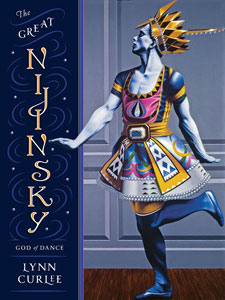 The Great Nijinsky: God of Dance
by Lynn CURLEE
illus. by Lynn Curlee. 120p. photos. Charlesbridge. Apr. 2019. Tr $19.99. ISBN 9781580898003.
Gr 8 Up—Born to Polish parents who worked as traveling performers, Vaslav Nijinsky was raised to be onstage. After training at the Imperial Ballet School in Russia, Nijinsky began performing and his undeniable skills amazed audiences. He also began choreographing, bringing new and sensational pieces such as The Rite of Spring to the stage. In this biography, Nijinsky's accomplishments on the stage are detailed, accompanied by paintings by the author and archival photographs. "Programs" for Nijinsky's performances, including facts and summaries of the ballets, separate the chapters. The biography focuses on more than just Nijinksy's art, delving into his personal life, including his relationships, sexuality, and his mental health. Curlee provides context for Nijinsky's life and introduces readers to the art scene of the time, including brief biographical sketches of other figures such as Fokine and Stravinsky. Appropriate for preliminary research, and simply for those interested in learning more about Nijinsky, the included back matter provides readers looking to delve deeper with avenues to continue exploring.
VERDICT While contemporary conceptions of sexual identity and mental illness cannot easily be superimposed over historical biographies, readers nevertheless are presented with a full picture of Nijinsky's life.
Reviewed by Zoë McLaughlin, Michigan State University
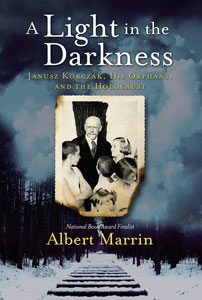 A Light in the Darkness: Janusz Korczak, His Orphans, and the Holocaust
Random . Sept. 2019. 400p. bibliog. index. notes. Tr $19.99. ISBN 9781524701208.
Gr 7 Up–Readers of Marrin’s new biography will learn that the only memorial stone in the cemetery of the razed Treblinka extermination camp is that of Janusz Korczak (the pen name of Henryk Goldszmit). The outline of his life is sketchy, as most documents have been lost. Korczak was a pediatrician who served Poland in three wars and volunteered for World War II. Nicknamed the Old Doctor, he is primarily known for his work caring for orphans in the Warsaw ghetto. He believed that children should be treated with respect and as individuals, rather than as objects to be molded by adults. Korczak protected the orphans through the Holocaust, turning down several opportunities to escape. On August 5, 1942, a Nazi patrol rounded up everyone in the Dom Sierot orphanage and marched them to trains headed to Treblinka. None survived. In a larger sense, this volume is about Hitler, his racist agenda, and his attitude toward children (and humanity in general), which stands in sharp contrast to the philosophy of Korczak. Marrin describes the horrors of the Holocaust in graphic detail. Often disturbing black-and-white photos enhance the text. Extensive notes for each chapter, accompanied by a comprehensive bibliography and an excellent index, make this book a good research source.VERDICT This fascinating work will terrify and educate readers about the dangers of autocracy and racism. Highly recommended for all young adult collections.
Reviewed by Katherine Koenig, Carnegie Library of Pittsburgh
 A Thousand Sisters: The Heroic Airwomen of the Soviet Union in World War II
384p. HarperCollins/Balzer + Bray. Jan. 2019. Tr $19.99. ISBN 9780062453013.
Gr 9 Up—From Wein, author of Code Name Verity, comes a nonfiction account of the women pilots of the Soviet Union. Starting prior to World War II, Wein describes how aviation became a hobby and passion for many young women in the Soviet Union. When World War II started, life under the Soviet system meant women could serve as pilots, theoretically equal to men, in the war effort. Wein provides a meticulously detailed account of Marina Raskova's Aviation Regiments: the 586th Fighter Aviation Regiment, the 587th Bomber Aviation Regiment, and the 588th Night Bomber Aviation Regiment. These three were largely staffed with women volunteers and fought on the frontlines of the war. The author provides an intimate look at the pilots' lives, both personal and military, as they work to defeat the Nazis. Likewise, Wein does not shy away from describing the difficult and often terrifying aspects of living under Stalin, including descriptions of man-made famines and the Great Purge. Some readers may have difficulty keeping track of all of the figures, but Raskova often acts as an anchor to assist readers in following the numerous and complex accounts.
VERDICT Recommend this richly detailed work of nonfiction to fans of Monica Hesse and Wein's historical fiction.
Reviewed by Kaetlyn Phillips, Yorkton, Sask.
 Torpedoed: The True Story of the World War II Sinking of “The Children’s Ship.”
Holt . Oct. 2019. 288p. Tr $19.99. ISBN 9781627795548.
Gr 5-8–Heiligman tells a story of bravery, courage, and despair through the eyes of the passengers on the SS City of Benares, a ship commissioned to sail to Canada with 100 children on board during World War II. The SS City of Benares was torpedoed by a German submarine. The imagery of the waves hitting the lifeboats and rafts as the survivors hung on for life is so vivid that readers almost feel as if they, too, are fighting for their lives. Heiligman includes information about the lascars, or Indian sailors, many of whom gave their lives to save as many people as they could. The book is filled with photographs, illustrations, and letters written from the children to their families, as well as the telegraphs reporting the deaths of those on board. The extensive back matter, paired with the author’s deft narrative touch, makes this title a must purchase for libraries, a must-read for all, and a beautiful memorial for those who perished in this tragic event.VERDICT Expect this book to garner Heiligman another nonfiction award. Pair this with Susan Wood’s historical fiction novel Lifeboat 12.
ALEX AWARDS (Adult Books for Young Adults)
 A Boy and His Dog at the End of the World
336p. Hachette/Orbit. Apr. 2019. Tr $26. ISBN 9780316449458.
Since the Gelding rendered most humans infertile, the global population has dwindled to a mere few thousand. Griz has never had neighbors or been in a crowd, though he and siblings Ferg and Bar are familiar with the concepts from photographs, homeschooling, and handed-down stories. Griz directly addresses readers about his family, his dreams, and life on an island, somewhere near what might have once been England. "In my whole life, I haven't met enough people to make up two teams for a game of football," says Griz, who scavenges and explores on land and sea. When a stranger steals Jess, one of Griz's beloved dogs, what's to be done but go after them? Griz is comfortable taking care of himself, though he is grateful to encounter John Dark, who speaks a different language and helps Griz after a nasty encounter with a boar. Action builds as Griz closes in on Jess, the stranger, and other "Baby Bust" survivors. While not as tightly crafted as Cormac McCarthy's The Road, this tale may gain traction with similar readers. Griz's casual acceptance of a depopulated world makes the plot believable, though the pacing early on may feel slow to some readers.
VERDICT For high school libraries seeking independent teen heroes in dystopian settings.
 Dominicana
by Angie Cruz
Flatiron: Macmillan . Sept. 2019. 336p. ISBN 9781250205933. $26.99; ebk. ISBN 9781250205926. F
 In mesmerizing prose, Cruz (Let It Rain Coffee; Soledad) captures the heartbreaking coming of age of Ana Cancion. Based on Cruz’s mother’s story, the novel centers on 15-year-old Ana’s transactional marriage to the much-older Juan Ruiz and her immigration to the United States from the Dominican Republic in the 1960s, after dictator Rafael Trujillo’s assassination. It also provides a window into the changing landscape of Harlem during the time period, as our resourceful young heroine must figure out how to survive New York City’s cold winters, her abusive husband, and being thousands of miles away from her family. Flashbacks of her life on the island serve as points of comparison for Ana—the short passages conjure moments of both trauma and bliss. She finds solace (and love) in her brother-in-law’s arms and her eventual pregnancy. It’s these two things, along with learning English, her beloved faceless “Dominicana” doll, and her burgeoning entrepreneurial skills that help her find her voice.
VERDICT This stirring immigration story is Cruz’s breakout book; it should be heralded alongside Julia Alvarez’s How the Garcia Girls Lost Their Accents.
Reviewed by Shelley M. Diaz, BookOps, NYPL and BPL
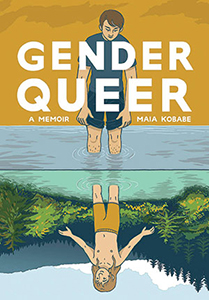 Gender Queer: A Memoir
by Maia Kobabe (text) & illus. by Maia Kobabe & Phoebe Kobabe
Lion Forge . May 2019. 240p. pap. $17.99. ISBN 9781549304002.
Gr 9 Up–Kobabe, who uses the pronouns e, em, and eir, was assigned female at birth but never felt that this designation fit. As e grew up, e learned about the spectrum of gender designations and settled on nonbinary as the best descriptor. E came out to eir family as nonbinary and asexual and found that eir family supported em however e identified. In this memoir, Kobabe chronicles eir life from the time e was very young through eir coming of age and adulthood. E describes common situations from the perspective of someone who is asexual and nonbinary: starting a new school, getting eir period, dating, attending college. The muted earth tones and calm blues match the hopeful tone and measured pacing. Matter-of-fact descriptions of gynecological exams and the use of sex toys will be enlightening for those who may not have access to this information elsewhere.VERDICT A book to be savored rather than devoured, this memoir will resonate with teens, especially fans of Alison Bechdel’s Fun Home and Mason Deaver’s I Wish You All the Best. It’s also a great resource for those who identify as nonbinary or asexual as well as for those who know someone who identifies that way and wish to better understand
Reviewed by Jenni Frencham, Indiana University, Bloomington
An SLJ Best Book of 2019.
Middlegame
528p. Tor. May 2019. Tr $29.99. ISBN 9781250195524.
This epic sci-fi adventure will grab fans of Doctor Who and Blade Runner. Twins Roger and Dodger were genetically manufactured in a lab so that their psychotic creator, Reed, who is also genetically manufactured, could unlock godlike powers. The twins are separated and raised on opposite ends of the country. Despite the distance, they are linked and nothing will stop them from connecting with each other. The plot is intricate yet fast paced, with classic sci-fi elements such as genetic engineering, psychic links, alternate dimensions, and time loops. The book follows the protagonists through elementary to graduate school, and teens will readily identify with the characters' thoughts and actions.VERDICT An excellent recommendation for those who enjoyed Lev Grossman's The Magicians and Lauren Oliver's Replica.
Red, White, & Royal Blue
Griffin: St. Martin’s . May 2019. 432p. ISBN 9781250316776. pap. $16.99; ebk. ISBN 9781250316783. CONTEMPORARY ROMANCE
DEBUT Alex Claremont-Diaz, son of U.S. President Ellen Claremont, doesn’t consider Prince Henry of Wales his arch-nemesis, not exactly. It’s just that Henry is a generic blank canvas with zero personality and a truly unfair resemblance to a real-life Prince Charming, and Alex can’t help despising every bland thing about him. After the two have a very public confrontation at a royal wedding, damage control is required from both sides of the pond. In order to maintain friendly international relations, Alex is forced to pretend to be longtime best friends with Henry. When the two actually spend time together, however, they learn that there is much more to the other than they’d realized. As a contentious reelection campaign for Ellen looms on the horizon, Alex and Henry tentatively forge a genuine friendship, which grows into more, until reaching an inevitable boiling point.VERDICT With a diverse cast of characters, quick-witted dialog, and a complicated relationship between two young people with the eyes of the world watching their every move, McQuiston’s debut is an irresistible, hopeful, and sexy romantic comedy that considers real questions about personal and public responsibility. For fans of Heather Cocks and Jessica Morgan’s The Royal We, as well as Alyssa Cole’s “Reluctant Royals” series.
Reviewed by Jessica Moore, Milwaukee P.L
The Swallows
by Lisa Lutz
Ballantine . Aug. 2019. 416p. ISBN 9781984818232. $27; ebk. ISBN 9781984818249. F
Lutz (“Spellman” series; The Passenger) makes a promising start with this super-smart and biting novel set at a Vermont prep school. Alex Witt, daughter of a jaded novelist and former Soviet fencing champ, who are divorced but still entangled, arrives to teach literature at Stonebridge Academy after a messy incident at her previous job. She ends up heading a creative writing course instead and soon learns the popular boys at the school have a secret online club that ranks the girls’s oral-sex abilities. The girls, led by misfit orphan Gemma, become aware of this and wage war against the boys, egged on by Alex. What starts out as a digital, shamey campaign turns physical and dangerous. In the battle of the entitled sexes, nobody wins and some will lose their lives. A large cast of characters and multiple narrators slows down the story, but Gemma, Alex, and a scrappy first-year named Linny come alive. The male characters—teachers, a dean, boy allies, boy villains—are less believable but good foils. The ending feels rushed and chaotic, but that’s also fitting.
VERDICT Lutz’s many fans will enjoy this, as will those who devour boarding-school novels such as Curtis Sittenfeld’s Prep or #metoo revenge stories. [See Prepub Alert, 3/11/19.]
Reviewed by Liz French, Library Journal
See also SLJ's additional coverage of the 2020 Youth Media Awards.

Added To Cart
RELATED


RECOMMENDED
CAREERS
The job outlook in 2030: Librarians will be in demand
CAREERS
The job outlook in 2030: Librarians will be in demand
ALREADY A SUBSCRIBER? LOG IN
We are currently offering this content for free. Sign up now to activate your personal profile, where you can save articles for future viewing
ALREADY A SUBSCRIBER? LOG IN
Thank you for visiting.
We’ve noticed you are using a private browser. To continue, please log in or create an account.

Add Comment :-
Be the first reader to comment.
Comment Policy:
Comment should not be empty !!!