


2018 School Spending Survey Report
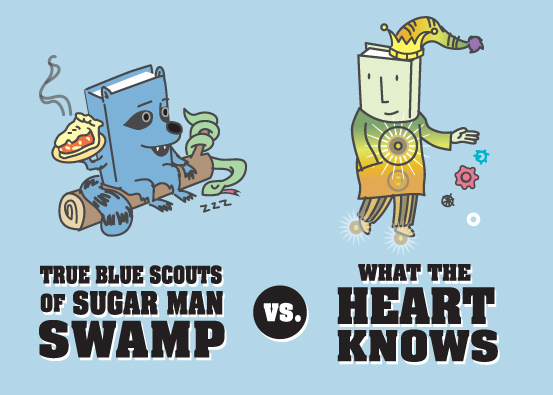
Round 1, Match 8: True Blue Scouts of Sugar Man Swamp vs What The Heart Knows
JUDGE - SHEILA TURNAGE True Blue Scouts of Sugar Man Swamp by Kathy Appelt Atheneum Books for Young Readers What the Heart Knows by Joyce Sidman Houghton Mifflin Books for Children Comparing Joyce Sidman’s What the Heart Knows – Chants, Charms & Blessings to The True Blue Scouts of Sugar Man Swamp by Kathi Appelt is [...]
 JUDGE - SHEILA TURNAGE
by Kathy Appelt
Atheneum Books for Young Readers What the Heart Knows
by Joyce Sidman
Houghton Mifflin Books for Children

Comparing Joyce Sidman’s What the Heart Knows – Chants, Charms & Blessings to The True Blue Scouts of Sugar Man Swamp by Kathi Appelt is an insanely difficult, apples-to-oranges job.
What the Heart Knows is a slim, beautifully produced volume of poems eloquently illustrated by Pamela Zagarenski. The True Blue Scouts of Sugar Man Swamp is a pudgy middle grade novel plopped down along a sweltering Texas bayou. One is home to poems as true as falling in love. The other is home to a heartbroken boy, a sleeping giant, and two charming raccoons.
Apples and oranges.
But as a fictitious character once told me, “when faced with apples and oranges, think fruit salad.” So let’s start slicing and dicing.
In What the Heart Knows, Joyce Sidman gives us 29 poems in four sections: Chants and Charms, Spells and Invocations, Laments and Remembrances, and Praise Songs and Blessings. In a note to her readers, she writes: “I wrote these poems for comfort, for understanding, for hope… They are words to speak in the face of loneliness, fear, delight or confusion.” Zagarenski’s rich illustrations keep pace with the poems’ complexity and humor, and sometimes with their uncluttered loneliness.
Sidman’s poems are as comforting as a teddy bear, as startling as death. Between those extremes lie poems to repair a friendship, find a poem, charm sleep. Sidman creates depth in a line of poetry as easily as I stretch a sweater: “Don’t come close, dark./ Don’t brush my face with your sticky hands./ Stay as cool and distant as a train whistle.”
She offers easy-going spells to find lost car keys, and uses these charmingly off-beat lines to help ward off awkward gifts: “Let it not be made of wool – snowflake/ pattern – one arm slightly longer/ than the other, knitted in my formerly/ favorite shade of green.”
In Laments and Remembrances, she gives us Lament for Teddy and Lament for My Old Life, and a wonderful coming-of-any-age poem, Where Is My Body? which starts, “Where is my body?/ The one I’m used to,/ slim and ordinary as a twig?”
Don’t get too comfortable, though. The opening of When Death Comes slashes like a razor: “It’s so far/ from what/ you expect:/ the difference/ between/ a ‘heroic battle’/ and/ an actual blow/ to the face.”
These poems capture Sidman’s wisdom, truth and humor – the magic that stitches life together. “I hope you’re inspired to write some [poems] of your own– and chant them in your own voice,” Sidman tells her readers. I hope so too.
This a wonderful book, and I loved reading it.
So much for apples. Now to oranges.
Kathi Appelt conjures up a different kind of magic in The True Blue Scouts of Sugar Man Swamp – two coming-of-age stories spun into one, with an ecological theme zigging through them like honeysuckle through a swamp.
In the first storyline, Official Scouts Bingo and J’miah, two young raccoons, have just inherited a mission: To patrol their beloved swamp and awaken the giant, Sugar Man, should an emergency arise.
In the second story 12-year-old Chap, a boy mourning the loss of his grandfather, has a mission of his own: to become a man, and to save Sugar Man Swamp from Sonny Boy Beaucoup, a developer planning to turn the swamp into a theme park – though he’s bound by a blood oath to protect it.
Sonny Boy offers Chap a deal: He’ll let Chap and his mom keep their home and sugar-pie café for a boatload of cash or proof of Sugar Man’s existence.
Either way, chances are slim. Sonny Boy is a pig of a man.
Sonny Boy’s not the only pig in the story. In fact, as the stories unfold a band of feral hogs rumble-rumble-rumble-rumbles its way to the sugarcane at the heart of the swamp – the cane Chap’s mother needs for pies, and the cane Swamp Man needs to awaken.
An emergency! Our raccoon Scouts scamper into action.
I don’t want to spoil the story, so let me stop to mention structure. This 327-page novel contains 104 chapters, some just a few lines long. The chapters read as ragged and perfectly balanced as treefrogs’ song deep in a swamp. Appelt ricochets from storyline to storyline, perspective to perspective. We see through the eyes of an alligator wrestler, a vain rattler, an art-loving raccoon. We zip through time, learning about DeSotos, cryptids and conquistador pigs.
And we meet Chap’s nature-sketching grandfather Audie.
Audie counts – in Chap’s heart and very quickly in mine.
Kathi Appelt’s language shifts gear with her plotlines – skittering, hissing, snorting. She writes Chap’s story richly and simply, anchoring the reader’s senses in his. “As soon as Chap’s hand was large enough to grip the machete, his mom taught him how to cut the cane… swing and chop, swing and chop, until he felt the rhythm of it roll up from the blade of the machete to the muscles in his neck.”
It’s darned good storytelling. And lest you worry, in the end the raccoons stand tall, the Sugar Man awakens, pigs fly, and Chap makes a man’s decision.
So. How’s that fruit salad coming along?
Actually, these apples and oranges blend better than I expected. Both Sidman and Appelt are first-class spell-casters who fix their magic in familiar worlds. They write about finding courage, standing up, facing change, making peace. Both books made me smile. Appelt’s made me laugh; Sidman’s made me gasp several times.
If I have a qualm, I’d say for me Sidman’s poetry (ages 12 and up) sometimes hits the grown-up end of the scale. While Zagarenski’s art offers a wonderful second avenue into the poems, I wondered if a few really were for young readers. And in Appelt’s book (ages 8-12), while the story is always accessible, the narrator occasionally gets a bit too folksy for me, and sprawls on a snig too long.
While I admire both books, if I were handing out books to young readers I believe I’d reach most often for Kathi Appelt’s. The writing’s energetic and charming enough to rope a reader into the story. And it’s layered enough, and fun enough to make a reader of any age want to stay.
The winner: The True Blue Scouts of Sugar Man Swamp.
– Sheila Turnage

This is a famous case of Mo picking Chap – I mean, what else could happen, and how could Ms. Turnage NOT love True Blue Scouts (poor Three Times Lucky). True Blue Scouts is, hands down, the most lovable book in this competition. The question: Should it beat The Thing About Luck? I think not, but boy, did I love those pies. But neither can we overlook What the Heart Knows. Poetry. That’s novel enough for BoB. And really, read them out loud. At first it seemed a bit too treacle-y, but Sidman’s poems are quietly powerful and revelatory. As Ms. Turnage remarked, I don’t know if kids will really like it, but I did. And everyone’s life can use a bit of poetry at some point, as we learn in Rose Under Fire. So, now it’s Round Two, and let the best book win.
– Kid Commentator RGN
THE WINNER OF ROUND 1 MATCH 8: THE TRUE BLUE SCOUTS OF SUGAR MAN SWAMP

Added To Cart
RELATED


RECOMMENDED
CAREERS
The job outlook in 2030: Librarians will be in demand
CAREERS
The job outlook in 2030: Librarians will be in demand
ALREADY A SUBSCRIBER? LOG IN
We are currently offering this content for free. Sign up now to activate your personal profile, where you can save articles for future viewing
ALREADY A SUBSCRIBER? LOG IN
Thank you for visiting.
We’ve noticed you are using a private browser. To continue, please log in or create an account.

Add Comment :-
Be the first reader to comment.
Comment Policy:
Comment should not be empty !!!