


2018 School Spending Survey Report
Waterfalls, Geysers, & Turbines |Touch and Go
“In Stockholm, Sweden, researchers have found a way to create usable energy from the excess body heat generated by the quarter million commuters who pass through the city’s train station every day.” This fact and a look at our use of energy—yesterday and today—can be found in a new app from Kids Discover.
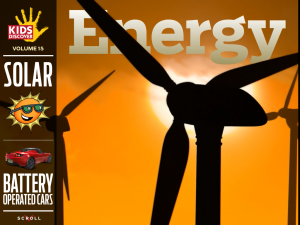 Following the same format as the other apps in the Kids Discover series, this new production cover the various forms of Energy ($3.99; Gr 4-8) that humans harness as well as the energy that they and plants produce. Viewers can access information via a scrollable, thematic table of contents on the opening screen or through a visual index of the 11 chapters. Once inside the app, they can swipe their way through it page-by-page, hop about using the scrubber bar on the bottom of the screen, or tap the home icon to return to the index.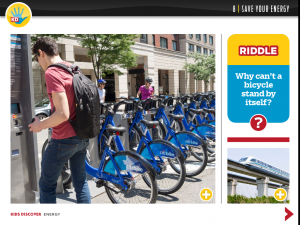
Screen from 'Energy' (Kids Discover)
Eight of the 11 chapters are comprised of several pages of information on the types and use of energy (“Light and Heat”; The Boiling Point,” etc.), while others have a more ecological focus (“Energy Yesterday and Today,” “Save Your Energy”). Each page or screen begins with a video clip (of wind turbines, a waterfall, a geyser, etc.) or a colorful photo or labeled diagram, and includes a fact or two or a paragraph of text, or poses a question. Visual cues or instructions indicate where to find interactive elements and additional screens of information. A few sidebars highlight figures, and there are mentions of events such as the bike-sharing program that began in New York City in 2013. The text includes some definitions (geothermal, etc) and a few simple demonstrations (fission vs fusion, etc.), but there is no glossary or list of key facts. The last three sections offer activities, a quiz, and a list of resources. The first two will be enjoyed for their simplicity, but readers are unlikely to choose to revisit them (the quiz contains only five questions). The "Resources" section offers five Internet and six print resources. The websites can be accessed from the app, while the book links lead to Amazon pages. All in all, solid information in an engaging presentation.—Elizabeth Kahn, Patrick F. Taylor Science & Technology Academy, Avondale, LA For additional app reviews, visit the Touch and Go webpage.
Added To Cart
RELATED


RECOMMENDED
CAREERS
The job outlook in 2030: Librarians will be in demand
CAREERS
The job outlook in 2030: Librarians will be in demand
ALREADY A SUBSCRIBER? LOG IN
We are currently offering this content for free. Sign up now to activate your personal profile, where you can save articles for future viewing
ALREADY A SUBSCRIBER? LOG IN
Thank you for visiting.
We’ve noticed you are using a private browser. To continue, please log in or create an account.

Add Comment :-
Be the first reader to comment.
Comment Policy:
Comment should not be empty !!!