


2018 School Spending Survey Report
Q & A with 'A Moose Boosh' Author Eric-Shabazz Larkin
Just in time for the holidays, SLJ talks to author Eric-Shabazz Larkin about his authorial debut A Moose Boosh, an imaginative collection of poems to do with food, accompanied by lively illustrations.
 For Eric-Shabazz Larkin, food is powerful. Though he’s all too aware that making time to eat together is increasingly difficult nowadays, with his imaginative collection of poetry, A Moose Boosh: A Few Choice Words About Food (Readers to Eaters, 2014), he attempts to breathe new life into the dinner table. Larkin presents his subject from different angles, from the whimsical (“Ashley Won’t Eat It If She Can’t Spell It”) to the joyful (“Dancing Kitchen”) to the thought-provoking (“Food Desert in Harlem”), often using humor to shed light on significant issues but always conveying his sheer delight for food. The illustrator and poet caught up with SLJ, discussing the importance of food in his own childhood, his artistic background, and what he hopes kids will take away from A Moose Boosh. Where did you get the idea for your book? Families aren’t treating dinnertime as special, as they once did. We eat dinner while we sit at our desk, in front of the television, on the go, in a car. And so I really wanted to create a collection of poems that were essentially meant to be read at the dinner table or in the kitchen while you’re cooking. Poems that would make dinnertime special again. Coming from a very religious household, we would pray before every meal. Not all people share that religious background, and so I wanted to create something where, if you don’t say a prayer before you eat, maybe you say a poem, just to make it special. That’s where the name of the book comes from. An amuse bouche is a fancy word for a little gift that a chef gives you before you eat a meal. I imagined these as a book of literary gifts to share with the people that you love before you eat something together. Your book is visually very creative, with illustrations drawn on top of the photographs themselves. When I was working in an advertising agency, I would have all these books at my desk, because I was an art director. So I’d have all these books from photographers. I would take out photos…sharpies, white-out, paper clips, and I would just start vandalizing the photo books, but people would fall in love with the vandalisms. So I decided to go and take it further. I went out and took my own photos in the street…then I’d go home, and I’d vandalize the photo. The illustrations are really the childhood imagination layered on top of the photos.
 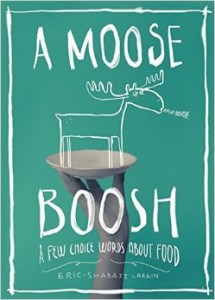 I did a presentation when I launched the book…with a bunch of kids in east New York and…they were so inspired that I created this style of presentation in white out and with a Sharpie. I think there’s something to be said for the ingenuity of [using] the things that are right in front of [you]. In some ways [the art] serves as a metaphor for cooking. People become artists and celebrities from just taking a couple of ingredients and putting them together and making something that tastes delicious. What is your poetry background? I come from a spoken word background. [I think that poems] are supposed to be read aloud. My editor, Karen, we fought a lot about what words rhyme and what words don’t. When you’re a spoken word artist, you can make any word rhyme. And that doesn’t always come across when you’re writing it down. This is my first time actually writing down poems for people to read and not coming from my own voice. So I had to grow a lot as a poet in writing the poems for that very reason. I just hope that some kids will read this book and take the stage in their living room before their meals, with their family. What was your own childhood relationship with food? The dinner table was a big part of my family. That was where my father would quiz me on my vocabulary. That was where my mother would tell stories of her hospital. (She was a nurse.) Everything happened at the dinner table. It’s really sad for me to find that people don’t have that centerpiece of life anymore…My wife is pregnant now, and I can’t wait to sit my son down at the table and have dinner with him, and pass on the traditions. Was cooking a big part of your childhood? I’m thinking of your poem “My Father Is a Painter,” which compares cooking to an art form. It’s funny. My father is certainly not a painter and certainly not a cook. My father had one special dish. It was called Chigetti. I don’t know what that means, but I know there were noodles involved, there was meat involved, and there was some red sauce involved, but it was great, because it was the only thing my father would make. That poem really kind of came from something I read a while ago that says the perfect meal has something salty, something sweet, something crispy, something sour, something savory. And if you can have all these things on your plate, then it’s the perfect meal. But I [also] always try to have many different colors on my plate. That poem really came out of learning when you have a plate that’s all brown, maybe you need to try to add some other things. I didn’t grow up in a home where I got to have the greatest meals, and most of my meals were brown. My family couldn’t afford to have fancy things—purple cabbage, red beets. We had brown rice and brown chicken, and that was it. So that was a very special poem for me, because it is something I learned later on in life. I learned about the colors and the textures. I didn’t want to point out—hey, you kids who don’t have the means to have big, fancy meals, this is what you could be having. Instead, I just wanted to show these things. In an urban context. What can the colors of the table be? And have kids think about these things in a way they never did. A big theme of your book is that not everyone knows where the food they eat comes from. Was that something you were thinking about when you were writing? I don’t know that we do a good job of teaching about our bodies. So I really started to write so many poems that were educational. And then my publisher said, you know the best thing you can do? Make the kids think about what they’re eating, and they will be better at what they’re eating. You don’t need to be another educational voice. I think that we’re very far removed from the food that we eat. Especially if you live in some of the food deserts that we have right here in New York City. You don’t think of [food] as something that grew out of the ground or something that walked the earth. [A couple of weeks ago, at an event] when I launched my book, I had kids tell me their favorite food and then [tell me] where that food comes from. Just having kids think about where their food comes from, I think that they become better food people in general.
 Also, read:
Feeding Minds and Bodies: Libraries, Nonprofits, and Authors Offer Food Education

Added To Cart
RELATED


RECOMMENDED
CAREERS
The job outlook in 2030: Librarians will be in demand
CAREERS
The job outlook in 2030: Librarians will be in demand
ALREADY A SUBSCRIBER? LOG IN
We are currently offering this content for free. Sign up now to activate your personal profile, where you can save articles for future viewing
ALREADY A SUBSCRIBER? LOG IN
Thank you for visiting.
We’ve noticed you are using a private browser. To continue, please log in or create an account.
Add Comment :-
Be the first reader to comment.
Comment Policy:
Comment should not be empty !!!