


2018 School Spending Survey Report
Team Blanket Making—Intergenerational programming for teens… and adults
Heather Booth discovers a new way to bring an intergenerational maker program—and benefit the community—to the Thomas Ford Memorial Library in Western Springs, IL.
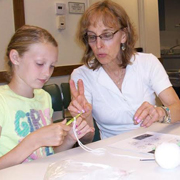
Knitting skills handed down from one generation to the next at Thomas Ford Memorial Library
Sometimes we try really hard to make beautiful moments happen at the library. Sometimes, the best way is to set the stage and then step back and let the pieces fall into place on their own. This summer, in the midst of trying really hard to make my summer reading program relevant and fun, I was fortunate enough to be present for the latter. For years, the Thomas Ford Memorial Library in Western Springs, IL, where I work, has had an active knitting circle. The adult members meet twice a month to offer advice, encouragement, and ideas. This year, Marilyn Montgomery, one of our knitting circle members, had more to share. She had acquired a number of crochet kits from a local fabric store and wondered if the library might be able to use them. She also—and this was the best part—offered to help teens learn how to use the kits. I gratefully accepted the offer, and suggested that rather than begin with a scarf or other individual item, we teach the teens to make a simple “granny square.” We would then collect them back, stitch them together into a blanket, and donate it to a child in need through Project Linus. This would be low-pressure, collaborative way to appeal to teens’ innate sense of social justice, and it was likely that teens could complete a square in the hour and a half we had allocated. The project also provided an opportunity for ongoing engagement with the library as teens could continue working on squares throughout the summer.Organizing the materials
When the day of the event rolled around, my expectations were exceeded. Marilyn brought a bounty of yarn, crochet hooks, and a lovely pattern using only two stitches. Donations from a store are ideal, but those who don’t have have such luck still have simple and inexpensive options to replicate this project. Local yarn aficionados probably have a few skeins that they would be happy to part with, and also will likely have tools they are willing to bring. But knitting needles can also be made from some simple materials. Purchase a few narrow diameter dowel rods at a hardware store, cut them into foot-long segments, sharpen the ends in a pencil sharpener, and sand them smooth. If your library doesn’t have a knitting circle, reach out to the local senior center, fiber arts collective, or solicit individuals through signs in the library or your newsletter.Getting to work
Enough knitting circle members showed up so that each of them could work one-on-one with a teen. The teens who participated were all invited to the knitting circle to share their progress or to get back on track if they missed a step. As the days and weeks passed, the teens and some of the adult helpers brought their completed squares into the library and dropped them off in a designated box.Keeping it going
Such a project doesn’t have to be limited only to the teens and adults who visit the library. One teen brought in a square that looked different from all of the others and explained that her grandmother had heard about the project and wanted to donate a square. I also crocheted on my vacation and managed to make four additional squares. Just the other day, a library member came in and inquired about the program. She had read about it in our newsletter and wondered if we could use the yarn that she found while cleaning out her mother’s home.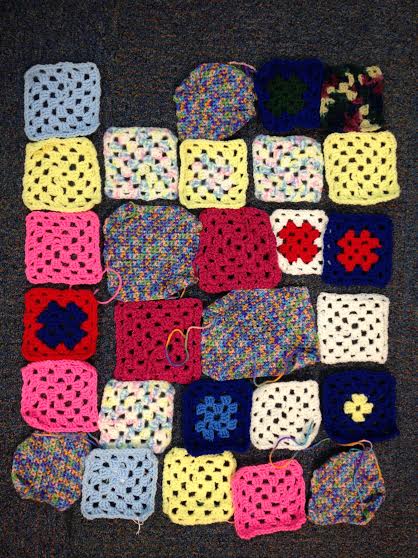
The collection of finished "Granny Squares" made by the participants.
Not limited to knitting
People love sharing their passions for hobbies, and the teens and tweens will appreciate the dedicated attention. If it’s not blanket making that ignites that passion in your community, maybe it’s something else. Recruit teens to build a community garden with help from local master gardeners. Bring engineers into your maker space to inspire and assist teens with their projects. Merge teen and adult book clubs one month to share a title with crossover appeal. There are so many ways to encourage cross-generational community interaction at the library.Benefits for teens and adults
It’s not often that adults in our communities are available to teens as resources, but I’ve found again and again that these intergenerational programs are not just good draws, but they are rewarding and enriching for everyone involved. When adults in our communities feel good about the interactions they have with teens at the library, they are more likely to be supportive of teen programs and services, and to give their time and talents again. Likewise, when libraries create opportunities for teens to meet and learn from adults, they are reinforcing that they—and members of the community—value teens.‘A living organism’
What I found so remarkable about this program was how clearly it illustrated what a library can be—a gathering place, a conduit for exchanging information, a venue that’s open to all, a community center, a true third place. At its best, the library isn’t a resource that is managed by staff and used by the community; it’s a living organism that thrives only when fed by the skills and passions of the community. Set the stage and you’ll be amazed at what beautiful things can happen.
Added To Cart
RELATED


RECOMMENDED
CAREERS
The job outlook in 2030: Librarians will be in demand
CAREERS
The job outlook in 2030: Librarians will be in demand
ALREADY A SUBSCRIBER? LOG IN
We are currently offering this content for free. Sign up now to activate your personal profile, where you can save articles for future viewing
ALREADY A SUBSCRIBER? LOG IN
Thank you for visiting.
We’ve noticed you are using a private browser. To continue, please log in or create an account.

Add Comment :-
Be the first reader to comment.
Comment Policy:
Comment should not be empty !!!