


2018 School Spending Survey Report
Game Station: Spare funds and some hand-me-down desktops have turned a forgotten room at the Flemington Library into tech central
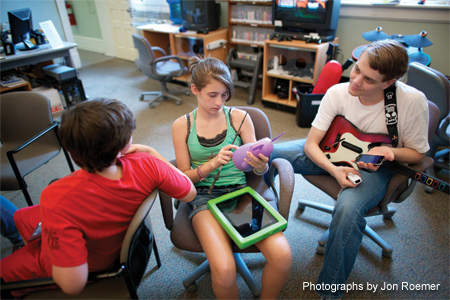
Max, 17, downloads a multiplayer game a friend has sent him, while 14-year-old Isa checks out his Facebook page, at the same time, texting a friend. Joe, an 18-year-old high school senior, and Danny, 17, riffle through a pile of sample video games left for them to test, as several other teens chat and rove about a ragtag space stocked with patched-together desktop computers. Bookshelves are laden with games for just about every console system known to man.
It’s a typical afternoon at Flemington (NJ) Free Public Library’s (FFPL) Mediatech Foundation. Open two to four hours a day, five days a week, the center’s a place for neighborhood kids to come hang out and mess with technology that many wouldn’t otherwise have access to. There are no kidney-shaped designer tables here and the lone iPad sits tethered in a corner. But the 836-square-foot room is neat and clean, the computers work, and the students who come to shoot the breeze and play games don’t care so much that the space doesn’t resemble an Apple store—they’re just happy that it exists.
“I don’t have a lot of money and I’d come to this place before I had my own computer so I could use the Internet,” says Joe, a graduating senior at Hunterdon Central Regional High School in Flemington, a small town of 4,600 about 50 miles from midtown Manhattan. “I use it to borrow the games and they’re all free,” says Joe, who’s been a regular since the Mediatech Foundation opened its doors in 2003. “But it’s not just where you go and play games. People are talking to each other. People make friends here.”
Mediatech’s founder, Warren Buckleitner, is standing across the room, out of earshot. But comments like Joe’s are what he lives for. The path to making the Mediatech Foundation a reality was long yet one that Buckleitner, a library trustee, former schoolteacher, and editor of the monthly Children’s Technology Review, never stopped pursuing, despite some push back from the community, staffing concerns, and a Spartan technology budget. To Buckleitner, the room represented a resource he realized his community needed more than a decade ago.
“The idea started from a problem,” says Buckleitner, a father of two teenage daughters, who moved to town when his oldest, now 19, started kindergarten. “There were kids complaining there was nothing to do in the downtown area, and it kind of bothered me,” he explains. “And being a teacher, it bothered me that our town was letting them down. I started thinking, what was the solution? I was always acutely aware of the potential of tech for keeping kids busy while teaching them.”
And busy they are. Mediatech boasts 14 computers—some purchased, others donated from local businesses including a storage company and also PC magazine—running variously on Linux, Windows, and Mac OS, and all see heavy use. There’s WiFi throughout the space, courtesy of CenturyLink, the local phone company. Consoles and games are available for Sony Connect, PlayStation 2, PlayStation 3 with Move, Microsoft’s Xbox 360, and Nintendo Wii, DS and 3DS. Plus, students can check out the 1,200 circulating video games, up to six per user, to take home.
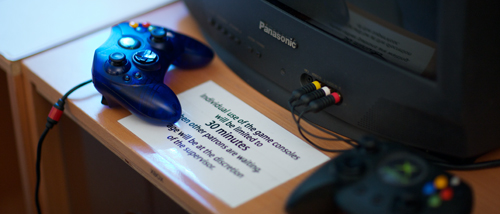
Students pledge to not bring in M-rated games, or visit improper sites online. And food? That’s verboten, too. But all the systems are outfitted with speakers, and there are no time limits on the machines. Every Friday is “Games Testers” day, a popular event at the Mediatech Foundation, when Buckleitner shows up with preview copies of games. Kids were delighted, on one recent summer Friday, to get their hands on "Harry Potter and the Deathly Hallows: Part 2."
“You get to play a lot of new games,” says 14-year-old Aleze, a seventh grader at the local J. P. Case Middle School. “If you don’t have a game at home or your parents can’t buy it for you, you can always come here. I type sometimes if I have a research paper. But I usually come here and play games. You can get loud, and there are always people. I like people.”
It’s a scene Buckleitner long envisioned. In 1998, on a stopover from the Bologna Children’s Book Fair, he visited a youth technology center in Lake Garda, Italy. There, Buckleitner imagined creating a similar place back home where local kids could have free access to technology.
After pitching the idea to the Rotary Club, parents, local businesses, and even students themselves, he wrangled an $800 donation from the Flemington-Raritan School District Parent Technology Committee, enabling him to purchase a domain name for the center, build a WordPress site, and formally launch the project.
The biggest obstacle? Finding a suitable space. But during a library board meeting, Buckleitner happened to discover a room upstairs. Essentially forgotten, the musty space housed treasures from the local historical society. There was even an elevator, at that time considered to be “an elevator going to nowhere,” he says.
At first, the idea of repurposing the room met with resistance from the historical society, which was concerned about moving its artifacts, including old newspapers, archived documents, and a collection of flint tools and arrowheads. However, when the local police department volunteered its former evidence vault as an alternative storage facility for many of the historical items, everyone agreed: the artifacts couldn’t be safer.
But renovations were desperately needed for the vacated space. FFPL agreed to kick in $100,000 from the May Fisher Stout Trust, a fund bequeathed to the library by a former patron, to paint, install lighting and carpeting, and hardwire the space, as well as put in bathroom facilities and other basic amenities like air-conditioning. The technology for Mediatech was cobbled together on a slender budget of approximately $18,000—nearly all donations finagled by Buckleitner himself from local businesses such as Flemington Car and Truck Country, an auto dealership, and the Rotary Club, he says.
“The computers are Frankenstein computers,” he says of Mediatech’s workstations. “Parts from one feed the other. It’s sort of a nightmare, but there’s a volunteer who watches over them. The main objective is to keep them limping along, to keep them working. And the kids also bring their own laptops. So we cleared off two tables, and there they play Mindcraft,” a construction video game with 3-D cubical blocks.
The room is managed by Carol Wachter, a senior library assistant and paraprofessional who’s the sole staff for the space. She catalogs the games, adding them to the library’s online circulation system. As Buckleitner brings in more games, she inputs those as well.
Her presence also makes Mediatech a friendly environment for all, allowing the library to more comfortably welcome families and other patrons through its doors. While the room was always open to anyone, Wachter’s supervision fosters a more consistent vibe. Wachter is also a calming force, short-circuiting some of the students’ rowdiness with her “teacher eyes,” says Buckleitner. “She seems strict, but actually loves the kids a great deal and knows a lot about them,” he says.
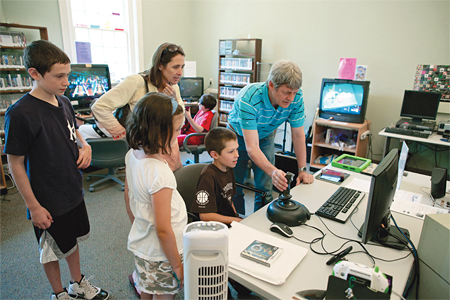
Wachter is also a strong advocate for the entire library, reminding teens that in addition to PCs and gaming cartridges, there’s a whole building full of great resources. “They’re definitely computer-oriented,” she says of Mediatech’s regulars. “But they occasionally come in for library assistance. Rarely do they do homework here. Not yet. We’re hopeful. But actually they have discovered we have movies downstairs, and that’s the next step.”
Buckleitner is pleased to have Wachter on board. In the beginning, he ran the foundation solo. If the alarm went off, he would be the one who had to go reset the system and talk to the police. During afternoons when Buckleitner had to attend to his day job, the kids would manage the place themselves—not a consistently reliable option. When FFPL agreed to step in to staff the space, Buckleitner drew a huge sigh of relief.
FFPL’s director, Shawn Armington, says Buckleitner was very receptive to the idea of partnering more closely with the Mediatech Foundation. Since then, Armington has noticed a shift in the way the space is used. Although the center began as an independent project of Buckleitner’s, coordination with the library happened fairly early on.
“It has become a very family-friendly space,” says Armington. “A lot of games are geared toward teens and preteens. But Warren’s collection also has games for a younger audience and we see those utilized a lot more. We have other people go up there, and had classes where volunteers helped with income taxes. And we use it for off-hours for computer classes, when Mediatech isn’t open. But we get a lot of kids after school so it’s something the library can offer to a certain age group that are regular users, and it’s very popular for certain kids who really are at risk. There’s a big mix there.”
During the summer, tech camps also use the center. Children aged six and up are introduced to Scratch, the MIT-designed software that teaches them how to program. At the end of the week, they show off their best projects, which have included a video game that illustrates the food chain. While age groups can vary wildly at the Mediatech Foundation, that can be a good thing. The older students often end up mentoring the youngest, and new friendships form over the common bond of technology.
Mediatech’s also been a springboard to bigger and better things. A bunch of its kids have gone on to college. The “graduates” leave with fond memories of the experience, for sure, but perhaps something more.
“I thought Mediatech was perfect,” says Joe, who created a public service announcement for the site as a school project. “In some ways when I was first coming here, there were people who were my age now, and it’s interesting to look back on
that, and now talk to people younger than me. I’d like to see more of these open up. And I’d really like to see this as a nationwide thing and have them in bigger cities. I’d like to see the place flourish.”
Join the Club
Looking to start your own game testers group? The Mediatech Foundation offers these tips:
- Canvas patrons about possibly donating their old computers, gaming systems, and games when they’re ready to upgrade to the latest versions.
- Pick a specific day or night to hold the club, which students and families can count on.
- Devise a simple set of ratings that kids can apply to games, such as “buy it, borrow it, bag it.”
- Make it a family affair—get parents involved, and include younger and older children.
- Put mature students in charge, and give them some responsibility for running the club. Let them pick games to demonstrate, teach new members how to play, or even try their hand at maintaining the “Frankenstein” computers.
- Encourage kids to create and edit reviews in video form (make sure parents sign off on permission slips before posting these clips online).
- Launch a gaming tournament, publicize it online, and invite local media.
Above all? Have fun.
| Author Information |
| Lauren Barack is a freelance journalist living in New York City. Her last feature for SLJ, “The Kindles Are Coming,” appeared in our March 2011 issue. |

Added To Cart
RELATED


RECOMMENDED
CAREERS
The job outlook in 2030: Librarians will be in demand
CAREERS
The job outlook in 2030: Librarians will be in demand
ALREADY A SUBSCRIBER? LOG IN
We are currently offering this content for free. Sign up now to activate your personal profile, where you can save articles for future viewing
ALREADY A SUBSCRIBER? LOG IN
Thank you for visiting.
We’ve noticed you are using a private browser. To continue, please log in or create an account.

Add Comment :-
Be the first reader to comment.
Comment Policy:
Comment should not be empty !!!