


2018 School Spending Survey Report
Christopher Franceschelli on the Art, Design, and Nutritional Value of Board Books | Up Close
Christopher Franceschelli has worn many hats from editor to creator to book packager. The busy bookmaker discusses his new work, Dinoblock, what makes a great board book, and how these tiny works of art are for more than just babies.
Publisher of Chronicle’s Handprint line of innovative books and creator of high-concept early learning titles like Alphablock (2013) and Countablock (2014, both Abrams), Christopher Franceschelli has worn many hats from editor to creator to book packager. The busy bookmaker discusses his new work, what makes a great board book, and how these tiny works of art are for more than just babies.
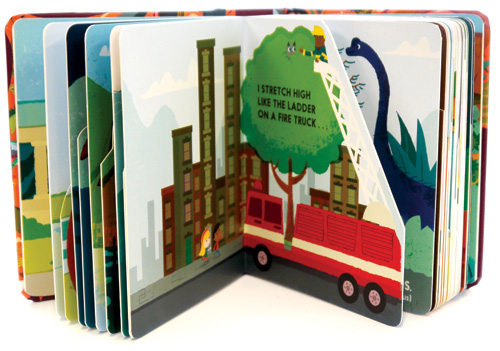 Tell us about your new book, Dinoblock (Abrams, 2015). It’s by far the most difficult board book with which I’ve been involved, particularly since I was initially convinced it would be a cakewalk. But the conundrum soon reared its ugly head: How do you give toddlers some concrete understanding of critters that disappeared millions of years ago, many of whom looked pretty much alike? How do you even explain what 130 million years might feel like? Thankfully, Peskimo, the husband-and-wife illustrator team, helped solve these problems by cleverly linking concepts with which three-year-olds might be familiar (“I stretch high like the ladder on a fire truck...”) with the actual dinosaur (“I am BRACHIOSAURUS”). What they did with the final gatefold is nothing short of brilliant.
You’ve worn many hats in the kid lit industry: publisher, editor, and creator. How and why did you get into the creation of board books particularly? I dearly love working with a broad range of books for all ages–but as English is not my first language, I’ve never felt entirely comfortable manipulating texts. But an equally compelling reason is that I trained as a printer and studied book design before heading off to college. Those experiences only deepened my affection for the physicality of books, for the dimensionality of paper, for the sheer hands-on joy of building a dummy.
Your board books play with sophisticated art and design elements. What’s your philosophy on board books? There’s the false mathematical equation that too many folks make—even those in the industry—that the younger the book’s intended audience, the cheaper it should be. Of course, the exact opposite should be the case: we should be pouring the most resources into making those first books the best and most memorable that children will ever encounter. It’s also true that all too often picture books are still far more likely to be taken seriously and be reviewed than board books. So it becomes far easier to publish some texts and illustrations as picture books even though they’re crying out to become a board book.
What are the special design and construction challenges in writing, illustrating, and creating a board book? For the board books that I publish on the Handprint list, that answer is really easy: apply exactly the same criteria as for any other format. Simply, that it be the best possible book. Perhaps there’s a bit more attention paid to the integrity of the book’s construction. In my parallel life as a book packager, most of the board books that I create incorporate some novelty component or feature. (Though novelty is such a horrible term. It reminds me of the cheap plastic freebies in the old CrackerJack boxes. Creative physical component is more accurate but hopelessly long-winded.)
There’s always some technical problem that needs to be tackled. Can we die-cut a particularly intricate shape? Can we ensure that a tab will pull smoothly even after the 100th tug? Others are challenges we set ourselves: Could we construct a board book whose individual leaves each have a different color edge, as in Natalie Marshall’s concept books? There’s real satisfaction in working through and solving such questions.
What’s your favorite way to see your books being used? Do you mind if babies and toddlers munch on your titles? Shared. The best board books are those that can accommodate four hands, be they those of a parent and child, two friends, or siblings, who can share a book and find joy in its spreads. As for munchability? Books intended for babies and toddlers are tested so thoroughly these days that they’re likely to be considerably safer than a loaf of Wonder Bread. I’ve often wondered why we can’t just spritz them with some vitamin solution and slap on a nutritional value label. So far I’ve managed to resist that impulse.

Added To Cart
RELATED


RECOMMENDED
CAREERS
The job outlook in 2030: Librarians will be in demand
CAREERS
The job outlook in 2030: Librarians will be in demand
ALREADY A SUBSCRIBER? LOG IN
We are currently offering this content for free. Sign up now to activate your personal profile, where you can save articles for future viewing
ALREADY A SUBSCRIBER? LOG IN
Thank you for visiting.
We’ve noticed you are using a private browser. To continue, please log in or create an account.
Add Comment :-
Be the first reader to comment.
Comment Policy:
Comment should not be empty !!!