


2018 School Spending Survey Report
'Teaching to Complexity' | Professional Shelf
When it comes to measuring text complexity, teachers and librarians know it’s not just about attaching a particular lexile number or other quantitative label to a book jacket. A new, practical tool walks educators through the process of selecting the best texts for instruction.
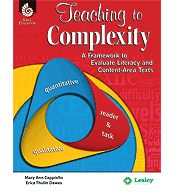 When it comes to measuring text complexity, teachers and librarians know it’s not just about attaching a particular lexile number or other quantitative label to a book jacket. The quality of the content and how the text will be used by students are essential pieces of the puzzle. In Teaching to Complexity: A Framework to Evaluate Literary and Content-Area Texts (Shell Education, 2014), Mary Ann Cappiello and Erika Thulin Dawes, both Associate Professors of Language and Literacy at Lesley University in Cambridge, MA, offer a perceptive examination of this complicated process. First, the authors take a close look at the distinctions between reading and literacy and the interdependency of reading, writing, speaking, and listening, asking teachers to consider the nature of these skills and their relationship to “disciplinary literacy” in science, social studies, mathematics, and the arts. The teaching of literacy isn’t limited to reading and it isn’t relegated to a specific block of time; instead it’s developed and reinforced throughout the school day in all subject areas. From there, Cappiello and Thulin Dawes move on to the how-to’s of evaluating literary and informational texts. Since teachers’ familiarity with literature for children and young adults and their access to good school libraries varies, the authors provide a solid introduction to the basics, including how to identify and use genre characteristics, content, text structure, language, and visuals to assess a particular text. A chart with constructive questions scaffolds the analysis, and an in-depth discussion of Barbara Kerley’s Those Rebels, John and Tom (Scholastic, 2012) puts the approach into practice. Once teachers are comfortable identifying quality texts, it’s time to determine how to use them as teaching tools. Instructional purposes and practices are identified along with specific questions that guide decision making. Again, Kerley’s picture book biography serves as an example as the authors demonstrate how a particular text can be used to achieve several different teaching goals. So what does all this have to do with text complexity? Ultimately, readers, and what they are reading, matter a great deal; text complexity doesn’t exist as a separate, definitive measure. The chapter, “Considering Complexity,” analyzes Common Core Reading Anchor Standard 10, delineates the limitations of quantitative measures, and focuses attention on the importance of the reader and the reader’s purpose. “Complexity in Context” brings it all together by walking teachers through the process with examples of specific texts and how decisions about their use in instruction impacts the level of complexity across different grades. With “Questions for Reflection” at the end of each chapter; “Resources for Locating Children’s Literature,” a long list of relevant websites; and a Digital Resource CD that allows for easy reproduction of the book’s charts, guides, and templates, this is a timely, practical tool for teacher training programs, professional development, and curriculum planners. Consider using it in conjunction with Teaching with Text Sets (Shell Education, 2012), a related title in which the authors do a top-notch job of demonstrating how to use collections of print and digital texts from various genres to support differentiated instruction across the curriculum.
Added To Cart
RELATED


RECOMMENDED
CAREERS
The job outlook in 2030: Librarians will be in demand
CAREERS
The job outlook in 2030: Librarians will be in demand
ALREADY A SUBSCRIBER? LOG IN
We are currently offering this content for free. Sign up now to activate your personal profile, where you can save articles for future viewing
ALREADY A SUBSCRIBER? LOG IN
Thank you for visiting.
We’ve noticed you are using a private browser. To continue, please log in or create an account.

Add Comment :-
Comment Policy:
Comment should not be empty !!!
C. Staley
Is this a framework for all levels or just children's books primarily?Posted : Feb 11, 2015 09:49