


2018 School Spending Survey Report
Masters of Real-World Horror | SLJ Day of Dialog 2013
A panel of YA authors shared with nearly 250 children’s librarians what inspired them to write about “tough stuff” at SLJ’s annual pre-BEA Day of Dialog event. Moderated by Karyn Silverman—SLJ blogger and librarian and educational technology department chair of the Little Red School House & Elisabeth Irwin High School—the panel’s discussion flowed from dark to light, touching on topics such as school shootings and Nazi Germany.
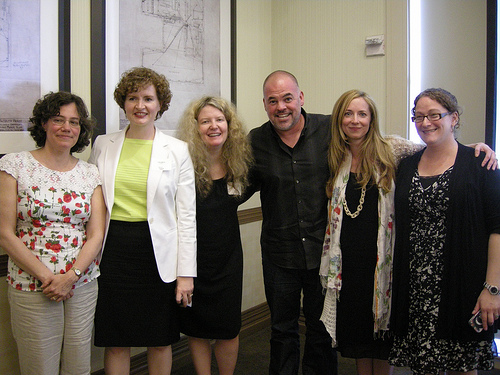
The "Real World Horror" panel at SLJ's Day of Dialog 2013 included (l. to r. ) authors Elizabeth Wein, Julie Berry, Elizabeth Scott, Matthew Quick, Adele Griffin, and moderator Karyn Silverman.
Following Holly Black’s keynote on her recent foray in horror, a panel of YA authors shared with nearly 250 children’s librarians what inspired them to write about “tough stuff” at SLJ’s annual pre-BEA Day of Dialog event. Moderated by Karyn Silverman—SLJ blogger and librarian and educational technology department chair of the Little Red School House & Elisabeth Irwin High School—the panel’s discussion flowed from dark to light, touching on topics such as school shootings and Nazi Germany. Matthew Quick, author of The Silver Linings Playbook on which the Oscar-winning film is based, grew up in a blue collar town “where you didn’t talk about depression or mental health,” and where being a young man who cried about books meant that there was something “profoundly wrong with him.” Quick didn’t read much YA fiction as a teen, but revered Mark Twain, Charles Dickens, and Ernest Hemingway as father figures. His new title, Forgive Me, Leonard Peacock (Little, Brown, 2013), centers on a potential school shooter, and was galvanized by a deeper look into recent alarming events. “Literature is the place where I can tell the truth as I see it," Quick told the rapt attendees. I’ve met so many kids that are like Leonard: kids that so many people would easily dismiss, when really they are dark storms on verge of crisis. I wanted to explore what happens when kids don’t pull the trigger,” shared the former educator-turned-author. Adele Griffin took inspiration from a personal tragedy when writing Loud Awake and Lost (Knopf, 2013): very much like Amber, her main character, Griffin’s own brother experienced a life-altering car accident that left him and his family indelibly scarred. “Fiction can be so humbling. I don’t know why I got the privilege to write this story, but my brother had to experience the actual tragedy,” she confessed. She enjoys writing for teens because “they’re on the brink of their own lives, and have a certain suppleness to their character. They’re willing to be changed and can still be changed.” Elizabeth Wein. Code Name Verity author, also endured a similar cataclysmic car accident that resulted in her mother’s death, and left her brother quadriplegic to this day. “This experience in my background is what drives me to write about horrible things, and how despite them, you go on living,” she shared. Wein’s new title, Rose Under Fire (Hyperion/Disney, 2013), is a companion novel for the acclaimed Verity, and follows another brave female pilot who is caught behind enemy lines during World War II and is detained in a Nazi concentration camp. Known for her hard-hitting novels, Elizabeth Scott’s works are a far cry from the “issue-books” and frothy “Sweet Valley” series that were prevalent during her teenage years. The idea for Heartbeat (HarlequinTeen, 2013), about a girl whose mother is brain-dead and being kept alive by machines for the sake of the unborn baby, came to Scott when she read an obituary about a woman in a similar situation. The author opined, “everyone has a well of misery somewhere in their lives and some people are drawn to it more than others. Writing about the dark places that some of us don’t want to see is incredibly liberating, because you’re telling something that needs to be said.” Quick shared that he tries to make order out of chaos in his books, and he hopes that readers can understand that “It’s not just chaos. We’re not alone.” His biggest fear is not connecting with people through his writing. “You just hope that when you stick your hand out someone will be there to shake it,” he said. Scott is most afraid of people’s inaction. “I’m afraid of people who look away when something bad is happening. How it can be obvious that someone is suffering, and how easy it is to look away.” Despite the heavy themes, Silverman pointed out that in each of the panelists’ books, redemption came in the form of friendship, and that in these stories, making connections with other people continued to be a saving grace. Julie Berry, author of All the Truth That’s In Me (Viking, 2013), loves titles with romance, but “one of the things that makes me nuts is when romantic stories are spun so that the love interest is the total focus for the main character. Without friends we’re toast—girls should know that their lives gain richness not from some guy, but by a core of female friends.” The mostly-female panel emphatically agreed. Friendship is the definitive theme in Wein’s Verity, and makes a comeback in her latest book, she noted. While conducting research on Nazi concentration camps for Rose Under Fire, she discovered a common thread: “From reading the survivor accounts, I gathered that if you didn’t have people to count on, then you wouldn’t make it. Friendship had to be present so that my character could survive.” Wein added that the underlying theme for her new book is hope, something that the authors agreed the real world—and the teens they write for—need to see more each day. In a place where Sandy Hook and other tragedies continue to be in the news, YA novels can be conduits for teen readers. And Berry argues that this is good for kids. “The scales are falling from their [teens’] eyes. They see the news; they see the truth in their communities. There is no guarantee that you can make it through life unscathed. There are no answers, but the novel is the closest we can come to approach them; there can be a messy resolution, or a blossom of hope.”
Added To Cart
RELATED


RECOMMENDED
CAREERS
The job outlook in 2030: Librarians will be in demand
CAREERS
The job outlook in 2030: Librarians will be in demand
ALREADY A SUBSCRIBER? LOG IN
We are currently offering this content for free. Sign up now to activate your personal profile, where you can save articles for future viewing
ALREADY A SUBSCRIBER? LOG IN
Thank you for visiting.
We’ve noticed you are using a private browser. To continue, please log in or create an account.
Add Comment :-
Be the first reader to comment.
Comment Policy:
Comment should not be empty !!!