


2018 School Spending Survey Report
"Know-Nonsense" Guides to Honing Writing Skills
Writing inspiration from the likes of Jack Gantos and Patricia Reilly Giff awaits middle graders.
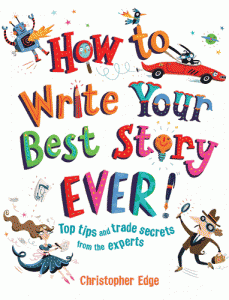 Christopher Edge takes readers on a wacky romp through the creative writing process in How To Write Your Best Story Ever!: Top Tips and Trade Secrets from the Expert (Barron's, Aug. 2016; Gr 2-5), illustrated by Nathan Reed. Divided into two sections, the book tackles the roots of great storytelling: attention to character, setting, plot, and so on. Edge reminds students that writers shape texts through the tools such as similes. He urges potential creatives to focus on what they want readers to imagine or come away with. The second half of the book explores the key tenets of different genres. "How To Write Your Best Scary Story Ever!" suggests that writers spook readers by engaging their five senses and avoiding cliché. A "Language of Horror" vocabulary web (literally, a spider is shown at its center) provides a plethora of scare-inducing words. This format is replicated for each genre. The book's energetic layout and Reed's bold cartoon illustrations of aliens, pirates, and even a banana dressed as a thief combine to produce a work that students will pore over and return to. School libraries and classrooms will want to have this on hand as both a resource for kids and educators. Teachers could easily use the "Word Web" sections to inspire and improve student writing.
 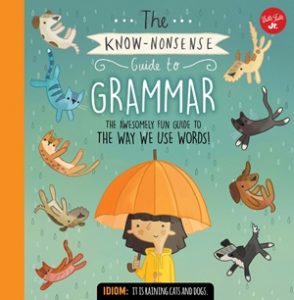 Heidi Fiedler's The Know-Nonsense Guide to Grammar: An Awesomely Fun Guide to the Way We Use Words! (Walter Foster, Apr. 2017; Gr 3-6) is designed for students who may need just an extra push when it comes to grammar ("This book tackles key concepts that are introduced in school, but might be confusing the first time around...."). Three sections focus on different parts of speech, general grammar rules, and common literary devices. The text, in conjunction with Brendan Kearney's soft and rounded cartoon illustrations, uses humor to make potentially complex concepts comprehensible. For instance, the spread on alliteration features a "happy hedgehog" that "has a huge house" and the entry for adjectives stars a band of brave pirates. With large font, consistent layouts, and friendly artwork, this is an accessible resource for kids who are looking to build on or strengthen their grammar skills, either at home or in the classroom.
 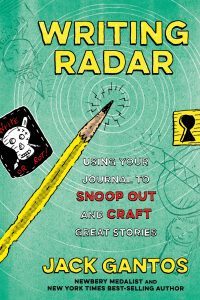 If there was ever a writer aspiring wordsmiths should look up to, it is Jack Gantos. The award-winning author has dazzled young people and adults alike with his unconventional yet deeply funny characters, plots, and themes. Gantos, smartly predicting such a demand for his valuable insights, has penned Writing Radar: Using Your Journal To Snoop Out and Craft Great Stories (Farrar, Aug. 2017; Gr 4-8), an approach to storytelling that emphasizes structure and patience. SLJ's starred review called Gantos a true craftsman, "embellishing, sanding, and varnishing his work." The aim of the guide is twofold: to provide technical insights to readers through explanations (e.g., using real-life conversations for dialogue, illustrating how to locate the action and emotions in a story), and, on a more subtle level, to demonstrate these skills through various anecdotes (the pros and cons of mining one's life for story material are hilariously explored in the chapter " 'I'll Kill You,' Said My Sister."). Upper elementary and middle schoolers will treasure this mentor text, while educators can check out Gantos's website for more tips, resources, and videos.
 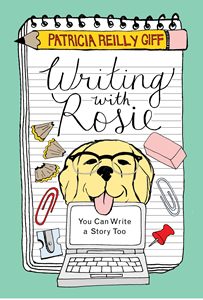 And finally, for a slightly younger audience, Patricia Reilly Giff and her lovable pup Rosie take readers on a stroll through the creative process in Writing with Rosie: You Can Write a Story Too (Holiday House, Aug. 2016; Gr 3-6). The work opens with Giff in her living room. Sitting with her eyes closed, she's trying to conjure up a character. But Rosie's canine antics are too difficult to ignore so Giff must adapt. Rosie's constant interruptions are also a tacit reminder of the daily smaller challenges writers face. Even readers without an interest in storytelling can benefit from this examination of balancing external stimuli and internal thoughts. Giff uses her novel Lily's Crossing as a launching point for discussion, providing passages from the book that best exemplify character development, setting, action, and more. Chapters range from one to four pages in length and could easily be excerpted for classroom use, especially the segments in which Giff writes in the second person ("Think of places you know.... Splash on some color. Paint the walls; wallpaper the kitchen.").
Added To Cart
RELATED


RECOMMENDED
CAREERS
The job outlook in 2030: Librarians will be in demand
CAREERS
The job outlook in 2030: Librarians will be in demand
ALREADY A SUBSCRIBER? LOG IN
We are currently offering this content for free. Sign up now to activate your personal profile, where you can save articles for future viewing
ALREADY A SUBSCRIBER? LOG IN
Thank you for visiting.
We’ve noticed you are using a private browser. To continue, please log in or create an account.

Add Comment :-
Be the first reader to comment.
Comment Policy:
Comment should not be empty !!!