


2018 School Spending Survey Report
“Are there any girl bears?”: Gender and the 21st Century Picture Book
Apparently I’m under the impression that it would be a good idea to write a potentially hot and toasty topic while I walk beneath the Spanish sun with limited access to the internet. But this is something that’s been on my mind a lot recently, and it all came a head the other day as [...]
Apparently I’m under the impression that it would be a good idea to write a potentially hot and toasty topic while I walk beneath the Spanish sun with limited access to the internet. But this is something that’s been on my mind a lot recently, and it all came a head the other day as I was assigning various picture books to the branches of my library system.
In the course of my work I get a lot of books to consider for both purchase for NYPL and review for Fuse #8. I was, on this day, handling some copies of 100 Animals on Parade by Masayuki Sebe. Compared in some circles to Richard Scarry it received stellar reviews from Kirkus, PW, etc. and is a lot of fun to thumb through. Unfortunately I noticed something that Kirkus had taken the time to note (well played, Kirkus). In one spread we see a long line of marching bears. The child reader is asked to find a lot of things, and must answer the question, “Are there any girl bears?”
Come again? Seeing as how the bears are bereft of genitalia and boobs (which, don’t get me wrong, I’m grateful for) one has to assume that the book is asking kids to say that the bears with the long eyelashes, bows in their hair, and dresses are the girls. Oh, how far we’ve sunk back down, eh? Time was when folks got more than a bit peeved when you started limited girls in this way. The most famous example of this involves the aforementioned Richard Scarry. I’m sure you guys are familiar with the following comparison between Richard Scarry’s The Best Word Book Ever, 1963 and 1991.
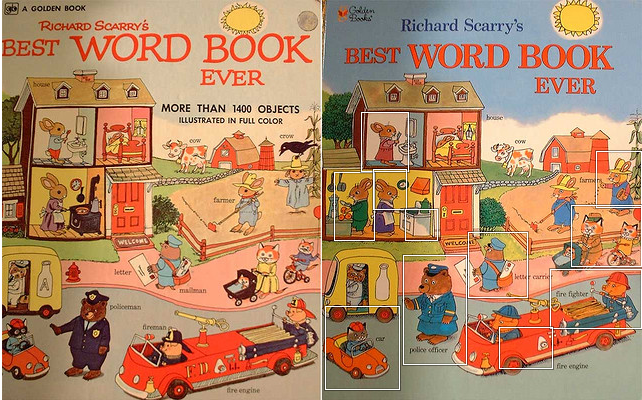
This is a very fun and very systematic look at how Scarry was given a more open-minded outlook on the roles men and women play in everyday life. And sure, the girls have dresses and bows and the men suits and sneakers, but at least their work in the home and occupations are a bit more interesting. These days I’m noticing that some children’s books, particularly those of the mass market ilk, are going the way of our toy stores. Which is to say, they’re getting VERY gendered. Sometimes this is directly because of the gendering of toys (the “girl version” of LEGOs was kind of the last straw for me) but other times it’s just a reliance on the old sexist standbys.
The exception to all of this is our 21st century Scarry, Brian Biggs. I’m consistently impressed with his Everything Goes series, and Mr. Biggs takes special care to challenge your assumptions. Everything Goes In the Air, notably, makes the pilot of the airplane a woman without blowing it up into a great big deal. Women fly planes. It happens. Deal with it.
Fair play too to books like Guinea P.I.G.: Pet Shop Detective series where the guinea pig in question is female (Sasspants is her name, solving crimes her game) and doesn’t walk around with four foot eyelashes and loads of pink accoutrements.
I’d be interested in what other folks have seen as well. Naturally there are some books out there for girls that don’t want to be fairy princesses and boys who like reading a pink book (like Babymouse) once in a while for fun (though admittedly the amoeba spin-off was ostensibly aimed at the boy folks). Still, is it just me or are things getting frighteningly boys-do-this / girls-do-this these days in our children’s literature?


Added To Cart
RELATED


RECOMMENDED
CAREERS
The job outlook in 2030: Librarians will be in demand
CAREERS
The job outlook in 2030: Librarians will be in demand
ALREADY A SUBSCRIBER? LOG IN
We are currently offering this content for free. Sign up now to activate your personal profile, where you can save articles for future viewing
ALREADY A SUBSCRIBER? LOG IN
Thank you for visiting.
We’ve noticed you are using a private browser. To continue, please log in or create an account.
Add Comment :-
Be the first reader to comment.
Comment Policy:
Comment should not be empty !!!