


2018 School Spending Survey Report
A Librarian’s Guide to OER in the Maker Space
Open educational resources (OER) are a boon to maker activities, according to library media specialist Laura Fleming, who provides related tips and links to fun, cost-effective projects.
What are OER?
OER are teaching, learning, and research resources that reside in the public domain or have been released under an intellectual property license that permits sharing, accessing, repurposing—including for commercial purposes—and collaborating with others. They include educational materials, such as lesson plans, games, textbooks, tests, audio, and video. In addition to being free, these no-cost teaching and learning materials are available online for anyone to use, modify or share with others.This use, reuse, and remixing of instructional materials is a powerful way to gain and share knowledge. Because OER are customizable and flexible, they can be used very effectively to support students to achieve their learning goals. Made possible by digital technology, the innovation potential of OER become apparent when they are used to instill and encourage lifelong learning habits in students, enabling them to take their learning into their own hands and pursue topics or areas that interest them, for free, even at home, and outside the hours of the school day. Not only can educators easily create innovative classroom resources, but students also have the power to produce self-generated content that directly supports their needs or interests, to create their own personal learning environment.The benefits of using OER in the maker space
The Williamsfield School District in Illinois has been leading the OER charge. Officials focused on strengthening science, technology, engineering and math (STEM) instructional content and practice and on opening up innovative learning opportunities for students. They achieved this through the use of OER in place of their outdated textbooks. “The biggest transition for me, from what it was like before to what it is like now, is that kids can do things that they’re interested in, instead of having one prescribed way to do things that comes from a textbook,” says Lori Secrist, a science teacher in the district. Because of their capacity to stimulate creativity, OER are the perfect complement to the maker space movement. The maker movement shares a philosophy with the open source movement by fostering creativity, collaboration, and personalization in schools. The integration of OER into well-planned, well-designed maker spaces brings together physical and virtual interests and activities and expands learning opportunities. Maker spaces are especially well suited for OER because they demonstrate inquiry-based learning and allow students some autonomy to direct their learning. Librarians, teachers, and students are limited by the space and supplies available for maker spaces, often because of budget constraints. But through OER, educators or students can pull high-quality content into maker spaces. Leveraging OER can help bridge the gap between what educators have in a maker space and the deeper learning opportunities they want students to have. OER Commons is a digital library where educators can find resources to develop, support and amplify their maker space practices. The site is searchable by subject, grade level or standard. Users can also filter results to include topics, such as activities and labs, games, videos, lesson plans, and interactive tools.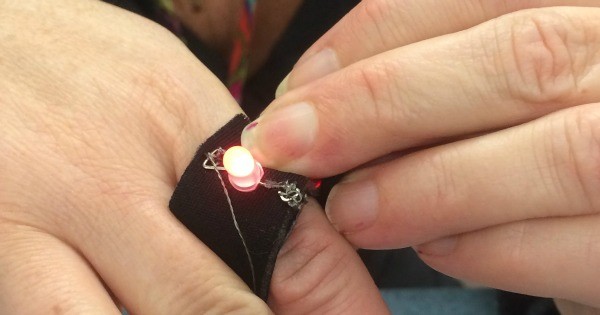
A switch-activated circuit from "High-tech Fashion."
maker space-related resources on OER Commons:
Activities and Labs: LEGO Robots Hair and Snail Challenges 3d Printing in the Classroom Discover Engineering High Tech Fashion Maze Challenge Construction and Destruction Using Castles and Catapults What is a Robot? About the author: Laura Fleming is a library media specialist at New Milford High School in New Jersey, as well as the author of Worlds of Making: Best Practices for Establishing a Makerspace at Your School (Corwin Press, 2015).

Added To Cart
RELATED


RECOMMENDED
CAREERS
The job outlook in 2030: Librarians will be in demand
CAREERS
The job outlook in 2030: Librarians will be in demand
ALREADY A SUBSCRIBER? LOG IN
We are currently offering this content for free. Sign up now to activate your personal profile, where you can save articles for future viewing
ALREADY A SUBSCRIBER? LOG IN
Thank you for visiting.
We’ve noticed you are using a private browser. To continue, please log in or create an account.
Add Comment :-
Comment Policy:
Comment should not be empty !!!
Tani nocleg Szczecin
Ekstra, że nareszcie się zarejestrowałem.Posted : Oct 06, 2015 11:54