



2018 School Spending Survey Report
Magic Realism x2 (Bone Gap and The Accident Season)
Happy 2016. I closed out the old year by frantically reading my way through a backlog of wonderful (and not so wonderful) books. Today, to start the new year on the right foot, I’m catching up on discussing some books I read ages ago but have been avoiding writing about. Also! A week from today […]
Happy 2016. I closed out the old year by frantically reading my way through a backlog of wonderful (and not so wonderful) books. Today, to start the new year on the right foot, I’m catching up on discussing some books I read ages ago but have been avoiding writing about.
Also! A week from today most of us will be in or en route to Boston, or else enviously reading #alaleftbehind tweets, so we’re in the homestretch! We’ll be reading and posting like mad all week and right on up through (and possibly past!) ALA.
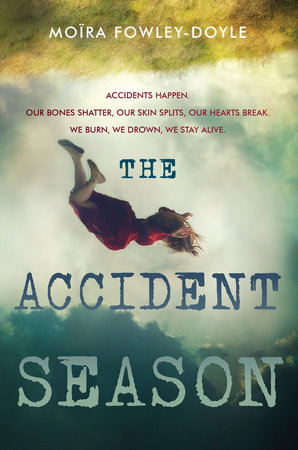
Kathy Dawson Books (Penguin), August 2015
Reviewed from final copy
A relatively quiet magic realist text about family abuse, silence, and the healing power of love, this has been overshadowed by 2015 favorite Bone Gap. Which is a shame, because this is a wonderful book.
The writing sings — especially the haunting refrain, the accident season song from the exquisite corpse poem the characters write. Almost every word is perfectly placed. There’s a sense of magic and also a practical mundanity to the world Fowley-Doyle depicts, and it’s just right. As a reader, I never felt something was being hidden; I came to the realization with Cara that there were strange things, secrets, and darkness hiding.
It’s also a deceptive book, mixing a problematic love story (sort-of step-siblings) and friendship on the top layer above the seething pit of secrets; it’s very meta, in fact, because that layering is exactly what Cara in particular is doing to hide from the truth behind the accident season and the way some accidents are not accidental at all. And it’s a beautiful take on magic realism, managing to be both true to the literary conventions of that tradition and also feel pretty definitely Irish (especially the use of the ghost and the ghost house, which both draw on ideas rife in the Celtic tradition).
I’ve read this twice now and it only got stronger on the second go; here’s hoping the RealCommittee (and all of you) give this a closer look.
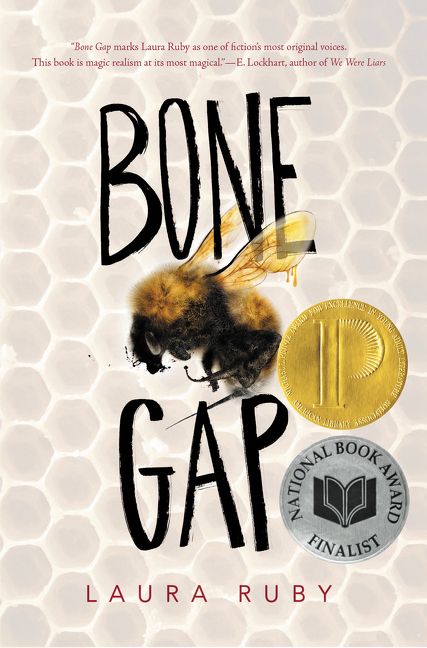 Bone Gap, Laura Ruby
Balzer + Bray, March 2015
Reviewed from final copy
Oh Bone Gap. Everyone loves this book. I love this book. I don’t really want to belabor it’s strengths, which are many, because I think we all know them. (But if you want a refresher, may I point you to the New York Times Book Review? Or the glowing review from The Book Smugglers? Or the three starred reviews or the NBA finalist sticker on the front cover? Or the fact that it swept the Pyrite? I could also point out the luscious writing, the use of mythology, the subtle glimmers of humor, Finn and Petey’s relationship, the characters in general, and on and on and on…)
But at our Printzbery table, one of the librarians in attendance said something I can’t get out of my mind. This is a somewhat inexact quote, but basically: “For a book that spends so much time telling us women are more important than their looks, and is getting good press for never describing their physical selves, it sure is obsessed with their looks and seems to make everything ultimately about appearance.” Also: it’s all in a male voice. I think both of these are thoughts worth exploring more deeply, especially as this is a book that has received a lot of attention for being feminist. I agree with both, but also think it’s not accidental and may be part of the larger conversation Ruby is having with the world via her readers — but that’s not definite, and that this question existed is worth noting. I also don’t know if this matters for the RealCommittee, since it’s an award for literary excellence and not for MESSAGE, but since the awesomeness of the book isn’t actually a question and lovefest conversations are pretty boring, this is the conversation that is intriguing me.
The other thing worth investigating is how this seems to be a book that hits readers rather differently depending upon the reader’s familiarity with the Persephone myth, one of the strongest elements in a discussion of the literary strengths on display. I didn’t think this was all 100% perfectly executed, but the way the myth resonates in Roza’s story was just right; emotional winter, a loss of growth in the sense of forward momentum — yes and yes. I think the more you know the source material, the more impressive the novel is in straight up literary terms; the magic realism here is actually something between magic realism and contemporary (sub)urban fantasy and a mythic retelling, and it’s the reworking of the mythic material that succeeds most, but a few readers who didn’t come of age on Greek mythology and/or the complete works of Rick Riordan have said that they were left feeling a little bit “huh” because they didn’t get what was going on, and the book was thereby diminished.
There is no question that this is a serious frontrunner, and I wouldn’t be surprised (nor dismayed) to see it recognized, but I’d love to hear arguments for and against because again, all the loving has been drowning out the more complex conversation I’d like to have about Bone Gap.

Added To Cart
RELATED
FICTION
PREMIUM
The Shy Book
FICTION
PREMIUM
Luna and the Night
FICTION
PREMIUM
Miriam and Her Dancing Shoes


RECOMMENDED
CAREERS
The job outlook in 2030: Librarians will be in demand
CAREERS
The job outlook in 2030: Librarians will be in demand
ALREADY A SUBSCRIBER? LOG IN
We are currently offering this content for free. Sign up now to activate your personal profile, where you can save articles for future viewing
ALREADY A SUBSCRIBER? LOG IN
Thank you for visiting.
We’ve noticed you are using a private browser. To continue, please log in or create an account.

Add Comment :-
Be the first reader to comment.
Comment Policy:
Comment should not be empty !!!