



2018 School Spending Survey Report
It’s All In the Wrinkle in Timing: Changes Are Afoot!
I figured it out. If this whole librarianship ship doesn’t pan out for me (I’ve held down various library jobs for 14 years but nothing in this life is certain) I’ve decided on my back-up career: Film critic of children’s books-to-movies. Granted, I’ve no film background (aside from being married to Matt) but I’ve noticed […]
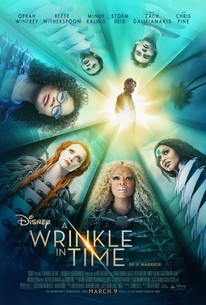 I figured it out. If this whole librarianship ship doesn’t pan out for me (I’ve held down various library jobs for 14 years but nothing in this life is certain) I’ve decided on my back-up career: Film critic of children’s books-to-movies. Granted, I’ve no film background (aside from being married to Matt) but I’ve noticed that there’s a great big gaping hole in the market for this kind of a reviewer. Critics of children’s films may exist, but how many specialize? Nope. I’m settled. It’s the part I was born to play, baby.
The other night the aforementioned husband and I had a chance to see the new Wrinkle in Time movie. If you are unfamiliar with the adaptation of Madeleine L’Engle’s best known work, then you are probably also unaware of the fact that the film has been receiving somewhat mixed reviews. Generally I try to avoid reading reviews before seeing a film, but it’s tricky not to stumble over them in your daily life. In the end, I figured I had to see what was going on for myself.
This is the part where I’d usually do a rousing critique, but what’s the point? I am not, by my nature, a film critic. Anything I might conceivably say will probably have been said somewhere by someone better informed and more eloquent than I. But let’s get back to that idea of me trying on the mantle of a film critic of children’s books-to-movies. That’s a little different. And, to be frank, a bit more interesting.
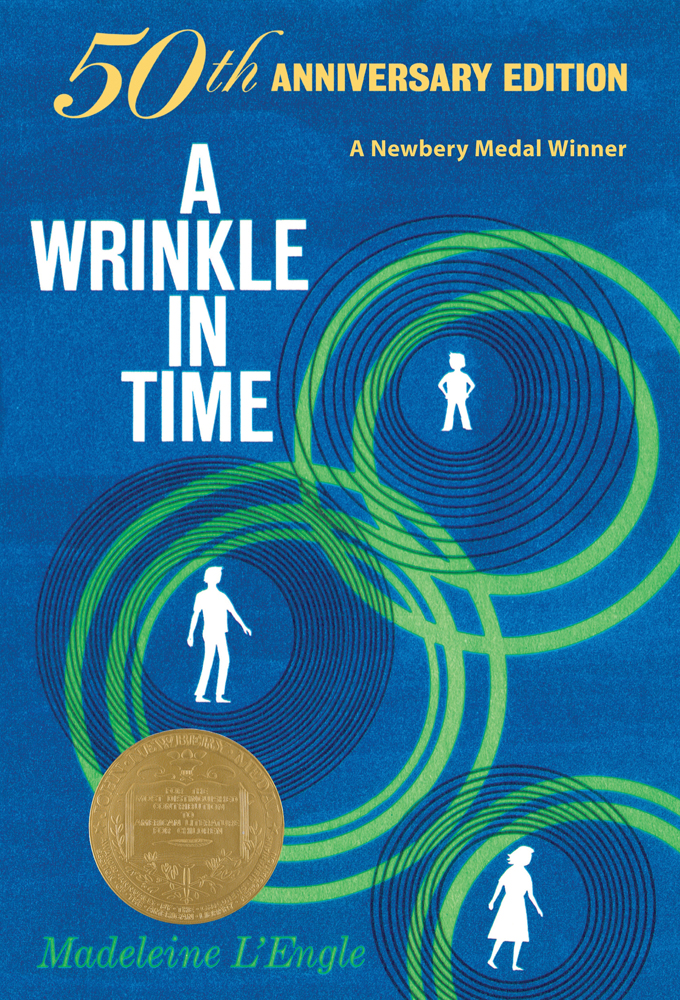
Today we’re going to examine Ava DuVernay’s film strictly through the lens of how it differs, improves upon, and detracts from the original book. But to do that, I need to set up some ground rules:
 1. You will hear critics of the film say that adults are incapable of getting it because it was created for children and we are imbued with an inadequate supply of wonder. I think that’s fairly silly. Whether a film is created for kids or adults, it should be the best possible film it can be.
2. Folks will occasionally say that the book is unfilmable. Let’s just work from the viewpoint that anything can be adapted with enough skill and artistic vision.
3. Spoilers ahead. Here be dragons.
All good? Let’s begin. And by that I mean, let’s try looking at what was changed:
Sandy and Dennys, We Hardly Missed Ye
I’m starting off with a big change from the book right at the get go. Which is to say, the erasure of Sandy and Dennys. And why is the Dennys name plural? Focus, Betsy, focus! That’s not the issue right now.
If you didn’t notice that the twins didn’t make it into the film, be of good cheer. Most folks don’t remember them from the books anyway. In fact, you’d be perfectly fine with forgetting about them until you get to Many Waters, and if you wanted to forget about that book as well, no one’s going to blame you. When people decry the changes made to the film, they don’t miss the twins. Of course, if they continue to make these films and they actually get to Many Waters, it’s going to take some quick talking to explain why we’re watching these two guys at all.
In an interview with HelloGiggles the screenwriter Jennifer Lee explained why they were essentially exchanged for the new girl bully character. Alas that bully, named Veronica, is almost as entirely two-dimensional as the twins were. I mean, she harbors a secret shame about her weight but that’s about as interesting as she gets. Given a choice, I wouldn’t have minded cutting her along with the twins. Mean girl tropes supported the empowerment narrative the film was setting up but they’re a dead end when it comes to creativity in storytelling.
Fantasy + Science Fiction + Religion (Minus the Science Fiction and Religion) Equals . . .
One of the reasons people give for the fact that the book A Wrinkle in Time was rejected by publishers so many times is that it’s such a strange combination of fantasy, science, and religion. Indeed, that is one of its charms. L’Engle was comfortable with this dichotomy (trichotomy?). Moviemakers, less so. You can certainly embrace one of those three qualities, but at the expense of the other two.
Here’s a question: Did anyone else find it odd that a tesseract was never adequately explained in the film? We all remember this image in the book of the tesseract.
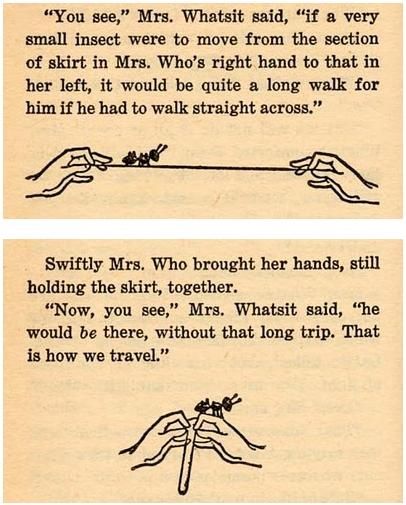
Folks questioning whether or not such a thing is possible can find a rather lovely explanation at Refinery29 this month. But in the film, the science surrounding the titular wrinkle in time is omitted, as is much of the science of the book. This is not to say there isn’t some lovely science at work. The film begins with Meg’s dad showing her a Chladni plate where vibrations move sand into different patterns (a lovely complement to the upcoming June biographical picture book about Sophie Germain, by the way). Meg, however, isn’t allowed to be seen as a smart science and math geek like she is in the book. It’s as if we can’t have her being browbeaten by the bullies AND be good at a subject in school. They haven’t excised her brains entirely since at one point she’s allowed to talk about thrust. And there’s also a nice geometry at work when she rescues her dad. But her love of science is as subdued as the film’s. The closest thing we get to a tesseract explanation is an image that appears behind Meg’s dad during his big TED talk to the government.
 As for religion, fuggeddaboutit. Adults that go back and reread A Wrinkle in Time are often surprised by how religious it is. It’s not The Lion, the Witch, and the Wardrobe levels of Christianity, but it’s still there.
In the movie Mrs Whatsit doesn’t get to turn into an androgynous winged centaur-like angel creature. Instead she resembled a flying artichoke, which was an interesting take and not a terrible one. I happen to enjoy artichokes. But, of course, get rid of the flying centaur people and you’ll get rid of the psalms to the Lord. That’s probably the most obvious religious portion of the book. The other involves name-dropping Jesus. In the book the kids are encouraged to name the people who have been fighting the darkness on earth. Einstein, Marie Curie, and Gandhi get name-checked, but don’t wait around for Jesus. He’s nowhere to be seen.
Auntie Beasts of the Southern Wilds
Nope. There is no Aunt Beast in the movie . . . . sorta. According to various news reports, many attempts were made to include Aunt Beast in the final product of the film, but nothing quite worked. She is there, to a certain extent. During one of the Happy Medium’s visions we see what looks to be furry versions of the aliens in Arrival while the Medium says something about “Aunt Beast”, but that’s the whole enchilada. Going into the movie I knew about this change and I was upset by it. But when I watched the film in person I realized that it actually made a lot of sense to cut that sequence out. I love it, but consider how the film works vs. the book. In the book Meg, her father, and Calvin tesser away from Charles Wallacce, leaving him behind, arriving on the planet of Aunt Beast. Then Meg receives her gifts and returns to get him. In this movie, she goes to get her dad, Charles Wallace is ensnared, her father attempts to tesser Meg and Calvin away, and she resists, staying to save Charles Wallace alone. That makes sense! Do you honestly think you’d believe it if you saw her dad allowing her to return there after he was trapped for so long? They shortened the movie considerably by cutting all that out, and it really improves the flow of the narrative.
Charles Wallace
But for me, more than any other problem with the adaptation, the change that made me the saddest was how the movie handled Charles Wallace.
 Some have taken issue with the child actor that portrayed Charles Wallace in the film. I find this somewhat unfair. Charles Wallace has, in the past, struck me as nothing so much as an escapee from an E.L. Konigsburg novel. He’s your typical wise-beyond-his-years child savant, and that’s a hard role to embody without coming across as creepy or annoying. I did find it a pity that DuVernay didn’t spend more time on reinforcing the affection between Meg and her little brother. As the movie reached it climax, I found myself realizing that it had opted to tell, and not really show, the two of them affectionately. He warms her milk, but they do not hug. He defends her on the playground and insists she join the quest, but there’s no snuggling. They added the detail that he’s adopted, I guess to explain why he doesn’t resemble anyone else in the family, but then why don’t we get a scene of Meg first meeting her new baby brother and bonding with him? All this means is that when he turns evil at the end and she saves him with the power of love, I wasn’t crying. And that was killer crying material.
But that’s not the biggest problem there. The biggest problem is that Charles Wallace isn’t allowed to be human. In this version he is perfect. And even though L’Engle did write him along those lines, she knew that it was imperative for IT to ensnare Charles Wallace through hubris. Remember, in the book Charles thinks he can go into the mind of IT and keep a portion of himself safe. In the film, the red-eyed man just has to count by twos and Charles Wallace is lost. It was quick and efficient, but I would have much preferred him to have been lost through his own devices.
All told, I found the film interesting and frustrating. That said, I would welcome a sequel. That principal of the school definitely got adequate face time on the screen. Might we be seeing more of him in the future? If so, I suspect there won’t be any avoiding the seraphim and the singing mitochondria. Let us see where this all goes next.

Added To Cart
RELATED


RECOMMENDED
CAREERS
The job outlook in 2030: Librarians will be in demand
CAREERS
The job outlook in 2030: Librarians will be in demand
ALREADY A SUBSCRIBER? LOG IN
We are currently offering this content for free. Sign up now to activate your personal profile, where you can save articles for future viewing
ALREADY A SUBSCRIBER? LOG IN
Thank you for visiting.
We’ve noticed you are using a private browser. To continue, please log in or create an account.

Add Comment :-
Be the first reader to comment.
Comment Policy:
Comment should not be empty !!!