


2018 School Spending Survey Report
Invented Dialogue and the Conundrum of the Picture Book Biography
You know, it’s not that I’m a big nonfiction reader or advocate in particular. It’s just the nature of children’s librarianship in this day and age. You simply cannot work in the field without encountering nonfiction and, as a result, sometimes you end up with granite hard opinions about the form. Take me, for example. [...]
You know, it’s not that I’m a big nonfiction reader or advocate in particular. It’s just the nature of children’s librarianship in this day and age. You simply cannot work in the field without encountering nonfiction and, as a result, sometimes you end up with granite hard opinions about the form. Take me, for example. My trajectory in matters of nonfictiony nonfictioness (why yes, I was an English major, why do you ask?) proceeded accordingly:
Fear nonfiction based on the books I recall from my youth which, each and every one, would at some point ask me what the major goods and services of, say, Iowa were. Read nonfiction as part of my job with great initial reluctance. Love nonfiction and discover that not only is it fun to read but I can now supplement my tawdry elementary/middle/high school education (to say nothing of college) with facts that at the very least make for good dinner party conversation. Defend nonfiction against those that do not slot neatly into my understanding of the form since, as in any religion, it is the newest converts that are inevitably the most zealous. Take myself down a notch.At the moment I am transitioning between #4 and #5 with feet planted firmly in both spheres. This is exemplified in no better way than in the case of invented dialogue. For lo, when it comes to picture book biographies in which situations and characters are fleshed out through dialogue that has no basis in fact, I am unforgiving and cruel. Beautiful books with art that would make a blind man weep are crushed beneath my toes as I note and distain moments of verbal creativity. In general I stand by my anti-faux dialogue stance but recently I’ve been cajoled into softening, if not abandoning, my position.
You see this Saturday past I hosted a Children’s Literary Salon at NYPL called “Personal Passions and Changes in Nonfiction for Children and Teens: A Conversation with Marc Aronson”. During the course of his talk Mr. Aronson gave a fascinating review of the history of American children’s nonfiction over the decades. It was absolutely engrossing. Afterwards we had a chance to engage in a bit of a Q&A and I got to bring up the subject of invented dialogue. Marc’s answer was to the point. Quote, “We should be honest about saying what we do and do not know.”
Simple, right? And yet it caused me a bit of soul-searching. There is a new crop of picture books out this year that make up dialogue left and right with scant backmatter to boot. I shall not name names. They know who they are. On the flip side, there are the books that are honest about what they do and don’t know. These books are hardly new. Consider a lot of Jonah Winter’s books like The 39 Apartments of Ludwig Van Beethoven or Here Comes the Garbage Barge. But we really don’t have a separate section for them. Heck, we don’t even have a name for them!
Consider the following books that use invented dialogue but are honest about it. These books are all shelved in my library’s Picture Book section and not the Bios or Nonfiction. Is that the best place for them? Impossible to say. Still, they represent an interesting phenomenon in the world of publishing. Mostly they are accurate, but when they are not they confess the fact. To wit:
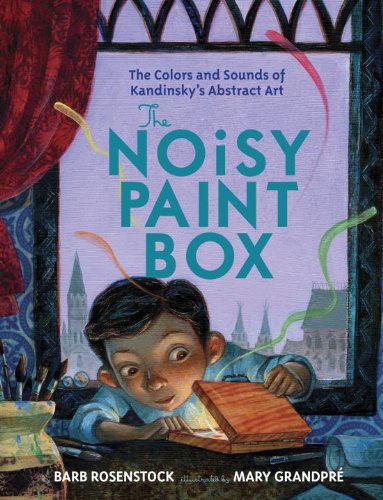
The Noisy Paintbox: The Colors and Sounds of Kandinsky’s Abstract Art by Barb Rosenstock, ill. Mary GrandPre – I confess that when I first read the book I was incensed at the unnecessary family dialogue in it. That was before I noticed the note in the back that makes plain the fact that Ms. Rosenstock felt obligated to include the section but that it’s made up. That’s honest. Of course if she hadn’t included it I am convinced it would have been a stronger book. As it stands, the GrandPre illustrations do much to elevate it above the pack.

Albie’s First Word: A Tale Inspired by Albert Einstein’s Childhood by Jacqueline Tourville, ill. Wynne Evans – This one’s so honest that the subtitle itself gives away the game. “Inspired by” is a smart way of putting it. You can’t blame Tourville for wanting to tell this story to the best of her ability. If Albert Einstein didn’t speak until he was three then what was his first word? That’s the kind of question that could launch a thousand picture books. Thus far, this is the only one I know of.

Ben Franklin’s Big Splash: The Mostly True Story of His First Invention by Barb Rosenstock, ill. S.D. Schindler – Again with the honest subtitle. This one veers awfully closely to the true story, but Rosenstock (sound familiar? See: The Noisy Paintbox) confesses that there are just some things out there we cannot know. It’s an awfully engaging book too. I should note that the three books I’ve mentioned here thus far all received stars from Kirkus.
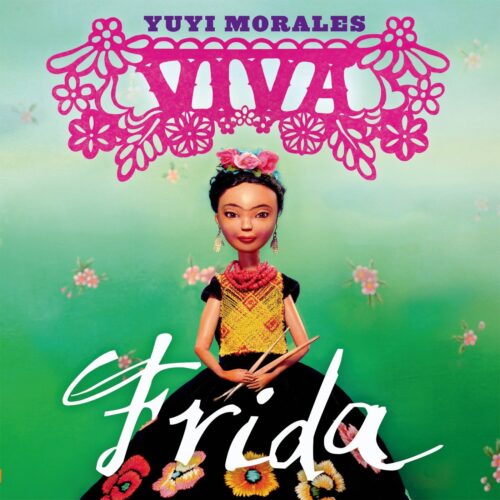
Viva Frida by Yuyi Morales – This one’s a little different than the other books here since I don’t think Morales sees this as a bio in any way, shape, or form. Frida Kahlo merely serves as the starting point. The real story here is one of inspiration in everyday life. Kirkus called it an homage to Kahlo’s art. Could be. All I know is that it’s awfully interesting but not the sort of thing you usually run across.
By the way, in case you’re curious about attending a Children’s Literary Salon, you can see our upcoming topics here. 2014 is closing out with a bang, I do believe.


Added To Cart
RELATED


RECOMMENDED
CAREERS
The job outlook in 2030: Librarians will be in demand
CAREERS
The job outlook in 2030: Librarians will be in demand
ALREADY A SUBSCRIBER? LOG IN
We are currently offering this content for free. Sign up now to activate your personal profile, where you can save articles for future viewing
ALREADY A SUBSCRIBER? LOG IN
Thank you for visiting.
We’ve noticed you are using a private browser. To continue, please log in or create an account.
Add Comment :-
Be the first reader to comment.
Comment Policy:
Comment should not be empty !!!