


2018 School Spending Survey Report
In the Groove with Andrea Davis Pinkney | Interview
Weaving history into her profiles of such Motown groups as the Supremes, the Temptations, and the Jackson 5, Andrea Davis Pinkney has crafted an evocative and insightful look at a sound and an era.
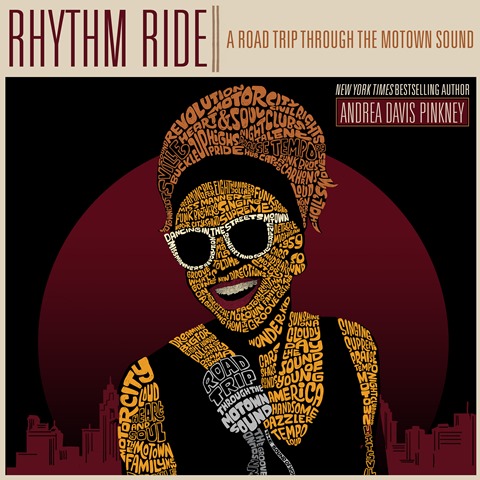 Music is powerful, as any fan can attest: listening to a favorite song or album often brings back a rush of memories and feelings. The Motown sound has a unique place in pop culture: from “My Girl” to “What’s Going On,” these songs capture the mood of the era yet still reverberate with fans today. With Rhythm Ride: A Road Trip Through the Motown Sound (Roaring Brook, Sept. 2015; Gr 5-9), Andrea Davis Pinkney provides a loving tribute to one of the most influential record companies of all time. Weaving history into her profiles of groups such as the Supremes, the Temptations, and the Jackson 5, Pinkney has crafted an evocative and insightful into the Motown vibe. What inspired you to write the book? Has the music of Motown always been part of your life? Last winter, several Motown Moments (MMs) happened within days of one another that inspired me to write Rhythm Ride. MM #1: While ice skating, I was listening to a Motown soundtrack and jamming to the music. I caught myself thinking, “I’m experiencing joy right this minute because of this incredible sound.” It occurred to me that though I had never met Motown’s founder, Berry Gordy, his genius was having a direct effect on me 55 years after he’d shaped his musical empire. MM#2: Blaring from my teenage son’s bedroom was a Jackson 5 soundtrack. My kid was getting down to the Jacksons’ hit song “ABC.” He was the same age as Michael Jackson during MJ’s Motown heyday but was loving the music decades after it had first become popular. MM#3: Ten minutes into a taxi ride, I noticed that the driver, a college student, had created his own Motown playlist. When I asked him why he was listening to this music, he said, “I love Motown, lady!” MM#4: I took my mom to see Motown the Musical on Broadway, and honey, let me tell you, it was one big party! The most impressive aspect of the evening was the audience—it was filled with people of all ages, races, and nations. From the moment the curtain went up, the aisles were alive with dancing and singing. What struck me most was that for three hours, the audience was like a family at a reunion. We shared something in common. Motown’s music had become a part of each and every one of our hearts and souls. I knew then—I had to write this book!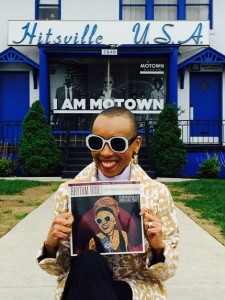
Andrea Davis Pinkney at Hitsville U.S. A. Detroit, MI, home of the original Motown headquarters
Rhythm Ride is narrated by the Groove, a guide who takes readers on a tour throughout Motown (“You ready, child? Let’s go./I’ve got my pulse on all the roads. And side streets. And avenues. And alleyways.”). What inspired you to develop the Groove? The Groove is an elder whose voice is that of someone who’s traveled the journey to Motown’s development. He takes readers on a road trip filled with street signs and scenes. The Groove is modeled after James K. Snowden Jr., my second cousin, who everybody in our family calls Scoopy. He was a legendary deejay, voiceover actor, and recording industry executive. Scoopy knows everything about the origins of black song and instrumentals. He can reel off information about the nuances of musical genres and black singer-songwriters. And the man can tell some good stories! That’s why the adaptation of Scoopy’s vernacular is so important in telling the Motown story. My cousin has experienced key moments in the history of black entertainment that the rest of us can only dream of. He’s got the inside track on the performers who started as teen wannabes from the neighborhood, and became legends. Scoopy’s spent time hanging out with Smokey Robinson, The Jackson 5, Diana Ross, Otis Williams from The Temptations, The Commodores, Rick James, and lots of other notables. Scoopy even has an impressive collection of their framed gold and platinum records with personal inscriptions to him. As soon as I knew I was going to write Rhythm Ride, I called on Scoopy to tell it like it was. You incorporate social issues and history seamlessly into the work. Can you talk about why you chose to include so much about the tenor of the times? “The Motown sound” is best known for its unmistakable “makes-you-feel-good” rhythms. But Motown music was also called “the Sound of Young America.” That’s because when Motown was churning out hit after hit, the world was on the brink of a cultural, political, and racial revolution. Motown music was one of the most powerful agents of social change. Berry Gordy, the executives who worked at Motown, and the performers themselves saw their music as pivotal to racial progress. It was Berry’s vision to erase the hard-and-fast lines of what was deemed “race music”—recordings that were meant for only African Americans. Motown’s records were successful in “crossing over” so that all races of people could enjoy the music. One of my favorite chapters of the book—and one of the most painful to write—is a chapter called “Ugly Sightseeing.” This is a dark, treacherous part of the Rhythm Ride journey, in which the Groove takes readers onto a road that includes visions of the September 15, 1963 Sixteenth Street Church Bombing in Birmingham, AL; the stand Claudette Colvin took as she refused to give up her seat on a segregated Montgomery, AL, bus; and the 1955 Mississippi Lynching of Emmett Till. There are also references made to the March on Washington, the Vietnam War, and the assassinations of Martin Luther King Jr. and John and Robert Kennedy. With songs like Marvin Gaye’s “What’s Going On,” Motown was there through all of these events, giving voice to our fears, lifting us up, helping us keep the faith. It was important to me to show readers that Motown had a tremendous impact in shaping America’s history.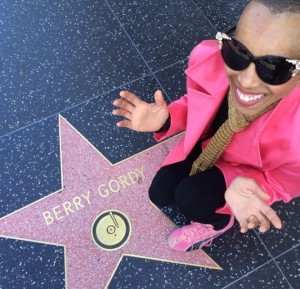
Andrea Davis Pinkney in front of Berry Gordon's star, Hollywood Walk of Fame, Hollywood Boulevard, Los Angeles, CA.
One of the strengths of the book is that you incorporate information about the songs so well into the text. Did you listen or watch a lot of performances before or while you were writing? Can you discuss your research process? I’ve always been a Motown fan, but in crafting the book’s narrative, I became obsessed with all kinds of popular music from the late 1950s through today, which I listened to nonstop. One of the best research tools was visiting Hitsville USA in Detroit, the original Motown headquarters, where the company was launched, and where the recording studios are now open the public for viewing. That was a transformative experience. I got goose bumps knowing that I was walking the same floors where Steve Wonder and Smokey Robinson had once made musical magic. I then started to collect and wear vintage clothing of the era. Theater buff that I am, I saw Motown the Musical on Broadway five times, taking careful notes with each viewing. The show is written by Berry Gordy and is based on his autobiography To Be Loved. I spent hours interviewing members of the Motown family, who mounted an exhibit at Harlem’s Schomburg Center for Research in Black Culture, which I visited for long periods. As if that wasn’t enough, I then appointed myself an ad-hoc member of the Motown family by studying choreography from some of the most pivotal moments in television history, in which performers like the Supremes and the Jackson 5 appeared on The Ed Sullivan Show. I even took a trip to Hollywood to see Berry Gordy’s star on the Hollywood Walk of Fame. At home in Brooklyn, where I live, I spent many evenings loading the dishwasher while pretending to be Diana Ross (giggles). It got to the point where my family started to say things like “That book has turned you into a Motown-ista!” (laughs). The design and images also help make the book so powerful, from the selection of photographs to page numbers, which are outlined in mini records. Did you have any input into the overall look? With the advent of social media, we live in an age where images pack a lot of power, especially for young readers. It was important to me that Rhythm Ride have a visual “language” that’s evocative enough for modern viewers but also reflect the Motown era. My amazing Roaring Brook editor, Katherine Jacobs, and senior art director Anne Diebel were great at allowing me to be integral to the process of selecting images for the book. They also allowed me to have a lot of input on the book’s cover, which includes a spectacular illustration by artist Dave Scott. Rhythm Ride’s shape and size echo that of a record album. It’s a beautiful package. One of the great things about your book was how you also called attention to lesser-known Motown artists like the Funk Brothers. The Funk Brothers were a group of musicians who played behind Motown singers during recording sessions. Most folks don’t know them by name, but while enjoying Motown music, millions of kids were also listening to, dancing to, bopping to, snapping to, and singing praises to the Funk Brothers’ brilliance, without even realizing it. As the Groove, tells readers, “These were men whose contributions to the success of Hitsville’s songs were just as important as the ones who did the crooning. These guys were what people call behind-the-scenes. Not many fans saw them, but everybody who loved a Motown hit, loved what these dudes did. Speaking as the Groove, I know what it’s like to be in the background. Nobody ever sees me. But they feel me, child. Yes, they feel me. That’s why behind-the-scenes is a beautiful place to be. Without behind-the-scenes, there’d be no strength in front-and-center. You see child, there’s backbone in the background.” Do you have a favorite Motown group or song? (laughs) That’s like asking which of my two children is my favorite. I love them all for each of their unique rhythms. The same is true of Motown songs and the men and women who brought them alive. Looking for subjects for a nonfiction author/artist study? Consider Andrea Davis Pinkney and Brian Pinkney. Barbara Auerbach explores the work of this inimitable duo in "No More Yucky Spinach." Listen to Andrea Davis Pinkney reveal the story behind Rhythm Ride, courtesy of TeachingBooks.net.
Added To Cart
RELATED


RECOMMENDED
CAREERS
The job outlook in 2030: Librarians will be in demand
CAREERS
The job outlook in 2030: Librarians will be in demand
ALREADY A SUBSCRIBER? LOG IN
We are currently offering this content for free. Sign up now to activate your personal profile, where you can save articles for future viewing
ALREADY A SUBSCRIBER? LOG IN
Thank you for visiting.
We’ve noticed you are using a private browser. To continue, please log in or create an account.

Add Comment :-
Comment Policy:
Comment should not be empty !!!
Sandra Jenkins
I loved seeing Motown the Musical last year with my teenage daughter and singing and dancing along with the rest of the audience. Can't wait to read this book. Right now I'm going to play some Smokey Robinson!Posted : Sep 16, 2015 08:06
Natasha Wing
When I saw Andrea's cover, I immediately recognized the art! He had done a portrait of Malala in the words of her speech and I thought he'd be perfect to illustrate children's books, and I was right! Andrea, contact me if you want to do another children's book with him - I have an idea!Posted : Sep 09, 2015 03:11