Brussels entrepreneur incorporates everyday objects, such as buttons, bottle caps, and string, into digital-based learning with a new app.
A classroom lesson can be taught as easily with a piece of chalk as through a touch screen. Today, however, schools are stuffed with digital tools, along with a belief that students will be disadvantaged without access to the latest technological gizmo. Julie Anne Gilleland believes otherwise. To her, learning is what the youngest children, in particular, do naturally. Children weave stories, make connections, and uncover the world around them, whether that’s through a skein of yarn or through an ereader. Hence the program she co-founded,
Think with Things, an educational method that links everyday objects to learning moments, yet still incorporates technology to connect educators and parents to the lessons.
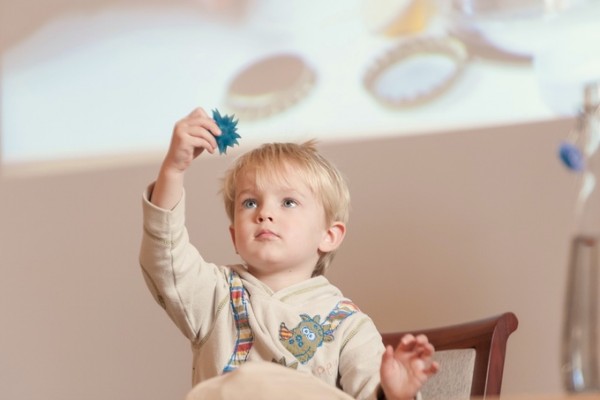
Harry demonstrating the Power of Things with his mom Isobel.
Image from the Think with Things Kickstarter page.
“I do believe we have adopted too strong of a ‘digital will solve everything’ thinking in education, but there are some real amazing things that technology allows us to do, that we didn’t have before,” Gilleland said by email from Brussels. “We believe that a balance between real world tools and digital tools is the next step.” Think with Things grew from Gilleland’s thesis at Finland’s
University of Helsinki about learning environments built with preschool children, rather than for them, she says. After graduating, she launched a children’s learning space called
Turtlewings in Brussels, where young kids and teachers work together with bits of cork, buttons, and even bottle caps. Getting kids to play with found objects is relatively simple. Turning those interactions into a lesson? That’s the idea behind Gilleland’s current launch. She hopes to create an app that lets schools, along with parents, catalog the things in their own space, and then marry them to learning plans others have used. To that end, Gilleland turned to
Kickstarter looking to raise just north of $38,000 to build a “digital cookbook,” she says. Her team has gleaned the content from pilots over the past year, including a six-week Google+ session with educators from 13 countries including Ireland, Nigeria, and Turkey. Interest is finally sparking among educators. One potential backer wrote she was “…keen to find ways of using digital technology that move away from children playing games on tablets” on Think with Thing’s
Facebook page. Pricing for the app would be about £1.99 ($3), with a yearly subscription expected at £99 ($151) a year, according to its Kickstarter page. The app is expected to work on mobile devices from smartphones to tablets. “[The app] will allow teachers who need inspiration to find it, and it will not stop there, but also give them ideas, questions, set up formulas to make a great lesson with found materials,” Gilleland says. “This will create a community library of everyday objects and their connected learning possibilities.”
Get Print. Get Digital. Get Both!
Libraries are always evolving. Stay ahead.
Log In.







Add Comment :-
Be the first reader to comment.
Comment Policy:
Comment should not be empty !!!