



2018 School Spending Survey Report
Guest Post: Melissa Stewart and Diversity in Thinking
I don’t often do much in the way of guest posts on this site. Aside from the occasional Walking and Talking episode by Steve Sheinkin it’s almost always a one-woman show over here. That said, when someone presents me with something particularly interesting and asks if they can post it on my site, I can’t […]
I don’t often do much in the way of guest posts on this site. Aside from the occasional Walking and Talking episode by Steve Sheinkin it’s almost always a one-woman show over here. That said, when someone presents me with something particularly interesting and asks if they can post it on my site, I can’t help but say yes. Author Melissa Stewart is known as the author of more than 150 children’s nonfiction books off possible types and reading levels. Most recently she was the one behind the magnificent No Monkeys, No Chocolate and the highly praised and well reviewed Feathers: Not Just for Flying, amongst others. Add in her bachelor’s degree in biology from Union College in Schenectady, NY, and her master’s degree in science journalism from New York University and you’ve got yourself a bonafide nonfiction expert in the field.
Today Melissa breaks down the nonfiction books winning the awards, whether or not kids read nonfiction, thoughts on what we can do to support high-quality expository nonfiction, and the ten STEM-themed expository nonfiction titles that should be in every elementary book collection.

In recent years, narrative nonfiction—books that tell a true story or convey an experience—has been all the rage. Children’s book editors are acquiring it. Reviewers are praising it. Awards committees are honoring it. And educators are buying it.
But what about kids? What do they think? To be sure, some young readers are enthusiastic about narrative nonfiction, but others—not so much. They’d rather read expository nonfiction—titles that describe, explain, or inform.
What accounts for the difference in opinion? How children think. The idea that different students think and interact with the world in different ways isn’t exactly revolutionary, but it has literacy implications that are worth keeping in mind.
Most of the adults who are passionate about children’s literature—editors, book reviewers, librarians, literacy coaches, classroom teachers, award committee judges—are naturally drawn to the Arts, humanities, and social sciences. They’re also drawn to stories and storytelling. So it’s no surprise that most of the nonfiction titles honored by the biggest awards in children’s literature employ a narrative writing style to recount historical events or highlight the accomplishments of influential people.
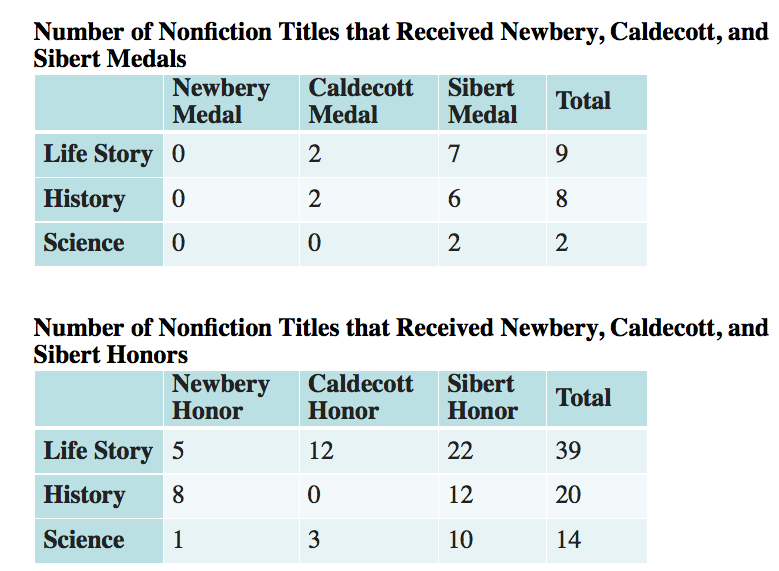
 In looking at the nonfiction winners for the Newbery and Caldecott since 1995 and for the Sibert (which focuses on nonfiction) since its inception in 2001, it’s easy to see that life stories—biographies, autobiographies, and memoirs—are the champs with a total score of 48 (9 medals, 39 honors). History titles come in second with 28 winners overall, while STEM (Science, Technology, Engineering, and Math) titles trail behind with just 16 winners.
A closer look at the life stories shows that 27 of them focus on key historical figures, while 13 feature visual artists, writers, or musicians. Just 8 highlight the accomplishments of scientists.
Combining all these figures, the totals work out to 55 winning social studies titles and 24 winning STEM books. In other words, social studies titles win these highly-respected awards more than twice as often as science titles. That’s a big difference.
Why is it important to spend some time pondering this discrepancy? Because plenty of children aren’t naturally drawn to the Arts, humanities, and social sciences. Budding scientists, engineers, mathematicians, computer programmers, accountants, electricians, and plumbers don’t necessarily crave an emotional connection with a central figure in a book. Instead, they get excited about data, facts, ideas, information.
These concrete, analytical thinkers enjoy reading engaging expository nonfiction with clear main ideas and supporting details. They’re captivated by books that emphasize patterns, analogies, concepts, comparisons, and calculations. As they read, their goal is to use the information they gather to learn about the world and its possibilities and their place in it. That’s what they want more than anything.
 We all know that the big awards generate big sales. Award-winning books end up in classrooms and libraries across the country, and that greatly increases the odds that they’ll end up in the hands of the children who need them most.
Because expository STEM books just don’t seem to win the most highly-respected awards as often as other kinds of nonfiction, I worry that young analytical thinkers are being underserved by the children’s book community. We need to honor these children by:
- purchasing and recommending more high-quality expository nonfiction
- choosing engaging, richly illustrated expository nonfiction as read alouds
- using carefully crafted expository nonfiction as mentor texts in writing workshop
Studies show that many primary-grade students who are enthusiastic about science, technology, engineering, and math get turned off to these subjects by the time they reach high school. If we want the United States to remain a global innovation leader, we must foster all the potential STEM talent our country has to offer. We need to fuel the curiosity of young analytical thinkers, and one way to do that is by nurturing and nourishing their minds with books they love.
The good news for us and for young readers is that during the last decade, expository nonfiction has undergone an exciting transformation. Once upon a time, it was boring and stodgy, but many of the expository nonfiction books being published today feature engaging text, captivating art, and dynamic design. As a result, these titles delight as well as inform.
Here are ten STEM-themed expository nonfiction titles that I think should be in every elementary book collection:
- An Egg is Quiet written by Dianna Hutts Aston
- Bone by Bone: Comparing Animal Skeletons by Sarah Levine
- Born in the Wild: Baby Mammals and Their Parents by Lita Judge
- Creature Features by Steve Jenkins and Robin Page
- Frogs by Nic Bishop
- Look Up! Bird-Watching in Your Own Backyard by Annette LeBlanc Cate
- Mysterious Patterns: Finding Fractals in Nature by Sarah C. Campbell
- Neo Leo: The Ageless Ideas of Leonardo da Vinci by Gene Barretta
- Tiny Creatures: The Invisible World of Microbes by Nicola Davies
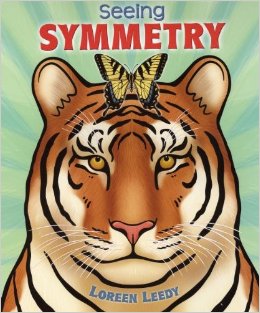
- Seeing Symmetry by Loreen Leedy
Melissa Stewart is the author of more than 150 science books for children and the co-author (with Nancy Chelsey) of Perfect Pairs: Using Fiction & Nonfiction Picture Books to Teach Life Science, K-2 (Stenhouse, 2014). To learn more about Melissa and her work, please visit her website.

Added To Cart
RELATED


RECOMMENDED
CAREERS
The job outlook in 2030: Librarians will be in demand
CAREERS
The job outlook in 2030: Librarians will be in demand
ALREADY A SUBSCRIBER? LOG IN
We are currently offering this content for free. Sign up now to activate your personal profile, where you can save articles for future viewing
ALREADY A SUBSCRIBER? LOG IN
Thank you for visiting.
We’ve noticed you are using a private browser. To continue, please log in or create an account.
Add Comment :-
Be the first reader to comment.
Comment Policy:
Comment should not be empty !!!