


2018 School Spending Survey Report
Going to the Movies with Katherine Paterson | "The Great Gilly Hopkins"
A conversation with the award-winning author on the release of a major motion picture adaptation of The Great Gilly Hopkins.
 The film version of The Great Gilly Hopkins is now in theaters around the country. Katherine Paterson’s beloved 1978 novel is about a bright but troubled foster child who goes to desperate lengths to be reunited with her birth mother. She finds love and a real family where she least expects it—in the home of Maime Trotter, whom Paterson says is her all-time favorite character. In the movie, she is played to a tee by Kathy Bates. I spoke on the phone to the Vermont author last week. Congrats on the new film. How very exciting. What’s it like to see characters you've created on a page come to life in this larger-than-life format? I've seen the movie at least nine times. And I love it every time. I think I'm the only one among my writer friends who truly loves to see adaptations of their work into film. You can see how wonderfully these actors have enlarged my vision. People have asked, Is it like you imagined it? I've said, No, it's bigger than I imagined it. Really! Other people have brought their own imaginations and their abilities and their life experiences to my work, just like a reader does. It makes the work bigger than it was; it comes to life in a new way with every reader, actor, and director. And my son wrote the script, and it's a good script! So it is very much a family affair. Oh, boy. (LAUGHS) Both of your sons are producers bringing this novel to the screen. Did it help having a proven track record with Bridge to Terabithia under your collective belts? We thought it might. But suddenly—Disney wouldn't talk to us anymore, because the day after Bridge opened, they began calling about the sequel. And we said, There is no sequel. And they said, What? And we said, There's no sequel. And so they don't speak to us. (LAUGHS) So, on this one, the boys decided to form a production company and go out independently, which would give us control. But of course it didn't give us money. And money is needed when you make a film.
 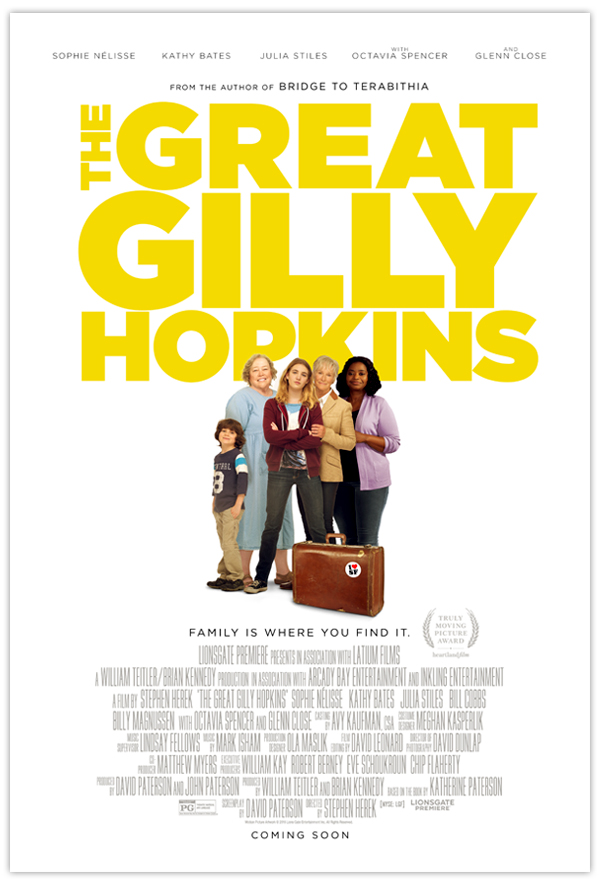 Why Gilly, why now? Next to Bridge, it's the most popular of my books, so in a sense, there's a built-in audience. It took nine years from when we started working on it to the film premiere. I [also] think it's the right timing because this is a country that is so divided, [with] people not speaking to each other. There's so much anger and hurt, and such terrible racial tensions that have been underground for a while [and are] now suddenly exploding all over the place. Here's a movie in which people come from anger and somehow manage to talk to each other and care about each other. I think Octavia Spencer [who plays Ms. Harris] is totally brilliant. She confronts Gilly's racism. I think Kathy Bates in her wonderful way, with humor and heart, loves this child just the way she is. We have to love each other as we are. Rereading the book, which was published nearly 40 years ago, I notice that there is very little that anchors it in a specific time. Was that intentional? Can you talk about the decision to set the film in the present day? I thought I was setting it in a specific time! There was no attempt on my part to make it timeless. It was probably was a good decision to make [the film] more up-to-date. For one thing, it takes a lot of money to stage a period piece, and it didn't seem all that important for the film to be set in the '70s. You have mentioned some of the brilliant casting. I really did think they did a phenomenal job in finding the actors, and young Sophie Nélisse (Gilly) is just terrific. Isn't she magic? She nailed it. Just the right combination of fierce determination, a little snark, and tender vulnerability. Were you involved in helping them develop their characters? Other than your cameo, did you spend much time on the set? (LAUGHS) That had to be fun. When they were trying to cut scenes to shorten it, I said, "Cut me, cut me, cut me! I do not further the plot!" (LAUGHS) I didn't really have anything to do with the casting except that when they would say things like, "we're approaching Kathy Bates to be Mamie Trotter," I thought, oh, my—wouldn't that be just a dream come true if Kathy Bates would say yes. And so, my son would say, "We want an autographed book and the note." (LAUGHS) So, potential cast members got autographed books and notes and saying how wonderful it would be if they signed on. But I don't think that was why they said yes. I think they liked the script. The Trotter character is so vitally important. Oh, yes. I got this wonderful note from Kathy Bates when I wrote to her and said it was hard for me to think of Trotter, who has always been my favorite character of all my books, without now seeing Kathy Bates. Me, too. She wrote, "Dear Katherine, thank you for your kind words. It means a lot to me that you were happy with my interpretation of a truly heroic woman, especially in these terrible times. It is important to realize that one right-minded, compassionate and determined person can make a difference by shaping the destiny of a child. We need more examples of this love in our world." Isn't that wonderful? As internationally loved as Gilly is, it's also been one of the all-time most challenged books. Why do you think that is? My kids used to cheer every time I'd find out somebody else was trying to ban it, but I said, no, no, no, no. Every time it's challenged, it means some teacher or some librarian is in trouble because of me. How could I ever be happy about that? I've just been so proud of these people who have stuck up for the book. At first, the only thing people would object to would be the language, and then occasionally somebody would talk about the racism in the book. But mostly it was the language. I thought, oh, you know, Gilly does awful things. She lies, she steals, she bullies. She's mean to the handicapped—she is a terrible racist. Why just talk about her language, which is really quite mild? I think because it was a safe target. I've had kids say to me, "If you put it in a book, readers will think it's okay for kids to talk that way," and I ask them, "You read the book, do you think it's okay now for you to lie, to steal, to bully?" And they say, "No!" I say, "Okay, then it's not all right for you to talk that way, is it?" (LAUGHS) Language is very powerful, isn't it? It is. Can you talk a little bit about our need to have happy endings? I've talked about hope, which is different. And now Gilly's—of course it's sad that she's leaving the only home she's ever known that she loves. But it's made it possible for her to reach out and love somebody else who's in need of love. And I think that's very hopeful. At Trotter’s in Thompson Park, she's learned how to love. Are there any more Paterson screen adaptations in the works? Of course, my two sons have lots of feelers out. But, feelers are quite different from contracts. We'll try. We laugh because it took 17 years to get Bridge to Terabithia to the screen. It took nine to get Gilly there, so at least we're cutting down the time it takes. Maybe it'll just be four and a half years for the next one, who knows? (LAUGHS) I just have to ask, are you working on anything new these days? Yes, well, I have had to stop everything to be a National Book Award judge and read. But I do have a book I've got a contract for, and it's been through a couple of revisions and probably will go through a couple more. I usually don't talk about books at this stage, but I seem to be talking about this one. It's fiction but it's set in 1961 in the Cuban Literacy Campaign which made Cuba the first country in the Western hemisphere to be declared a non-illiterate nation. Fabulous story and fabulous timing. You need to write that book right away. It's all written. It's written. We need you to get it out. Yes, we'll call Karen Lotts [Katherine’s editor] and say, "Hurry up with that book!" No, but it's the most amazing thing and Castro called for volunteers and 100,000 of the 250,000 who stepped forward were between the ages of 12 and 18. My heroine is a 13-year-old who goes to the mountains of Cuba to teach the farmers how to read and write. I can't wait to read it. In the meantime, we’ll be looking for you on the red carpet!
Added To Cart
RELATED


RECOMMENDED
CAREERS
The job outlook in 2030: Librarians will be in demand
CAREERS
The job outlook in 2030: Librarians will be in demand
ALREADY A SUBSCRIBER? LOG IN
We are currently offering this content for free. Sign up now to activate your personal profile, where you can save articles for future viewing
ALREADY A SUBSCRIBER? LOG IN
Thank you for visiting.
We’ve noticed you are using a private browser. To continue, please log in or create an account.
Add Comment :-
Be the first reader to comment.
Comment Policy:
Comment should not be empty !!!