


2018 School Spending Survey Report
Glory O’Brien’s History of the Future
Glory O’Brien’s History of the Future by A. S. King Little, Brown, October 2014 Reviewed from an ARC OK, can I confess something? When I’ve tried to describe Glory O’Brien, I’ve started to feel like maybe I’m Stefon because there’s a lot going on here. A LOT: bat drinking, dystopias, politics, graduation, a dead mom, [...]
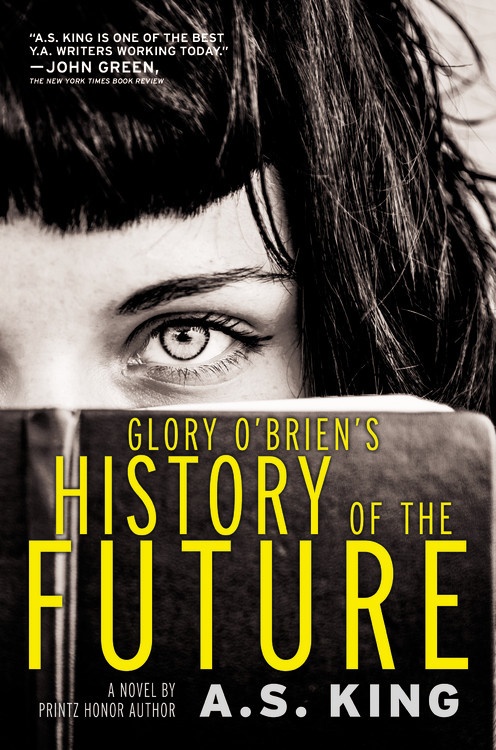
Glory O’Brien’s History of the Future by A. S. King
Little, Brown, October 2014
Reviewed from an ARC
OK, can I confess something? When I’ve tried to describe Glory O’Brien, I’ve started to feel like maybe I’m Stefon because there’s a lot going on here. A LOT: bat drinking, dystopias, politics, graduation, a dead mom, warring families, reclusive fathers, feminism, slutshaming, art, hippies, and STDs. Like, where are the Furbies and the screaming babies in Mozart wigs?
Which is not to say I’m not taking this review seriously (Stefon is always deadly serious anyway, right?) — with six starred reviews, with three placements on year’s best lists, A.S. King’s newest is getting a lot of love. Only, while I loved the wild ride of this read at first pass, as I’m writing this review now, it’s not entirely working. The things I loved are still there, but I have some problems and questions that are making me think twice as I write.
I loved the Stefon-ness of the plot, the throw-everything-in-and-let’s-see-what-happens; like NYC’s hottest club, Gush, this book has everything, and King’s novel feels like something unique. They drink a petrified bat? There are visions of the future? These visions are really happening, making this part dystopia and part magical realism? In a market with a lot of dystopia (still) around, Glory stands out — very few other books feel so euphorically comfortable with weird. (Well, Grasshopper Jungle, maybe; we’re getting to that soon.)
The strong characters, particularly prickly Glory, and the emotional honesty when describing interpersonal relationships (daughters and dads! endings of friendships!) are so satisfying. Lots of great humor, too; Glory is sly and funny inside her head. (“I took a picture of the bottles of shampoo. I called it Empty Promises.”) Glory considers herself a lone wolf with no friends, which almost made me roll my eyes (“And I didn’t fit into any conversation I ever heard because all people talked about was dumb crap that I didn’t give a shit about. Nobody talked about art.”) — until she actually talks to classmates and learn that they don’t hate her, and that maybe she might find them somewhat interesting. A big part of Glory’s coming of age is coming to terms with the fact that understanding people means interacting with them — taking action and speaking up for herself, and finding ways to connect with others. She eventually does this with classmates, with her dad, with Jasmine (indirectly), with Ellie. Glory’s own ambivalence about her future and her family and her options in life felt so true — and so neatly tied to the senior year experience, when the future looms so frighteningly large.
King uses the novel to explore big ideas — the purpose of art, the idea of fate, our ability (or lack of ability) to know and understand other people and ourselves — and there are moments that are rich and rewarding. The repetition of phrases throughout the text makes them feel momentous, weighty: Free yourself. Have courage. Everything serves to further. You’re a pornographer, too, you know. You have something to do.
As bold as this book is, there are a few things that could keep it from getting the gold, however. A major part of the story is the slow ending of the relationship between Glory and Ellie, and I had a mixed reaction to it. Admittedly, Glory’s habitual acquiescence to Ellie’s big personality mixed with her irritation with Ellie for just being Ellie (and Glory not calling her on it, ever, even in the name of friendship) felt just right — messy and teenage-y, and true to so many friendships in real life. But Glory’s unspoken, often judgey, judgements of Ellie made me think — and then rethink. (“‘Nice shirt,’ I said, not commenting on how it was unbuttoned one button too many.”) On the one hand, they’re so starkly unfeminist in this feminist story. On the other hand, why do protagonists — especially female protagonists — always have to be nice to be likeable. And on my mutant third hand, isn’t this judgey habit just another way to say “You’re a pornographer, too” within the story — we’re all so shaped by misogynist culture that even when we are consciously working on our feminism it’s really easy to judge someone in an unfeminist way.
A lot of this flip-flopping comes down to pacing. Because the end of the Ellie-Glory relationship is a big part of the story, the end-end — the final familial confrontation and the giving of the check — felt rushed. Glory’s ultimate realization about Ellie suffers from this suddenness. Glory seems to instantly switch from an equally immature, self centered perspective to grandly mature; it feels unearned even though that’s exactly what she’s been learning to do the whole book. If the rest of the book moved just a little faster, or if the ending slowed down just a touch, it would be more balanced, and the resolution would feel sufficient, rather than too-pat.
Additionally, there are times when Glory feels a little preachy. I mean, in a book where the major (off-page) villain is named Nedrick the Sanctimonious, maybe subtle is the wrong thing to look for. (Hilarious, obviously, but subtle, not so much.) Glory’s transmissions work as metaphor — they get her engaged with and interested in the outside world. They work to differentiate this dystopian experience from others. But they are not subtle, and sometimes Glory’s narration is not, either.
This is bold and ambitious storytelling, but it doesn’t always hang together perfectly. I loved reading it, I loved the big questions it’s still got me mulling over, but my guess is that RealCommittee will want a little more polish on their winner. But I’ve gone on for 900+ words. What do you have to say?


Added To Cart
RELATED


RECOMMENDED
CAREERS
The job outlook in 2030: Librarians will be in demand
CAREERS
The job outlook in 2030: Librarians will be in demand
ALREADY A SUBSCRIBER? LOG IN
We are currently offering this content for free. Sign up now to activate your personal profile, where you can save articles for future viewing
ALREADY A SUBSCRIBER? LOG IN
Thank you for visiting.
We’ve noticed you are using a private browser. To continue, please log in or create an account.
Add Comment :-
Be the first reader to comment.
Comment Policy:
Comment should not be empty !!!