



2018 School Spending Survey Report
Gary Soto, the Art of Not Writing for Children, and the Public Shame Theater
I was flipping through my most recent copy of Horn Book feeling pretty special since I’ve an article in there (“Apples to Elephants: Artists in Animation”) and when I get to the back I see a mention of a book I’ve never heard of before: Why I Don’t Write Children’s Literature by Gary Soto. If […]
I was flipping through my most recent copy of Horn Book feeling pretty special since I’ve an article in there (“Apples to Elephants: Artists in Animation”) and when I get to the back I see a mention of a book I’ve never heard of before: Why I Don’t Write Children’s Literature by Gary Soto.
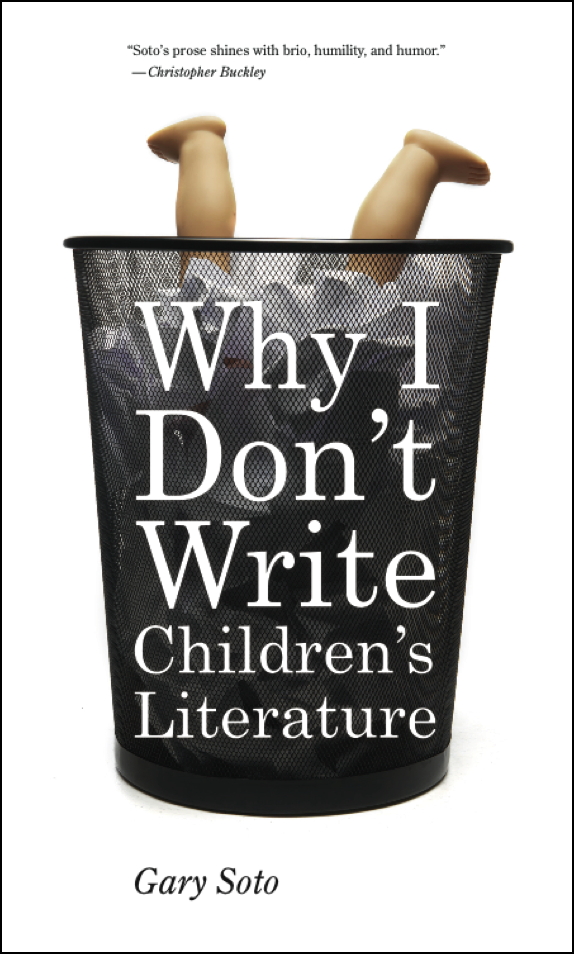
If I missed the book it’s not too terribly surprising. The publisher is a university press (University Press of New England, no less). Not my usual bag. And I’m not going to necessarily debate the relative merits or lack thereof of Soto’s point of view. If you want to do that, Roger did a post back in 2013 (long before this book came out) about a Huffington Post piece Soto wrote on the same topic. Roger’s post was called Now You’re Telling Us? and it contains the world’s greatest accompanying photograph (seriously, I wish I could steal it with impunity but he knows where I live). There’s a more recent review of this book specifically over at Bookshots.
What interested me so much about the piece was what it had to say about those children’s and YA authors and illustrators that find themselves subjected to a rousing bit of public shaming. Because, quite frankly, in 2015 that topic is particularly pertinent.
In case you’re not familiar with the case of Gary Soto and why he’s saying he’ll never ever ever write for kids again, no sir, don’t ask him, nuh-uh, *fingers in ears going lalalalalalala!!!!*, here’s a recap. In 2005 Gary was our most prominent Latino guy writer for kids. You’ve heard of Chato’s Kitchen? No? Go out, read it, and come back to me. Okay? Good stuff. He did middle grade as well, though his day job (so to speak) was as a poet. And since he was so incredibly prominent and popular, who should come ah-knocking at his door but Mattel. Yes, the toy company. The toy company that a couple years earlier had purchased the American Girl dolls and was now in charge of publishing some accompanying books. There was a new doll in town by the name of Marisol, and she was in need of a good author. So the deal was pretty straightforward. Gary would write some early chapter books, they’d pay him, happy times all around.
Gary was told he could set the books in either Chicago or New York so he selected Chicago. Specifically, the Pilsen neighborhood. For a while. You see, in the first book Marisol’s mother explains to her daughter that they’ll be moving away from their neighborhood because the parents think it’s too dangerous. The editor okays the book. It goes to press. It’s being read left and right. And then all hell breaks loose.
Here’s how Gary described the incident:
“The first of nearly hundreds of calls began, calls from the mayor of Des Plaines, aldermen, Chicano activists, an art director, Time, BBC, the Los Angeles Times, the New York Times, the Chicago Tribune, NBC’s “Today Show,” ABC’s “World News Tonight,” a journalist from Spain, students, professors–all because I had written a controversial piece of dialogue uttered by Marisol’s mother. She, in her motherly reasoning, argues that they had to move out of Pilsen. The mother spouts, “Dad and I think it’s time that we move out of this neighborhood.” The mother follows up in the same paragraph saying that it was dangerous and there was no place for their daughter (Marisol) to play. This was caught by Andrew Herman of The Chicago Sun-Times, who brought this apparent slight to the public’s attention. Mr. Herman was among the first and last callers. I didn’t pick up. “
As I read this I got the profoundest sense of deja vu. We’ve seen this before. This mass outrage. The piling on. The anger outsized to the supposed crime. What if, then, what if Gary had written Marisol not in 2005 but in 2015?
The interesting thing about Gary’s case is that his book was a very rare case of corporate diversity. Mattel was working to promote a book that was specifically about a girl from a too little lauded minority. We didn’t exactly have tons of early chapter books about Latino girls in 2005 (and we’re not exactly swimming in them today either). I can think of no equivalent to Marisol. Which is to say, a case where a huge company went out and found an author to help promote a product and the product was a girl of a race other than white. Then this happened and we got set back once again.
According to Soto, when you zero in on the moment of outrage, the instigator was Andrew Herman, a reporter from Chicago. But many times when people get angry it can be hard to pinpoint precisely what sets them off. So I got to thinking about the various controversies that might compare to Gary’s over the years with connections to children’s and YA literature (some tenuous) and how they were handled. And if we can learn anything from them, it’s that memory is a short thing and Twitter a mighty weapon. Some examples:
Alice Hoffman and the Twitter scandal – This year folks are talking about Alice Hoffman’s latest title for kids, Nightbird. Not many remember back in 2009 the unfortunate incident that occurred when Ms. Hoffman tweeted the phone number and email address of a professional reviewer. Twitter was only three years old when this incident occurred and Hoffman’s response launched many a think piece about writers and the current state of a kind of social media where there is very little to stop someone from reacting instantaneously without the benefit of time to slow down their responses. But as I say, few remember the incident today, which indicates to me that our memories of these various brouhahas fade faster than we might initially have thought.
James Frey turned Pittacus Lore – There is a longstanding tradition of people blackballed from one profession turning to books for youth. A lot of Hollywood writers went that route. Langston Hughes did too. So when Oprah called out James Frey on whether or not his memoir A Million Little Pieces was factual or not, it seems logical that after the furor that followed he would turn to YA literature. He would go on to seemingly pen the Pittacus Lore books, the first of which was I Am Number Four. That said, even his work on those books was not without its own kind of controversy. Not that many folks were aware of it at the time.
Kaavya Viswanathan and How Opal Mehta Got Kissed – Perhaps no controversy here is quite as famous as that of Ms. Viswanathan. The story of this YA author, fresh out of high school, attending Harvard, and writing YA novels of her own was marred by the discovery that whole swaths of her final book were plagiarized. Folks like Megan McCafferty and Meg Cabot as well as others were cited. Unlike Hoffman and Frey, Ms. Viswanathan has not returned to the world of YA literature, though she graduated with Honors. I was intrigued by a statement from Ms. McCafferty regarding the fact that this was an Alloy Entertainment title and they might have played their own role. “Was it the book packagers who really wrote the book and plagiarized my books or was it her?” Other folks equated her actions with the times we live in today.
Daniel Handler and Andrew Smith – And here we come to the most recent controversies in the children’s and YA realm. In one case, an author spoke at a large book award gala, made a statement that pretty much exploded the internet, and then turned around and apologized and offered compensation for his actions. When Mr. Soto cites in Why I Don’t Write Children’s Literature a writer who said that “in a rare moment of corporate courage [Mattel] didn’t simply give in to the extortion of demands (15 scholarships, plus jobs programs, plus more – I’m surprised they didn’t ask for ponies, too) but stood by its author and its book” I think of the Daniel Handler incident. The “extortion of demands”. Would it have been so awful if Mattel had made a scholarship? What would have been lost? What gained? Seems to me that Mr. Handler made good and went the classy route with his case.
The case of Andrew Smith is where Twitter turns from the place where mistakes are made, as with Ms. Hoffman, to where the fires of outrage are stoked. While Mr. Handler made a statement in front of a very large crowd, Mr. Smith made a statement in VICE that made a bunch of people unhappy. I won’t get into the where or the whys, except perhaps to say that this is an incident that filled my head with thoughts of this nature. More interesting to me is how Smith, like Handler, found his head on a pike with a speed hitherto unimaginable. I was reading up on the Justine Sacco incident the other day, where a single offensive tweet led to a witch hunt of unimaginable size and scope.
So imagine, if you will, that the Gary Soto incident occurred this year. Imagine the tweets. The headlines. Would Mattel have offered a scholarship in 2015 even if they hadn’t in 2005? I think it’s safe to say that Soto would still be deciding not to write for children when all was said and done. I just wonder if in our current state of public shaming whether or not more folks will follow in his footsteps or if we’re getting to the point where there’s a script to follow (it’s no secret that I’ve placed Jon Ronson’s So You’ve Been Publicly Shamed on hold with my library system). And will folks even remember five years later? We don’t have any answers, but at least Soto’s story carries with it some food for thought.

Added To Cart
RELATED



RECOMMENDED
CAREERS
The job outlook in 2030: Librarians will be in demand
CAREERS
The job outlook in 2030: Librarians will be in demand
ALREADY A SUBSCRIBER? LOG IN
We are currently offering this content for free. Sign up now to activate your personal profile, where you can save articles for future viewing
ALREADY A SUBSCRIBER? LOG IN
Thank you for visiting.
We’ve noticed you are using a private browser. To continue, please log in or create an account.

Add Comment :-
Be the first reader to comment.
Comment Policy:
Comment should not be empty !!!