


2018 School Spending Survey Report
Full Speed Ahead: Our leadership summit examines the wildly changing world of reading

Photograph by Daryl Grabarek
Better fasten your seat belts. The face of reading is changing, and it’s happening at a much faster rate than most people had imagined. Where’s it all going? What factors are driving the most significant developments? And what role do librarians play in this rapidly evolving world? These are some of the key questions that stakeholders—including educators, publishers, authors, and illustrators—recently sought to answer in Chicago during School Library Journal’s 2010 Leadership Summit on the future of reading.
 This marked our sixth Leadership Summit—and this year’s event was created with support from our platinum sponsor, Capstone, as well as silver sponsors Follett Library Resources, Follett Software Company, Gale Cengage Learning, Junior Library Guild, Mackin, Rosen Publishing, Safari Montage, and Scholastic.
One of the highlights of the October 22–23 meeting was a session on “Adding Value to Ereaders for Classrooms and Libraries” presented by guest speakers Andrés Henríquez of the Carnegie Corporation of New York, Harvard Professor Catherine Snow, and University of Oregon Assistant Professor Gina Biancarosa. The three experts spoke about a preliminary report that would offer significant recommendations to the publishing industry about what would constitute a successful ereader for the K–12 education market. Their suggestions ranged from the need for compatibility among ereader platforms to developing innovative features that support learning, such as the ability to take notes and add annotations.
One of the main reasons Henríquez came to the summit was to get input from librarians, who were omitted from a previous report, “Time to Act: An Agenda for Advancing Adolescent Literacy for College and Career Success (bit.ly/aqzwsb).” This time around, the panelists didn’t want to make the same mistake. The researchers listened to the advice of summit attendees, and a working draft of the soon-to-be-released report “E-Reading Technology and the Future of Academic Reading” now specifically mentions the importance of librarians in training other educators in the use of ereading technology that can be incorporated into classroom instruction. “If teachers can experience firsthand how the technology improves their ability to acquire and retain new content and strategies, they will naturally want to use it with their own students,” the draft reads. And one way to reach this goal is for “libraries to become laboratories for piloting, demonstrating, and supporting instructional uses of e-reading technology.”
Dale Lipschultz, the American Library Association’s (ALA) literacy officer in the Office for Literacy and Outreach Services, who moderated the session, says ALA plans to host a discussion at its midwinter meeting in San Diego this month to talk about the Carnegie report and explore further recommendations. Be sure to mark your calendars—“E-readers and Literacy for All: A Vision for the Future,” hosted by ALA’s Committee on Literacy Research-to-Practice Discussion Group, will take place Sunday, January 9, 2011, at the Westin Gaslamp Quarter, California Ballroom C, from 10:30 a.m. to noon.

Todd Brekhus (left) and Chuck Follett
Meanwhile, Todd Brekhus, president of Capstone Digital, talked about establishing an online, personalized reading environment. He was joined by Barbara Rooks, formerly of Florida’s Hillsborough Public Schools, and Marlene Simmons of the Chicago Public Schools. The panelists presented a new digital reading model that engages students in their interests, establishes their reading level using the Lexile framework, allows for free choice in reading selection, and gives anytime, anywhere access to books. Discussion ranged from how a digital reading program could build student confidence to how librarians and educators could administer personalized reading plans.
Other major news from the summit? Chuck Follett, president of Follett Technology Solutions, announced that librarians have a chance to win $100,000 worth of Follett products. In a competition sponsored by Follett, media specialists and public librarians who demonstrate an outstanding and creative way to apply technology to engage students, foster literacy, and encourage creative thinking are eligible to apply for one of the 10 $10,000 grants of Follett products and services, ranging from books and ebooks to the Destiny library and resource management system and Cognite, a digital tool that links the classroom with library resources.
Other summit sessions explored the latest trends in literacy and technology and identified ways in which librarians can add more value to their communities. In his presentation, “Misalignments of Public Policy, Assessment, and Instruction in an Online World of New Literacies,” Don Leu, director of the New Literacies Research Lab at the University of Connecticut, said that while the Internet is this generation’s defining technology for reading, not one state in this country measures students’ ability to read search engine results or to critically evaluate information found online—and this missed opportunity is where librarians can play a crucial role. “For me, the ereader issue isn’t an especially important one,” said Leu. The main thing is preparing kids to use online information, especially when Internet usage stats around the world are staggering.
Indeed, mobility, 24/7 access, and leveraging social tools to support student learning are what define the upcoming National Educational Technology Plan (NETP), geared to help the transition from a print to digital-based classroom, said guest speaker Karen Cator, director of the U.S. Department of Education’s Office of Educational Technology. And librarians “have a huge role to play” in digital literacy, said Cator, who will cochair a task force on the issue.
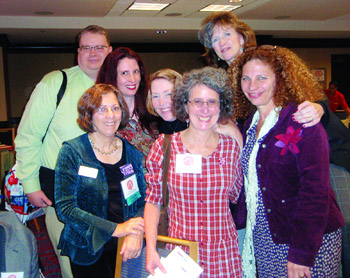
From left: Christopher Harris, Diane Cordell, Cathy Jo Nelson, Wendy Stephens, Frances Harris, Sara Kelly Johns, and Joyce Valenza.
Keynote speaker Stephen Abram, the president of Strategic Partnerships and Markets at Gale Cengage, gave an upbeat and enthusiastic presentation on “Libraries Matter: The Future of Reading in 2020.” The online purchase of reading and research materials—similar to an iTunes format—is what he thinks is in store. Consumers can customize their purchases, he predicted, whether they want to buy just one chapter of a book or an article from a magazine. The good news for reluctant readers, he added, is that reading will be integrated with sound, video, and social media components. “It’s about the reading and the knowledge and not about whether it’s got a binding or not,” Abram said.
Many guest speakers, like Deborah Ford, a district resource librarian at California’s San Diego Unified Schools, expanded on the reluctant-reader theme. For her, comics are another fundamental way to attract readers. In “Redefining Reading: Comics in the Classroom,” Ford emphasized that librarians “have to spread the word that comics are a legitimate form of reading.”
When it comes to encouraging kids to read, Patrick Carman said, “We need to get smart about tech.” The popular author of the “Skeleton Creek” and “Trackers” series (both Scholastic) described how technology can enrich the fictional narrative and engage young readers. With the “Skeleton Creek” series, for example, readers, at about every 20 pages, encounter a password and web address with which they can watch the story advance. His book Trackers goes further in bringing kids into the story with a gaming element, where readers can play as a character in the book, as well as learn more about related technology. Meanwhile, Caldecott Medal winner Paul Zelinsky told summit-goers that although he’s not opposed to digital technology, he took a very low-tech approach to creating the illustrations for Anne Isaacs’s Dust Devil (Random/Schwartz & Wade, 2010), and he hopes traditional picture books “never get replaced” by ebooks.
Peter Gutierrez, of the National Council of Teachers of English’s Commission on Media, made the important connection between pop culture and reading in his presentation, “Reading, Media, and the Paradox of a Critical Fandom,” saying there isn’t a difference between “in school literacy” and “outside of school literacy.” Gutierrez showed his audience how to tap into fandom to foster a lifelong love of reading. “A fan to me is someone who wants to consume and process everything by a given author or a series of a genre,” he said, using an example of how his young son devours the “39 Clues” (Scholastic) adventure series, which combines reading, online gaming, and card collecting. “You become a fan, and it leads to lots of other literacy benefits, lots more reading.”
On a hopeful note, Frances Harris, a librarian at University Laboratory High School at the University of Illinois at Urbana-Champaign, sat down with a few of her college-bound students to get their thoughts on the use of ereaders and ebooks in the classroom.
When asked whether a library played a significant role in their college search, one student named Ashley said it definitely did. “I thought, what if I go to a really small town and their public library sucks? What if I can’t get the sci-fi books that I want?,” she said. “I figure I’m not going to have any money and won’t be able to buy the books. I had a really minor freak-out about that, and I didn’t really know how I was going to deal with it. So that could be a factor.”
New Leaders Join the Summit Conversation

Above, from left: Naomi Bates, Northwest High School, Justin, TX;Melanie Lewis, Golden Valley USD, Madera, CA; Gwyneth Jones, Murray Hill Middle School, Laurel, MD; Shannon McClintock Miller, Van Meter Community School, IA;and Margaux DelGuidice, Garden City High School, NY.
The Cengage Learning/SLJ New Leaders Program made it possible for five new leaders to participate in the Summit. Based on recommendations from several Summit leaders, and selected by a committee from SLJ and Cengage, the leaders are all new to the profession, display leadership within their learning communities, and are actively involved in sharing and collaborating with colleagues through social networking and other venues. The summit was all the richer, thanks to their presence.
Added To Cart
RELATED


RECOMMENDED
CAREERS
The job outlook in 2030: Librarians will be in demand
CAREERS
The job outlook in 2030: Librarians will be in demand
ALREADY A SUBSCRIBER? LOG IN
We are currently offering this content for free. Sign up now to activate your personal profile, where you can save articles for future viewing
ALREADY A SUBSCRIBER? LOG IN
Thank you for visiting.
We’ve noticed you are using a private browser. To continue, please log in or create an account.
Add Comment :-
Be the first reader to comment.
Comment Policy:
Comment should not be empty !!!