


2018 School Spending Survey Report
New Nonfiction Explores the World of Insects | SLJ Spotlight
Three titles shed light on the brilliance of bugs.
Stories of strangely beautiful metamorphoses coexist with information on the spread of disease in these enticing and varied volumes that explore many facets of the fascinating, often frightening insect world.

 Albee, Sarah. Bugged!: How Insects Changed History. illus. by Robert Leighton. 176p. further reading. glossary. index. maps. notes. photos. reprods. websites. Walker. Apr. 2014. lib. ed. $22.89. ISBN 9780802734235; pap. $16.99. ISBN 9780802734228.
Gr 5-8 –The shock value alone makes this worth the cover price, but once kids are pulled in, they will learn more than they bargained for about the impact of insects on human history. Insects have determined the outcomes of wars and the paths of human migrations; they have brought plagues, provided strong fabrics, and sweetened our tea. Chapters are divided topically, beginning with the basics of insect life cycles, moving on to human hygiene and beneficial insects, and then covering “bad news bugs,” before tackling history from the “earliest epidemics” to current concerns in the relationship between humans and insects. This is history for those with a strong constitution, who aren’t bothered by phrases such as “cockroach brain tissue,” “crawling with maggots,” and “bursting buboes” or by the idea of receiving 9,000 insect bites in a minute. With a green-and-purple design, reminiscent of a beetle, and black-and-white photos and cartoon illustrations, this is an attractive package full of hand-washing inducing facts. Overall, this title is astonishing, disgusting, revolting, and ultimately fascinating, making it perfect for emerging entomologists, budding historians, reluctant readers, and gross-out junkies alike.
Murawski, Darlene & Nancy Honovich. Ultimate Bugopedia: The Most Complete Bug Reference Ever. 272p. (National Geographic Kids Series). chart. glossary. index. photos. websites. National Geographic. 2013. Tr $24.95. ISBN 9781426313769.
Gr 2-6 –This dense yet fascinating book provides information on just about any bug one can imagine (with individual profiles on 83 different species). Budding entomologists will learn about bug life cycles, scientific classifications, communication methods, feeding habits, and much more. The book is broken down into several clearly labeled sections, and a “How to Use This Book” chapter, along with the detailed table of contents, helps readers navigate through the information. Blocks of texts are used on each page but are not overwhelming, and the language is clear and engaging. Eye-popping color photographs, diagrams, text boxes with supplemental material, and a running fact stream across the bottom of every page also help students learn as much as they possibly can about these creepy-crawlies. Features such as “Talk with an Entomologist” and “How You Can Help” provide other perspectives and allow children to recognize their own role in the life of bugs and our ecosystem. Through the extensive index, researchers can look up topics easily, but the book also lends itself to browsing or just flipping through for fun. A highly recommended work.
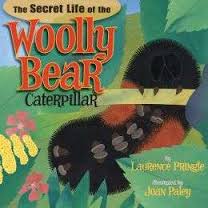 Pringle, Laurence. The Secret Life of the Woolly Caterpillar. illus. by Joan Paley. 32p. diag. glossary. Boyds Mills. Apr. 2014. RTE $16.95. ISBN 9781620910009. LC 2013947716.
K-Gr 3 –In this picture-book equivalent of watching a nature documentary, Bella, a woolly bear caterpillar eats, molts, and eats again in a months-long journey through forests, gardens, and lawns. Potential perils come in the form of a garter snake, a blue jay, and a passing car, though Bella gets through the dangers intact. Italicized insect terms are smoothly incorporated into the story, such as how the three pairs of her “true legs” attached to her thorax allow her to hold a leaf steady when she chews and help her climb. Colorful cut-paper drawings bring Bella and her world to life, emphasizing the texture of her fuzzy-looking black-and-orange body and gloriously displaying the wingspan of the tiger moth she becomes. Further information and a diagram of a woolly bear caterpillar are included in the back matter, all the better to satisfy insect-loving readers.

Added To Cart
RELATED


RECOMMENDED
CAREERS
The job outlook in 2030: Librarians will be in demand
CAREERS
The job outlook in 2030: Librarians will be in demand
ALREADY A SUBSCRIBER? LOG IN
We are currently offering this content for free. Sign up now to activate your personal profile, where you can save articles for future viewing
ALREADY A SUBSCRIBER? LOG IN
Thank you for visiting.
We’ve noticed you are using a private browser. To continue, please log in or create an account.

Add Comment :-
Be the first reader to comment.
Comment Policy:
Comment should not be empty !!!