


2018 School Spending Survey Report
YA Authors Talk Social Media, Research Process...and Spill Secrets
Rebecca Stead, Paul Acampora, and Valynne E. Maetani held court at “It’s Complicated: Secrets, Schemes, and Friends,” a panel held Sunday, November 9 at the New York Society Library and funded by author Richard Peck. The writers considered the role of social media, talked about their research process, and discussed the future of YA.
Social media doesn't supplant real life as much as distorts it
After asking the authors to read aloud from their work and having them divulge a few childhood and teenage secrets, moderator Jennifer Hubert-Swan, middle school librarian and director of library services at the Little Red School House and Elisabeth Irwin High School in Manhattan, brought up the topic of social media. She asked Acampora, whose novel I Kill the Mockingbird (Roaring Brook, 2014), centers on a group of middle schoolers who come up with an in-depth social media campaign to encourage other students to read To Kill a Mockingbird, whether he thought keeping a secret in today’s digital age, as his characters do, was possible.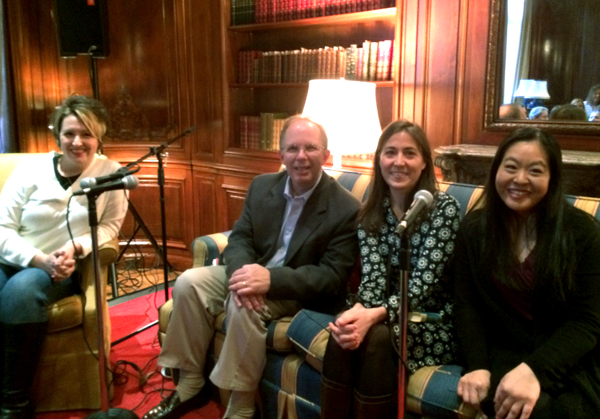
Left to right: Jennifer Hubert-Swan, Paul Acampora, Rebecca Stead, Valynne E. Maetani
Acampora, who often leads writing workshops for middle and high school students, believes that things haven’t changed as much as people think. “It is definitely possible to keep secrets. Life doesn't happen online. You talk about life online. [But] there are all kinds of things in the corners and the parking lots. All the things that were happening are still happening.” Maetani, too, brought up that much of what occurs online doesn’t accurately reflect real life. “We’re sharing a lot of highs but no lows," she said. "One of the most unfortunate things for teenagers these days is not understanding that other people are going through [bad] things, too. I think the secrets are these kinds of negative things. That’s the thing that’s kind of discouraging about social media, that everyone puts their best foot forward and that’s all you get to see.” Stead agreed. “It can be a real downer to think, ‘I’m the only person in the world who’s experiencing negative moments.” The author, whose coming-of-age novel Goodbye Stranger (Random, 2015) includes a plot thread in which a seventh grader sends a boy a provocative photograph of herself that goes viral, added, “I do think there is a kind of culture clash in terms of kid culture and what they are willing to share and what the generation above feels comfortable sharing.” Stead and Acampora both offered a balanced perspective on social media. “[Adults] are just looking forward,” said Stead. “We’re casting our minds into the future: job applications, school applications. [But] I also think that kids have a right to establish their own cultures. We have to give them the benefit of the doubt when it comes to their own decisions about what they’re willing to say. It’s a tough line. I feel protective. We all do.” “Fear makes me want to pull out every electrical outlet,” said Acampora. However, he added, “We created a generation of young people who support each other. You can make a friend quickly and stay in touch. [Social media is] creating beautiful experiences that were not possible before.”How social media helps diversity
Hubert-Swan touched on another positive aspect of social media, bringing up Maetani’s involvement in We Need Diverse Books (WNDB), a movement encouraging inclusivity within children’s literature that began as a Twitter hashtag. The author said that she wrote Ink and Ashes, which won the Lee and Low New Visions Award in 2015 (awarded to debut writers of color), in large part because she had rarely seen herself represented in YA and children’s literature when she was growing up and because she wished to give her sister, who was then about to turn 18, the gift of a novel that did so. “The only time I got to see myself as a protagonist was in fiction [set] in internment camps, where Japanese Americans were hated,” Maetani said, adding that she didn’t want her sister to have a similar experience. WNDB came out right before her book was released, and “this miracle of an organization stood for everything I believed in. I wanted other kids to see themselves. Books that are windows allow you to experience something different. [WNDB gained] a lot of ground mostly through Twitter and Facebook, and I don’t know if we could have gained as much traction as we did without social media.”research doesn't always follow a straight line
The authors also spoke about their research and writing processes. Maetani said that her research took place after writing her first draft of Ink and Ashes, the story of a girl who discovers that her now-deceased father may have been a member of the yakuza, the Japanese mafia. That’s when she realized that the facts she included about the yakuza, which she picked up from watching movies, may not have been true. A detail about the protagonist’s father’s missing finger, for instance, came out of Maetani learning that yakuza members would cut off a pinky finger as contrition for an offense, an act of atonement that goes back to the days when samurai fought with swords and losing a finger would weaken their grip and make them more dependent on the rest of the clan. While Stead said that Goodnight Stranger, which is set in present-day New York City, was “not a research-heavy book,” she spent a fair amount of time on Instagram to get a glimpse of how middle schoolers represent themselves on social media. “If you’re in seventh grade and there’s a picture of three Starbucks cups and a new manicure and you know that [your] friends went and did that and you weren’t there…that can wreck your afternoon,” she said.young audience was, is, and will be bright spot in authors' lives
The panel ended with questions from audience members on topics such as the future of YA and why they write for younger audiences. Panelists emphasized the importance of inclusivity. “I think the next big thing is working on getting more diverse voices,” said Hubert-Swan. “That seems to be what is really exciting teachers and librarians. And that’s more realistic.” Maetani agreed. “Right now, the percentage of people of color in literature...is not reflective at all of our reality.” For all of the authors, the choice to write for a younger audience was natural. Maetani reiterated that Ink and Ashes came out of her desire to give her teenage sister a novel in which she could see herself. For Stead, “What really comes to me organically and what’s natural is childhood and early teen years explored by characters who are that age.” Though Acampora said he originally attempted literary fiction, his submissions to various publications were all turned down and he eventually realized that his audience was middle grade and YA readers. “It’s fun for me to write in the middle grade world, because I know more than my characters know," he said. "When I’m writing teens, I think they know more than I do. My own theory is when it’s YA, [the characters’] relationship with the world is going to be really different. As a human, when you get older, you start to realize the world is shifting around your feet.”
Added To Cart
RELATED


RECOMMENDED
CAREERS
The job outlook in 2030: Librarians will be in demand
CAREERS
The job outlook in 2030: Librarians will be in demand
ALREADY A SUBSCRIBER? LOG IN
We are currently offering this content for free. Sign up now to activate your personal profile, where you can save articles for future viewing
ALREADY A SUBSCRIBER? LOG IN
Thank you for visiting.
We’ve noticed you are using a private browser. To continue, please log in or create an account.
Add Comment :-
Comment Policy:
Comment should not be empty !!!
Bruce
I think you are spot on with the social media helping people understand other cultures and to learn to celebrate diversity. I have learned so much from people in my social networks from different areas of the world. HHaving these different perspectives really helps with my education. I think that social media education should become a large part of the course offerings for young people today.Posted : Dec 30, 2015 07:49