


2018 School Spending Survey Report
Default in our stars
This week’s Entertainment Weekly has a list of “50 Books Every Kid Should Read” (view PDF here). Given that it strives to contain both classics (Where the Wild Things Are) as well as modern favorites (The Fault in Our Stars); and pop hits (The Hunger Games) along with critics’ darlings (Roll of Thunder, Hear My […]
The post Default in our stars appeared first on The Horn Book.
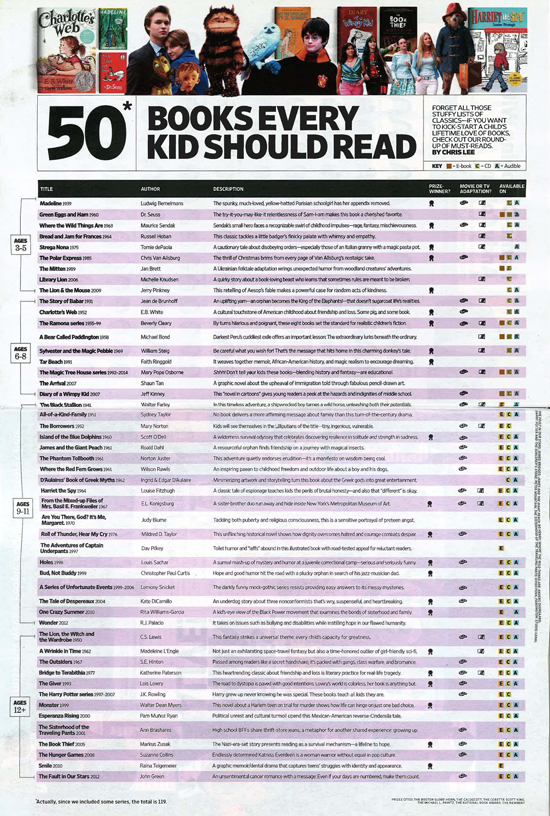 This week’s Entertainment Weekly has a list of “50 Books Every Kid Should Read” (view PDF here). Given that it strives to contain both classics (Where the Wild Things Are) as well as modern favorites (The Fault in Our Stars); and pop hits (The Hunger Games) along with critics’ darlings (Roll of Thunder, Hear My Cry), it’s a good list spanning more than eighty years of publishing.
What is sometimes peculiar are the age-level designations. Shaun Tan’s The Arrival for 6-8-year-olds? The Lion, Witch, and the Wardrobe for 12 and up? Why is Wimpy Kid for 6-8-year-olds and Captain Underpants for 9-11-year-olds? Proceed with caution.
I’ve been thinking a lot about reviewing and age levels as I’ve been engaging with a California lawyer who has called several times with detailed questions about how the Horn Book makes such decisions. She’s very nice and not crazy (unlike the lawyer for publisher Mitchell Lane who said our negative reviews of their books were defamatory and thus actionable) and I don’t think she’s going after us for anything. At any rate, she said she was also calling a number of our peers with the same questions. It all apparently has something to do with a school district and The Fault in Our Stars, and the lawyer wanted to know how we arrived at the “High School” designation in our review. “Was it the sex?” she asked. What sex, I replied, forgetting not just how far the kids Went in the book but that I had written the review (the lawyer reminded me). So many books, so few gray cells to remember them.
But it hadn’t been the sex that caused us to label the book as for grades-nine-and-up, although designating it as such meant we didn’t have to spend any time describing it. YA publishing’s “14 and up” label only dates back to the mid-eighties, and then it was still a curiosity rather than the default it is today. Back then, “YA readers” were mainly middle-school kids. I think of Fault in Our Stars and so much other contemporary YA as being for 14- and even 16-and-up not because of the inclusion of sexytime (God, is anyone else old enough to remember Spiro Agnew going on talk shows to discuss ”the obligatory sex scene” in his novel The Canfield Decision?) but because that’s who the implied reader seems to be. “Implied reader” didn’t go very far with this lawyer, unfortunately, who really seemed to want the assurance that “High school” meant sex scenes and “Middle school” or “Intermediate” did not. (Remember how The Canning Season lost the Newbery with “you little fucks”? Good times.)
All of this is just my longwinded way of saying that the Horn Book does not assign grade levels on the basis of subject matter, “language,” or sex scenes, obligatory or otherwise. We’re just trying to suggest who might best appreciate the book.
The post Default in our stars appeared first on The Horn Book.

Added To Cart
RELATED


RECOMMENDED
CAREERS
The job outlook in 2030: Librarians will be in demand
CAREERS
The job outlook in 2030: Librarians will be in demand
ALREADY A SUBSCRIBER? LOG IN
We are currently offering this content for free. Sign up now to activate your personal profile, where you can save articles for future viewing
ALREADY A SUBSCRIBER? LOG IN
Thank you for visiting.
We’ve noticed you are using a private browser. To continue, please log in or create an account.
Add Comment :-
Be the first reader to comment.
Comment Policy:
Comment should not be empty !!!