


2018 School Spending Survey Report
The Three Faces of the Bologna Book Fair
The atmosphere at the International Bologna Children's Book Fair was electric. Clearly, though, there were three simultaneous fairs taking place, and their story lines aren’t identical. Here’s a guided tour.
 I’ve just returned from the Bologna Book Fair with 10 students from the International K-12 Books class that I teach in the Master of Information program in the Rutgers School of Communication and Information. The atmosphere at the fair was alive and filled with a sense of excitement. Clearly, though, there were three simultaneous fairs taking place, and their story lines aren’t identical. Here’s a guided tour.
 The business reason for the Bologna fair is the sale of foreign rights. That is, the original publisher of a book, or an agent representing the author and/or illustrator, is there looking to find a foreign publisher who wishes to acquire the rights to publish the book in their territory, possibly in another language. For example, while the “Harry Potter” series was a global bestseller, Bloomsbury was the original publisher in England, while Scholastic acquired the US rights. When I first came to Bologna as a publisher, rights deals created the buzz. There was always “the book of the fair,” the must-have acquisition that editors would rush to read to be able to get an offer on the table—as bidding wars unfolded and rumors flew. There were six figure deals during this fair, but there was less of that overheated combination of anxiety and electricity. Perhaps, as Adam Lerner of Lerner Books suggested, it’s because digital versions of books are available when a publisher or agent wants to send them out, and exposure, reading, and bidding is no longer dependent on all parties being physically present in the same location.
Even if rights no longer set the tone of the fair, they are its raison d'être. Every day the booths of the publishers and agents were filled with people talking shop, offering show-and-tell pitches, and discussing possible numbers (print runs, costs, etc.). Walker books (Candlewick in the United States) allowed several of my students to listen in on their conversations, which the students found fascinating. One student was even called on to characterize Megan McDonald’s Judy Moody—“rambunctious” was her apt answer. A second purpose of the fair is the opportunity for young illustrators to showcase their work. Packs, really hoards, of people in their 20s carrying portfolios fill the hallways. Some publishers have signs announcing: “Illustrators Wanted.” By the sound (and logic) of it, most of these aspiring artists are Italian, though on one panel I heard German artist describe how she got her start—in precisely that way. This is an important function of the fair for which we have no equivalent of in the United States. Aspiring authors do show up at the annual Book Expo America (BEA) and American Library Association (ALA) conferences but they are far more likely to receive instructions on how to submit a proposal or manuscript than to hand one off—and those conversations are about text, not art. One of the most fascinating aspects of Bologna is to see the vast differences in how art for children and teens has developed in different parts of the world. At the fair’s bookstore visitors easily spot an American publication. US books are as straightforward and declarative as a New England church steeple. As Alexis de Tocqueville observed back in 1835, American artists “put the real in the place of the ideal.” By contrast, children’s artists from Europe, Korea, Iran, and Brazil, for example, are more likely to put the dream, the imagined, the painterly, the fantastic, or the whimsical, ahead of the real. The third aspect of the fair is the International Board of Books for Youth (IBBY). The Hans Christian Andersen (HCA) medal, sponsored by Nami Island Inc., is an IBBY award. Many of the national booths are run by their IBBY divisions. Presentation of the HCA was accompanied by a pitch for the 2016 IBBY International Congress in New Zealand. One panel after another stressed the central belief of IBBY’s founder, Jella Lepman: books for younger readers can build bridges between peoples. Lepman created the campaign to share books across boundaries in reaction to a world war that upended her life. That devotion to healing through books is, if anything, even more vibrant today. Lepman’s idealism was wonderfully echoed throughout the fair in a focus on today’s refugees and their needs. IBBY has programs in Lebanon and Canada for Syrian refugee children. Groundwood Books generously contributed 25,000 paperback copies of JonArno Lawson’s wordless picture book Sidewalk Flowers, illustrated by Sydney Smith, to those recent immigrants in Canada—and won the prize as best publisher in North America. IBBY is also at work distributing books and library cards at the US-Mexico border for the unaccompanied children from all over Central America who gather there. This is honorable and important work—sharing books with children who are, for the moment, safe, but away from home, and sometimes, family, friends, and school. Trapped in a precarious limbo, books can provide these children with a moment of escape, entertainment, knowledge, or pleasure, and a lifeline. 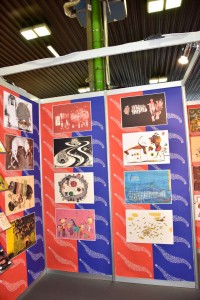
A view of the 2016 Iran booth at the Bologna International Children's Book Fair. Photo by Antigone Trowbridge
There was also a distinct impression at the fair that the idea of books as bridges has a larger meaning. At many of the national booths we visited we learned of class divisions, urban and rural differences, and concerns about illiteracy. In many countries there is a need, and an effort, to use books to lessen the deep challenges faced by those without educational opportunities. Also available in many of these places are books that expose young people to other cultures and experiences. This fair was a coming out party of sorts for Iran—almost as if the lifting of economic sanctions was being matched by a welcoming and an appreciation of Iranian publications (and especially, their illustrations). This international effort to spread art, stories, and books is creating an almost invisible, yet palpable, force, raising foundations on which young people can stand. Hesitations: every person who has ever been even shortlisted for the HCA writing award has one thing in common: she or he writes fiction. Every person who has been similarly honored for art has another thing in common: she or he draws, does not use photographs, to illustrate books. Nonfiction—especially books that use archival images—is the ignored stepchild, or at least it has been. This year, it was clear that publishers are beginning to dip their toes in new and imaginative ways into the field. I saw several books—one French, one Flemish, two British—offering world history through objects, time lines, or linked cultures. One popular Chinese volume was a lavishly illustrated book of “10,000 Whys”—questions and answers about the natural world. Still, reading as escape or dream, is far more the coin of the realm than reading to find out or discover.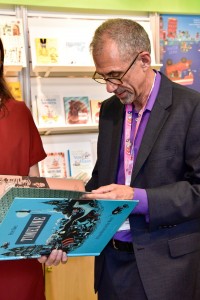
The author at the 2016 Bologna International Children's Book Fair. Photo by Antigone Trowbridge.
As Julia Eccleshare, children’s books editor of The Guardian, pointed out to us, coming to Bologna visitors hear again and again how story can bridge differences. But, she correctly added, as we explore each country’s books we also see real differences and distinctions. The IBBY approach, which took shape during the Cold War, hopes to emphasize commonality and thus avoid having to deal with intractable divisions over politics, faith, or ideology. Yet, especially in books for middle and upper grades, it would be more realistic (and indeed interesting to those readers) to talk about conflicts, differing worldviews, and to try to build understanding through an awareness of how and where we are not the same. That does not mean to rank, but rather to recognize different perspectives. Several French and one Italian publisher had marvelous looking books on philosophy for children and teens. It was exciting to think of a young person having access to the wealth of deep thinking about truth, life, and existence in the schools of thought that have evolved across time and around the world. What treasures these books make available to young, engaged minds—I wish these books were also available in English.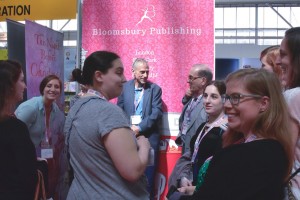
One of the pleasures of Bologna is the unexpected meeting— we ran into Leonard Marcus as we were talking to Julia Eccleshare ; L to r starting with her back to the image: Jenny Zbrizher, Emily Davis, Janis Werner, Marc Aronson, Leonard Marcus, Stacey Shapiro, Samantha Bremekamp, with Emily Merivis and Celeste Rhoads just off the edge. Photo by Antigone Trowbridge, also a student.
Cao Wenxuan won the HCA for writing. My group was especially thrilled to be at the ceremony after spending the previous week studying Chinese books for children and teenagers, and Wenxuan, in particular. One of his Wenxuan’s translators, Dr. Helen Wang, joined us in our online class, and a marvelous essay by Minjie Chen of the Cotsen Children’s Library at the Princeton University Library, prepared us for what we heard from the Carolina Ballester of the Shanghai Children’s Book Fair: literature for younger readers is the fastest growing area in Chinese publishing, and it continues to expand. Publishers are pushing boundaries, private library groups are being established, and families, who are sending their children overseas at ever younger ages, want books that suggest new ways of thinking, acting, and experiencing the world. On the other hand, the entire book creation and evaluation chain: authors, illustrators, editors, publishers, critics, teachers, librarians, and booksellers is in its infancy. I felt like getting on the next plane to China to be part of this dynamic moment. My students loved the fair and I’m already planning to take the 2018 group to the event. And I haven’t even mentioned the beautiful medieval city, the irresistible gelato, and Bologna’s spectacular food. Plan to go yourself one year, if you possibly can.
Added To Cart
RELATED


RECOMMENDED
CAREERS
The job outlook in 2030: Librarians will be in demand
CAREERS
The job outlook in 2030: Librarians will be in demand
ALREADY A SUBSCRIBER? LOG IN
We are currently offering this content for free. Sign up now to activate your personal profile, where you can save articles for future viewing
ALREADY A SUBSCRIBER? LOG IN
Thank you for visiting.
We’ve noticed you are using a private browser. To continue, please log in or create an account.
Add Comment :-
Comment Policy:
Comment should not be empty !!!
Mary Jeffers
Great article - love your insight on the difference between U.S. and (mostly everyone else) approaches to illustration.Posted : May 04, 2016 07:01