


2018 School Spending Survey Report
School Libraries Host Events to Welcome ELL Students and Families
Read-and-greet evening programs and home visits with culturally relevant books are some of the efforts librarians are making to bring families of English Language Learners into the school community.
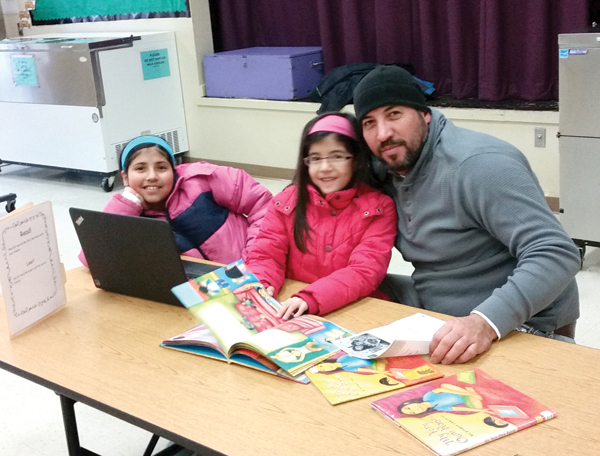
An evening event featured bilingual books at West Elementary, Jefferson, WI.
Sarah Rao wanted the parents of her ELL students to feel more connected to her elementary school community. So she decided to throw a little mixer—book club style.
Once a month, the families of K–5 students are invited to school for a “read and greet” evening program. The families read a picture book—available in both English and Spanish—and join in other activities. At a recent event, participants shared Amada Irma Perez’s book My Very Own Room, then kids and adults were invited to paint their own pictures. The events are on a drop-in basis, and parents don’t have to commit too far in advance. And since everyone is doing something with their hands, there’s less pressure to talk—but, of course, that’s exactly what they do.
“We noticed that there wasn’t a lot of interaction between ELL and non-ELL parents at school functions,” says Rao, the ELL teacher at West Elementary School in Jefferson, WI. “I think because there’s no pressure to talk to each other [at book club], because they’re doing something else, they make conversation about what they’re doing.”
Helping ELL students to become grounded in their new language is one goal. But educators know that parental support is key to the educational success of any child. So, finding a way to engage caregivers at school is something ELL instructors try to do.
“We know students will feel more supported and connected if their families understand the school’s expectations and if the family feels comfortable with the culture,” says Kristina Robertson, English Learners Supervisor for Roseville (MN) Public Schools. “So we talk with parents to better help them understand what goes on in our school system.”
Home Visits, With Books
Robertson encourages her ELL teachers to visit parents in their homes for evening events. There, teachers will bring books and even model how to sit and read with children—a practice Robertson says that not all cultures mirror.
“It’s important after a busy, stressful day, that we make this fun,” she says. “You want to make sure it’s a positive connection for the parents.”
To reach out to parents of ELL students, Jacqueline Jules, an author and former school librarian at Timber Lane Elementary School in Fairfax County, VA, opened her school library early in the morning. She’d also stay late to encourage parents to come by and check out books themselves.
Jules, who penned the “Zapato Power” series, among other titles, had more than 40 different languages, from Farsi to Vietnamese, spoken in her school. Finding books in these languages—at appropriate grade levels—wasn’t always possible. So Jules would try to stock her shelves with books about the countries of her students and their families.
“Books that showed pictures of their home country would certainly be of high interest,” she notes.
At Luther Burbank High School in Sacramento, CA, ELL teacher Larry Ferlazzo invites parents into the classroom. One parent played a traditional Hmong flute, while another, who had participated in Mexico rodeos, showed off his lasso skills.
“Not only do these experiences help adults connect to schools, they also provide great language-learning experiences,” says Ferlazzo, co-author of the upcoming book Navigating the Common Core with English Language Learners (Jossey-Bass, 2016). Rao also believes that when families understand where their children go every day, ELL students are better equipped to master their new language and succeed in school.
“I think school can feel very intimidating,” she says. “ELL families may feel they don’t have a say. And that’s not true.”

Added To Cart
RELATED


RECOMMENDED
CAREERS
The job outlook in 2030: Librarians will be in demand
CAREERS
The job outlook in 2030: Librarians will be in demand
ALREADY A SUBSCRIBER? LOG IN
We are currently offering this content for free. Sign up now to activate your personal profile, where you can save articles for future viewing
ALREADY A SUBSCRIBER? LOG IN
Thank you for visiting.
We’ve noticed you are using a private browser. To continue, please log in or create an account.
Add Comment :-
Be the first reader to comment.
Comment Policy:
Comment should not be empty !!!