


2018 School Spending Survey Report
Possibilities and Potential Disasters | Nonfiction Notes July 2013
In this month's column, the lives and work of scientists both past and present feature prominently.
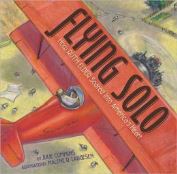 Cummins, Julie. Flying Solo: How Ruth Elder Soared into America’s Heart. (Roaring Brook/Macmillan; Gr 2-4). In 1927, the news media was abuzz with Charles Lindbergh’s historic flight across the Atlantic Ocean. People around the world followed the story with fascination and more than a few were inspired to take to the sky. Hearing about Lindbergh, the glamorous and plucky aviatrix Ruth Elder decided to become the first woman to transverse the Atlantic in a plane. Cummins follows the woman's unsuccessful attempt that ended in a dramatic rescue 36 hours into the flight, and her later career that propelled her both into the sky and the limelight. Dramatic pastel spreads echo the life and charm of this flamboyant woman, endowed with “grit and gumption.” Consider introducing this book in conjunction with some of the other, numerous picture biographies on pilots−men and women−and during Women's History Month in March.
 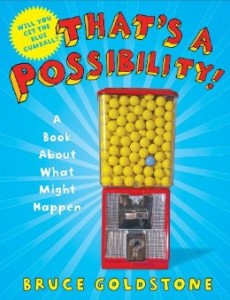 Goldstone, Bruce. That’s a Possibility! A Book About What Might Happen. (Holt; Gr 3-6). If you’re reading these words, it’s probable that you work with children and/or purchase books for them. Lucky for you, here’s a new title that clearly defines and carefully explains the difference between “possible,” “probable,” “likely,” “certain” (and their antonyms), and discusses those terms in relation to the word “odds.” With numerous illustrated examples incorporating colorful photos and diagrams, this kid-friendly introduction to probability from the author of Great Estimations (2006) and Greater Estimations (2008, both Holt), will find a home in both literacy and math classrooms.
 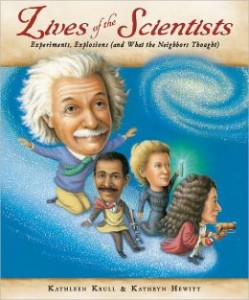 Krull, Kathleen. Lives of the Scientists: Experiments, Explosions (and What the Neighbors Thought). (Houghton Mifflin Harcourt; Gr 4-7). Illus. by Kathryn Hewitt. In her characteristic lively prose, the author offers profiles of 20 scientists (including two teams), from Chinese astronomer Zhang Heng (born 78 AD) to English ethnologist Jane Goodall (born 1934). The entries are filled with anecdotes about the subject’s personal lives, personalities, interests, and quirks (more than a few of the scientists were accomplished painters, a couple were loners, and readers will find a confirmed grouch or two in the bunch), as well as the passions that lead to their significant, sometimes world-changing observations, discoveries, and theories. Spot art and full-page oil portraits of the individuals, each carrying tools of their trade, accompany the profiles. Scientists is the latest entry in Krull’s well-regarded "Lives of" series that includes volumes on artists, presidents, musicians, and others. A great read-aloud choice, that is sure to send readers to the biography shelves.
 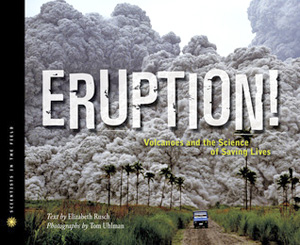 Rusch, Elizabeth. Eruption! Volcanoes and the Science of Saving Lives. (Houghton Mifflin Harcourt; Gr 5-10). Photos by Tom Uhlman. In 1985, the Columbian volcano Nevado del Ruiz erupted, killing more than 23,000 people in the nearby town of Amero. The book follows scientists working with the U.S. Geological Survey’s Volcano Disaster Assistance Program (VDAP), in particular their efforts to monitor the impending eruptions of Mount Pinatubo in the Philippines (1991) and Mount Merapi in Indonesia (2010). As one of the scientists noted, “Volcanoes don’t necessarily move from deep sleep to violent eruption in a straight orderly progression, they ramp up and drop down, ramp up and drop down,” making the tracking of these events difficult, dangerous, and often, dramatic. The book discusses what scientists must consider when determining whether a volcano is ready to erupt, when to evacuate populations, and the array of hazards produced—from lava bombs and landslides to toxic gases and acid rain. Maps and color photos offer before-and-after images of landscapes and towns that have experienced the destruction wrought by these powerful forces. Who knew the United States has 160 volcanoes?
Added To Cart
RELATED


RECOMMENDED
CAREERS
The job outlook in 2030: Librarians will be in demand
CAREERS
The job outlook in 2030: Librarians will be in demand
ALREADY A SUBSCRIBER? LOG IN
We are currently offering this content for free. Sign up now to activate your personal profile, where you can save articles for future viewing
ALREADY A SUBSCRIBER? LOG IN
Thank you for visiting.
We’ve noticed you are using a private browser. To continue, please log in or create an account.
Add Comment :-
Be the first reader to comment.
Comment Policy:
Comment should not be empty !!!