


2018 School Spending Survey Report
Conquering Middle School Miasma
There’s no need for kids to muddle through middle school—books can guide the way.
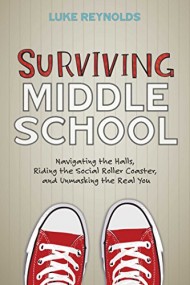 In Surviving Middle School: Navigating the Halls, Riding the Social Roller Coaster, and Unmasking the Real You (Aladdin/ S. & S., 2016; Gr 5-7), Luke Reynolds, a middle school teacher, offers practical advice and encouragement. He covers a range of topics from friendships and self-confidence to teachers and parents, understanding that these years can be both scary and challenging. Throughout the book, the author shares abundant stories from his school years and his work with students, while stressing the importance of being true to oneself even in the face of changing relationships. Occasional writing (and thinking) activities will help readers put their experiences in perspective; for example, he asks that readers look at an incident (the “bad thing” that happened at school today, witnessed or experienced), then try to list some aspects that were unknown about it, or might have been happening “below the surface.” Knowing that responding to these exercises might be difficult for many, Reynolds walks students through them as he underscores that sometimes “…life exists below the surface of what we can see” and that by exploring that level, we tend “to treat ourselves (and others) with more kindness.” Before sending students on their way, a final chapter addresses the “other stuff”—the day-to-day beyond grades and relationships—initiative, organization, sleep, etc. Throughout, Reynolds’s empowering messages are replete with humor, pull-quotes, and gray tone spot-art drawings that help make the advice go down smoothly.
 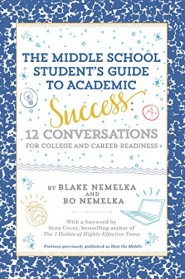 Some of the most successful programs and conversations to ensure that students who want to pursue higher education are able to do so, occur early in a child’s academic career. Consequently, many elementary and middle school administrators schedule group and individual meetings to encourage early planning to make college a reality. For motivated parents and students, Blake Nemelka and Bo Nemelka’s The Middle School Student’s Guide to Academic Success: 12 Conversations for College and Career Readiness (S. & S., August, 2016; Gr 7 Up) will be a useful tool. In a note to parents and mentors, the authors stress that their book should not be forced on a student; it’s a guide for the willing, with “action” items that require assistance and/or feedback from an adult. They admit that some of the work may “sound suspiciously like homework,” but emphasize that these can be “life-changing” steps for those who take them. Topics covered include setting goals, time management, grade point averages, extra- and cocurricular activities, service and work experiences, college testing and applications, and more. Each of the 12 chapters is divided into “things to do now” and “things to start thinking about” and structured with “listen,” “learn,” reflect,” and “act” exercises. Worksheets, which can also be accessed and downloaded from a website (address provided), are included. Throughout, chapters open with quotes from historical, literary, sports, and pop-culture figures, while shaded boxes offer additional tips and inspiration. This is a book that takes time to advance through, but students who stick with it will be rewarded with having established clear personal goals and knowledge of the work that will be required of them in the future.
Added To Cart
RELATED


RECOMMENDED
CAREERS
The job outlook in 2030: Librarians will be in demand
CAREERS
The job outlook in 2030: Librarians will be in demand
ALREADY A SUBSCRIBER? LOG IN
We are currently offering this content for free. Sign up now to activate your personal profile, where you can save articles for future viewing
ALREADY A SUBSCRIBER? LOG IN
Thank you for visiting.
We’ve noticed you are using a private browser. To continue, please log in or create an account.
Add Comment :-
Comment Policy:
Comment should not be empty !!!
Megan Fink
Thank you for these suggestions!Posted : Aug 31, 2016 06:21