


2018 School Spending Survey Report
Confrontations & Queries | Nonfiction Notes, April 2013
From a teen eyewitness account of the Battle of Gettysburg to an investigation of those pointy-nose Darwin frogs (with some very unusual brooding habits) to an examination of science myths, we’ve selected a few nonfiction books publishing this month that you’ll want to display, booktalk, and put in the hands of your patrons.
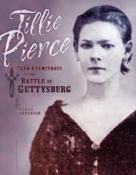 Anderson, Tanya. Tillie Pierce: Teen Witness to the Battle of Gettysburg. (Lerner, 2013; Gr 6-9) A courageous 15-year-old’s account of the July 1863 battle, first recounted in her 1889 memoir. Along with excerpts from that memoir and other primary resources, Anderson adds background information about the Pierce family, the Civil War, and the pivotal, three-day confrontation that took place in Pennsylvania field. When Pierce and her neighbors became trapped at a nearby farm, they witnessed the bloody battle (“…I felt as though we were in a strange and blighted land”) and cared for wounded and dying. Sidebars and captioned maps and archival black-and-white photos provide further information. Source notes; a bibliography; a select list of websites; and “Taking Tillie’s Path,” a Google Earth activity, are also included.
 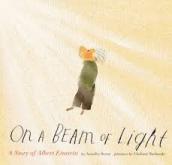 Berne, Jennifer. On a Beam of Light. (Chronicle, 2013; Gr 2-6) Illus. by Vladimir Radunsky. The name Einstein is synonymous with “genius,” but what does that word mean to a youngster? Berne’s picture book offers readers few biographical details, focusing primarily on the physicist’s intellect through the concepts that puzzled and excited him from his early years on—light, sound, gravity, and later, atoms, motion, and time. This was a person who spent his life “imagining, wondering, figuring and thinking” and asking questions. Radusky’s delightful pen-and ink illustrations depict events from Einstein's life, his thoughts, and a few of his quirks. When considering an author’s approach, this book makes a noteworthy companion to Lynne Barasch’s picture book Ask Albert Einstein (FSG, 2005) and Mareé Ferguson Delano’s photobiography, Genius (National Geographic, 2005).
 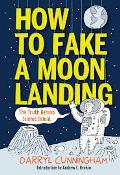 Cunningham, Darryl. How to Fake a Moon Landing: Exposing the Myths of Science Denial. (Abrams, 2013; Gr 6 Up). Ever hear of the moon hoax? The MMR vaccination scare? What do you think about climate change? Evolution? The author takes a look at these and other topics and the myths that surround them—in a graphic format. While Cunningham exposes intentional misinformation presented to the public by corporations and politicians, readers may question the breadth of his reporting in a few areas. However, as New York Times science writer Andrew Revkin (who introduces the book and calls Cunningham out on chiropractic and “fracking”) comments, chances are the author wouldn’t object. What Cunningham asks readers to do—beyond considering how information has and can be manipulated—is to think critically. This book will appeal to leisure readers, debaters, and future scientists, as well as fans of the graphic format.
 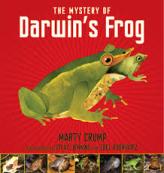 Crump, Marty.The Mystery of Darwin’s Frog. (Boyds Mills, 3013; Gr 4-8). IIlus. by Steve Jenkins and Edel Rodriguez. The authors of this month’s ‘On Common Core’ column note that nonfiction writers sometimes approach their topics through our “gaps in information.” Here Crump explores how we know what we know about these pointy-nose frogs, the astonishing role that the male plays brooding the young, and the questions scientists still have about these creatures—in particular, why their population is declining. A fascinating text, informative color photos, and collage illustrations, work together to create a visually appealing, accessible package supported by an illustrated time line, endnotes, a glossary, a list of related websites, and more.
 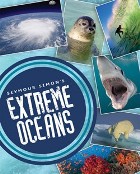 Simon, Seymour. Seymour Simon’s Extreme Oceans. (Chronicle, 2013; Gr 3-8). In his last title, Seymour Simon’s Extreme Earth Records (Chronicle, 2012; Gr 3-7), the author took “young readers on a tour of the most punishing places and severe geological events on the planet.” In this fact-filled, photo-packed guide kids will learn about the plants and creatures that inhabit our planet’s watery environs, and the extreme weather conditions experienced on and in them from La Niña to tsunamis. A brief chapter on climate change is included. If you missed last month's "Nonfiction Notes," it's still available online.
Added To Cart
RELATED



RECOMMENDED
CAREERS
The job outlook in 2030: Librarians will be in demand
CAREERS
The job outlook in 2030: Librarians will be in demand
ALREADY A SUBSCRIBER? LOG IN
We are currently offering this content for free. Sign up now to activate your personal profile, where you can save articles for future viewing
ALREADY A SUBSCRIBER? LOG IN
Thank you for visiting.
We’ve noticed you are using a private browser. To continue, please log in or create an account.

Add Comment :-
Be the first reader to comment.
Comment Policy:
Comment should not be empty !!!