


2018 School Spending Survey Report
Brown Girl Dreaming, and How I Discovered Poetry
In another interesting pair of subject-matter-coincidences, we have two works in verse from African American female writers this year that are memoirs of their childhood experiences which prepared them for their writing careers. (These both follow closely on last year’s Words with Wings by Nikki Grimes, for a triple coincidence.) Jacqueline Woodson’s BROWN GIRL DREAMING is [...]
In another interesting pair of subject-matter-coincidences, we have two works in verse from African American female writers this year that are memoirs of their childhood experiences which prepared them for their writing careers. (These both follow closely on last year’s Words with Wings by Nikki Grimes, for a triple coincidence.)
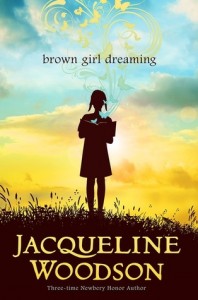 Jacqueline Woodson’s BROWN GIRL DREAMING is far an away a popular favorite for Newbery, if you go by responses to this blog and on Goodreads, and is still hanging on the National Book Awards Shortlist announced yesterday. Woodson’s free verse fixes her memories firmly in detailed moments that show her earliest recognition of herself as a sibling, as a daughter and grandaughter, as a friend, and as a storyteller. Who knew that Woodson had such a hard time reading as a child, but that stories–whether heard or imagined–were always so firmly a part of her mental landscape? She addresses this point of view in a straightforward and evocative way, through what I might called “lineated prose pieces” rather than “poems,” as I don’t think they necessarily stand alone, or are meant to. I found the beginning a little meandering, and a little hard to get a handle on the voice as much of it is clearly memory-by-proxy, or remembering stories she’s been told…but all of it was lovely, well-written, and necessary, and I think that readers will be intrigued enough to stay with it until Woodson’s voice solidifies, as her character does, as a slightly older girl in Brooklyn. We get to know her family members so well, and the author’s note adds crucial information that readers will be hungering for about her biological father. Astute readers will also pick up on the subtext on p. 275 “….and only my mother says, / Just so long as you’re not writing about our family.“), connect this with the information in the family tree, the author’s note, and the dedication, and be grateful that Woodson chose to tell and share her story in such a personal way, in the right time.
 In HOW I DISCOVERED POETRY, Nelson’s poems, as opposed to Woodson’s, are true stand-alone poems that are linked with a narrative–though a looser one. Each unrhymed sonnet allows the reader to dwell in that memory, unpack it slowly, move back and forth through the narrative to understand more each time. It’s a reading that deepens with context understood outside of the book, but Nelson offers threads to the reader in her note to pursue that context on their own. This is such a unique reading experience to readers of this age, and done extraordinarily well. It’s not a book for everyone, but that’s not a Newbery consideration. It’s not easily accessible, but neither is that a consideration, as long as the style and approach are appropriate for the intended audience. I need to get back to this book to give it a re-read, but it is so different and so excellent, I hope the committee is considering it. They will need to make sure it is deemed eligible, as several of these poems were previously published; but my guess is that it will be, as those previous publications were for such a different audience (poetry journals for adults).


Added To Cart
RELATED


RECOMMENDED
CAREERS
The job outlook in 2030: Librarians will be in demand
CAREERS
The job outlook in 2030: Librarians will be in demand
ALREADY A SUBSCRIBER? LOG IN
We are currently offering this content for free. Sign up now to activate your personal profile, where you can save articles for future viewing
ALREADY A SUBSCRIBER? LOG IN
Thank you for visiting.
We’ve noticed you are using a private browser. To continue, please log in or create an account.

Add Comment :-
Be the first reader to comment.
Comment Policy:
Comment should not be empty !!!