


2018 School Spending Survey Report
Authors Dig into the Unreliable Narrator | SLJ Day of Dialog 2014
"There's something about characters who lie. That charisma can carry you through [a story].” At SLJ's Day of Dialog, on May 28, authors Meg Wolitzer, Jodi Lynn Anderson, Alaya Dawn Johnson, E. Lockhart, and Barry Lyga engaged in a panel "Unreliable YA Narrators."
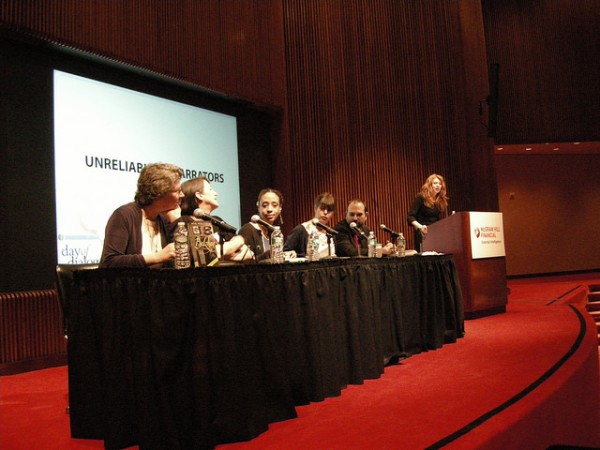
From L to R: Meg Wolitzer, Jodi Lynn Anderson, Alaya Dawn Johnson, E. Lockhart, Barry Lyga.
Moderator: Jennifer Thompson
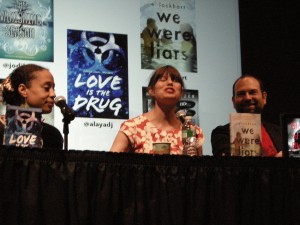
We Were Liars E. Lockhart (center).
The Interestings (Penguin, 2013) author Meg Wolitzer—who has a Penguin YA novel coming out Behlzar in September—compared the idea that a narrator must be relatable to the feeling that a presidential election should be decided on the basis of which candidate voters would most like to share a beer with—something she finds “alarming,” both in politics and in writing. Similarly, Barry Lyga—author of the upcoming I Hunt Killers (Little, Brown, 2012)—said that he never worries about making his characters likable, because to do so “[shears] off their rough edges.” For him, it’s more effective to make a character honest and true to life at the expense of making them someone that readers will necessarily gravitate toward. Lyga and Lockhart questioned whether any narrator can truly be reliable. Lockhart brought up Jane Austen’s Pride and Prejudice, saying that even though the classic work is written in the third person, it’s clear from the opening line that the narrator has a point of view and perspective. Lyga emphasized that any first person narrator is inherently unreliable and that even most third person narrators are as well. Truly omniscient narrators are rare, he said, because audiences now have a need to feel a connection to characters, rather than seeing them as objective characters who are far removed. “Readers demand that [connection],” says Lyga. Jodi Lynn Anderson discussed the spectrum of unreliability, from books where a character’s childlike innocence explains their unreliability (such as Mark Twain’s The Adventures of Huckleberry Finn) to examples of more nefarious, self-deceiving narrators, like Humbert Humbert in Vladimir Nabakov’s Lolita. Providing an example of innocence leading to unreliability, Johnson brought up Franny Billingsley Chime (Dial, 2011) in which a character sees her dramatic and effusive father’s actions as wonderful—but she’s unaware that his behavior stems from his alcoholism.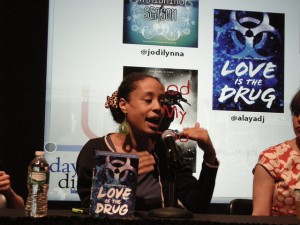
Love Is a Drug's Alaya Dawn Johnson
Though these authors are intimately familiar with crafting unreliable narrators, all enjoyed coming across the phenomenon when reading other books. Lyga likened his own experience of reading unreliable narrators to that of a professional chef eating a home-cooked meal, stating that he can often see where other writers are going or what they’re trying to do but that he appreciates when a writer pulls it off well. Wolitzer paraphrased author John Updike’s advice to reviewers—to submit to a book’s spell—rather than actively trying to figure out where an author is going. “I like both the pleasure of being right and the pleasure of being wrong.” Above all, authors emphasized the potentially exhilarating feeling of reading a book with an unreliable narrator, especially for adolescents. For Johnson, that moment that readers realize that adults are fallible and that the things you trust are broken is a powerful and memorable one. “Readers are innocent. You assume what a writer tells you is true,” said Wolitzer. “When you realize a character doesn’t know something that you have knowledge of, it’s an exciting feeling.” Watch a clip of the "Unreliable YA Narrators" panel. Read more coverage of SLJ's Day of Dialog.
Added To Cart
RELATED


RECOMMENDED
CAREERS
The job outlook in 2030: Librarians will be in demand
CAREERS
The job outlook in 2030: Librarians will be in demand
ALREADY A SUBSCRIBER? LOG IN
We are currently offering this content for free. Sign up now to activate your personal profile, where you can save articles for future viewing
ALREADY A SUBSCRIBER? LOG IN
Thank you for visiting.
We’ve noticed you are using a private browser. To continue, please log in or create an account.
Add Comment :-
Be the first reader to comment.
Comment Policy:
Comment should not be empty !!!