


2018 School Spending Survey Report
Amazing Marble Run Mazes | Programming Cookbook
Librarian and programming expert Holly Storck-Post offers a foolproof program recipe for fun—and educational—marble runs.
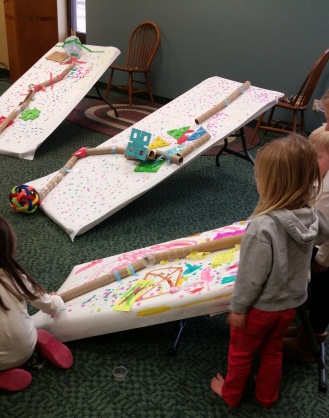
Teams at work on their unique marble runs. Photo courtesy of author.
groups and can be offered with a range of available(and free, cheap) materials. Working in teams, kids can learn about collaboration and teamwork along with some tricky engineering concepts. They will do a ton of problem solving, all while exercising their creativity. I like to offer challenges in my marble run programs; I'll ask participants to build the longest possible marble run, or the fastest run, or one with the most zig-zags. This keeps the kids on track and provides guidance for those who need a little inspirational nudge. I also offer the chance to name and decorate the marble run, which is fun and gives them even more ownership over their creation.What You'll Need
Tables or slanted surfaces Large sheets of butcher paper (optional, helps with clean-up) Lots of tape (packing tape, duct tape, masking tape) Markers Scissors Box cutter (for adult use only) Small bouncy balls Device to time and film final product (optional) Suggested maze-building materials: toilet paper tubes paper towel tubes milk cartons yogurt cups cardstock cardboardResources and Inspiration
How to Make a Homemade Marble Run YouTube video Pinterest ideas for Marble RunsIdeal Audience
Several small groups of kids ages eight to 12Program Prep
This is an incredibly simple program. You may want to start a few weeks before by gathering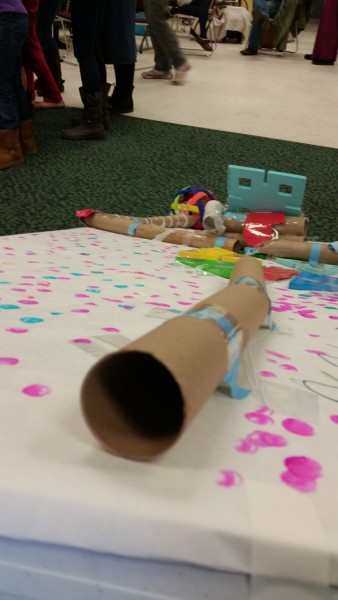
Marble run creation
recycled materials. Toilet paper and paper towel tubes are perfect, and I usually throw in some paper, cardboard, and anything else that is lying around—milk cartons, plastic cups, plastic spoons, etc. You will also need a lot of tape! Duct tape and packing tape are best, but masking tape will work as well. I always make sure that I have a box cutter in my pocket, too, in case the kids need anything cut more precisely than scissors can handle. Each team (anywhere from two to six kids) will need a flat, tilted surface to work on. I use folding tables with one set of legs folded under, so it is at about a 30 degree angle. Librarians could also use a large piece of cardboard, or even do vertical marble runs on a wall or cabinet. Covering the surface with a large piece of taped down butcher paper ahead of time makes clean up much easier and gives kids a larger surface to decorate. You will also need small rubber balls to send down the maze. Make sure that whatever you use will fit comfortably through the narrowest tubes you have. Finally, it is helpful to write any challenges on a whiteboard or large piece of paper for kids to refer to.Program Run Time
Approximately 1 to 1.5 hoursRunning the Program
At the start of the program, I share the challenges and give the participants a time frame—usually 45 minutes—to build before we share our creations with the rest of the group. I let them settle into teams, pass out balls, remind them to test as they go, and invite them to forage at the supply table. Then, they build! This is a mostly hands-off program for the librarian. I float among the teams, using the box cutter when needed, and sometimes helping teams problem-solve through a tricky spot: a ball that gets stuck in a turn, or a bump that sends the ball flying through the air. I remind the teams to name the marble run, and enjoy watching their projects take shape. With about 15 minutes left, it is time to share. I invite one team at a time to step forward and tell everyone about their marble run. Then, each team member gets a chance to send the ball hurtling through the maze. We time the run, or look at how long it is, and talk about how they addressed the challenges. I often film the runs on an iPad and post it to our library website so the kids can show their parents later on. After everyone has gotten a chance to share and show off their marble runs, and after every kid has begged for pictures, we end the program by cleaning up. I put the recycling bin in the middle of the room and tell the kids that it is time to destroy the runs. It is extremely easy to rip off the butcher paper and transport the entire marble run to the recycling bin, leaving minimal clean up.
Added To Cart
RELATED


RECOMMENDED
CAREERS
The job outlook in 2030: Librarians will be in demand
CAREERS
The job outlook in 2030: Librarians will be in demand
ALREADY A SUBSCRIBER? LOG IN
We are currently offering this content for free. Sign up now to activate your personal profile, where you can save articles for future viewing
ALREADY A SUBSCRIBER? LOG IN
Thank you for visiting.
We’ve noticed you are using a private browser. To continue, please log in or create an account.

Add Comment :-
Be the first reader to comment.
Comment Policy:
Comment should not be empty !!!