


2018 School Spending Survey Report
Five Years of Flame Con
The fifth year of New York's LGBTQ comics convention saw its highest attendance yet and a wide variety of entertainment for geeks, gamers, cosplayers, and more.
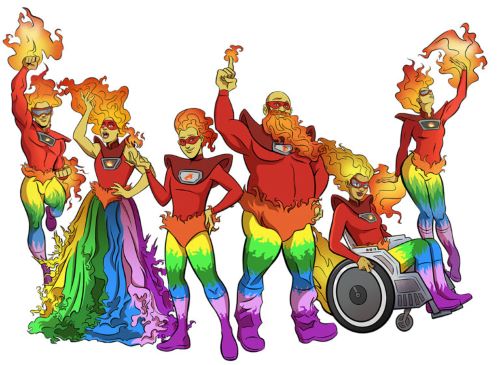 |
Image courtesy of Geeks OUT |
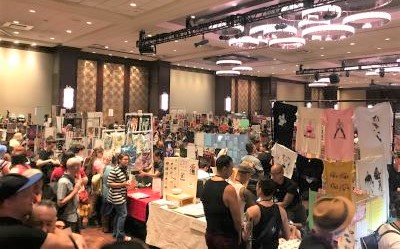
Five years in, and Flame Con is hotter than ever. Organized by LGBTQ non-profit Geeks Out, the New York–based event ran August 17-18 at the Sheraton Times Square and touts itself as a "comics, arts, and entertainment expo showcasing creators and celebrities from all corners of LGBTQ geek fandom." Geek mode was in full swing with programming dedicated to gaming, cosplay, pop culture, professional development, musical performances, and mentorship—plus a Gaymer Lounge and plenty of vendors. New this year was the micro-mentoring track: 15-minute consultations between special guest artists and emerging artists seeking to enter the industry. The convention also introduced formal meet-ups of affinity groups, including QTPOC (queer and trans people of color), people identifying as asexual/aromantic, TGNC (trans and gender nonconforming), and Lesbian/Sapphic. Per tradition, Sunday was Flame Con’s Youth Day, with free admission for attendees under 21 and 350 confirmed youth registrations. Overall, the ever-expanding event saw an uptick in attendance, with nearly 8,000 people topping last year’s record of 6,500. SLJ caught up with some panels that had their finger on the pulse of queerness and children's literature.
 SATURDAY
Inspired by the Slate 2014 opinion piece, “Against YA,” Saturday’s panel The Great YA Debate sought to untangle the persistent stigmatization of adults who read young adult literature. Moderated by Niki Johnson, panelists Dana Simpson (Phoebe and Her Unicorn), Mariko Tamaki, and illustrator Rosemary Valero-O'Connell (the duo behind Laura Dean Keeps Breaking Up with Me) spoke about their unique experiences creating and reading YA. Valero-O’Connell pushed back against the myth that kids’ books lack knowledge or maturity—as a child, her scope and language to talk about the world were smaller, but her desire to know about the intricacies of life was just as present. Similarly, Simpson challenged the notion that children are less intelligent than adults, asserting that they simply have fewer reference points. She “could tell when [she] was being condescended to,” which in turn shaped how she writes her comics for young audiences.
Tamaki pondered whether YA should designate style more than content. Though her first book wasn’t written as YA, it was marketed in the category due to its teenage protagonist. But to Tamaki, “[YA is] a kind of story. A kind of romance, [an] identity story” that is interested in a teenage experience—it’s not necessarily an earlier, or easier, form of literature. Valero-O’Connell spoke about her commitment to populating her work with young queer characters who emulate the people in her life. Portraying flawed queer characters can invite a great deal of pressure—but the cartoonist realized that she 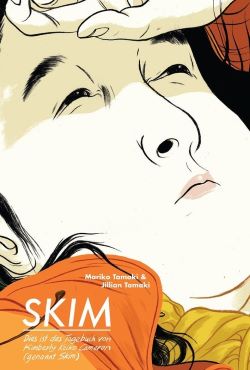 felt most trusting of her work when she flipped the script from “how will straight people read this?” to focusing on her queer readership.
Quintessential YA recommendations included Tamaki’s Skim and Alice Munro’s Lives of Girls and Women. Simpson admitted struggling to come up with recs; as a closeted trans child, she didn’t see herself in most kid lit, and opted for adult books instead. Now, her goal is to write the stories she would’ve wanted to read: “I’m writing for me at 10, at 12…Phoebe is a total self-portrait.”
When it comes to the limitations of YA, the creators discussed the seemingly arbitrary informal rules of the genre, from the age of the protagonist(s) to having no more than three main characters. Noted gaps in the industry included a wider variety of experiences: Tamaki expressed interest in more stories that deal with mental health and economic disparity, and people of color featured in narratives that don’t revolve around their race and trauma. Simpson commented that the prevalence of such issue-oriented stories can feel reductive: she is “a regular person living a life with regular person stuff in it,” and it would be refreshing to see more stories like hers represented.
Moderated by Amanda Bruns, Sunday’s Queer Kids Comics FTW saw Gale Galligan, Gina Gagliano, Leigh Hurwitz, Kiara Valdez, and Camilla Zhang discussing trends in kids’ comics, the state of the genre, and their individual approaches to broadening representation. An outreach librarian, Hurwitz noted, “There’s more queer rep generally, but a lot of it is white, and not #OwnVoices.” She addresses this challenge by proactively seeking #OwnVoices materials beyond this limited perspective, which sometimes means bringing in materials like webcomics and anthologies. Zhang expressed a similar commitment to highlighting #OwnVoices in her role as Comics Outreach Lead at Kickstarter, noting that she deeply researches creators and thoughtfully recommends topics and people who should be featured by the Kickstarter communication team. As a comics adapter, Galligan is limited in terms of creative liberties, but takes space to imagine characters as POC and queer whenever it’s not specified: “I want to take the opportunities whenever I can to represent the broad world we live in.” The rest of the panel consisted primarily of book recommendations for developing queer comic collections in any section of one’s library:
Early Readers: 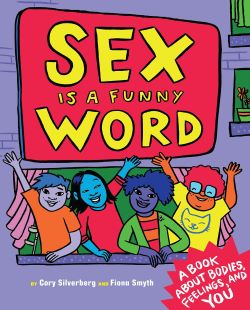
Aquicorn Cove, Princess Princess Ever After, and Tea Dragon Society by Katie O’Neill
Sex Is a Funny Word by Cory Silverberg & Fiona Smyth
Middle Grade: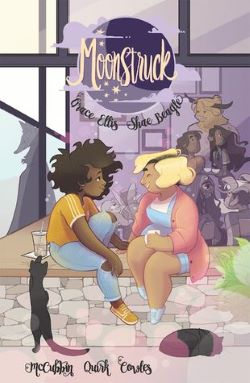
"Moonstruck" series by Grace Ellis & Shae Beagle
As the Crow Flies by Melanie Gillman
Snapdragon by Kat Leyh
Operatic by Kyo Maclear & Byron Eggenschwiler
Space Battle Lunchtime by Natalie Riess
Sincerely, Harriet by Sarah Winifred Searle
“Newsprints” series by Ru Xu
 YA:
YA:
Bingo Love by Tee Franklin, Jenn St. Onge, and Joy San
Band vs. Band by Kathleen Jacques
Witchy by Ariel Slamet Ries
“Our Dreams at Dusk” series by Yuhki Kamatani
The Avant-Guards by Carly Usdin & Noah Hayes
On a Sunbeam and Spinning by Tillie Walden
“My Brother’s Husband” series by Gengoroh Tagame
Spit and Passion by Cristy C. Road
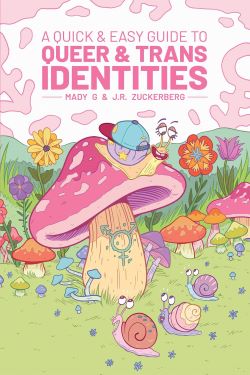 Nonfiction:
Not Your Mother’s Meatloaf edited by Liza Bley and Saiya Miller
A Quick and Easy Guide to They/Them Pronouns by Archie Bongiovanni & Tristan Jimerson
A Quick and Easy Guide to Queer and Trans Identities by Mady G. & J.R. Zuckerberg
SUNDAY
Queerbrarians: Libraries, Pop Culture, and the LGBTQ+ Community was moderated by Birgit Pols and featured Long Island–based librarians Valerie Acklin, Derek Ivie, Nicki Loder, and Nola Thacker as they talked navigating queerness in their roles, and what it means to best serve the LGTBQ+ community. The group traded examples of the benefits and challenges of being out at work (Acklin: “Anything rainbow in the library will find its way to your desk!”)—but LGBTQ+ trainings and additional labor might fall to queer librarians (Loder: “Once you are the targeted queer...you get everything.”). Increased expectations to be the champion for all things queer doesn’t protect against dismissive responses to LGBTQ+ programming from supervisory staff: "It's almost like you're shouting down a well," remarked Thacker.
Advice included finding ways within one’s purchasing power to fortify collections with as much queer material as possible, and using one’s relative privilege to speak up and push back against problematic occurrences in the workplace like hate speech or censorship, whether it’s among patrons or staff. The power of pop culture was also addressed; forming safe spaces around popular media and modeling inclusivity often provides an opportunity for deeper, more personal connections with patrons. While rife with useful anecdotes and guidance, the panel contained no people of color or librarians from other regions; in terms of professional expectations, power dynamics, and safety at work, the consideration of race as a factor was completely absent. A wider variety of perspectives would’ve enriched the already informative session.

Added To Cart
RELATED
RECOMMENDED
CAREERS
The job outlook in 2030: Librarians will be in demand
CAREERS
The job outlook in 2030: Librarians will be in demand
ALREADY A SUBSCRIBER? LOG IN
We are currently offering this content for free. Sign up now to activate your personal profile, where you can save articles for future viewing
ALREADY A SUBSCRIBER? LOG IN
Thank you for visiting.
We’ve noticed you are using a private browser. To continue, please log in or create an account.
Add Comment :-
Be the first reader to comment.
Comment Policy:
Comment should not be empty !!!